
Fill every bookable hour and you'll look efficient right up to the week you fail a delivery. That's the most popular advice in post, and it's backwards. A grading theatre at 100% booked has nowhere to put a sick colourist, a late network note or a conform that arrives with handles missing, so the slack comes out of people's evenings instead.
Good team workload management doesn't chase full diaries. It protects the right people, rooms and licences from being sold twice, keeps deliberate gaps where work always expands, and makes a producer name the trade-off before a date is promised. If you're a head of post, that's a weekly arithmetic job, not a motivational one.
Why Post Workload Swings Between Idle and Overload
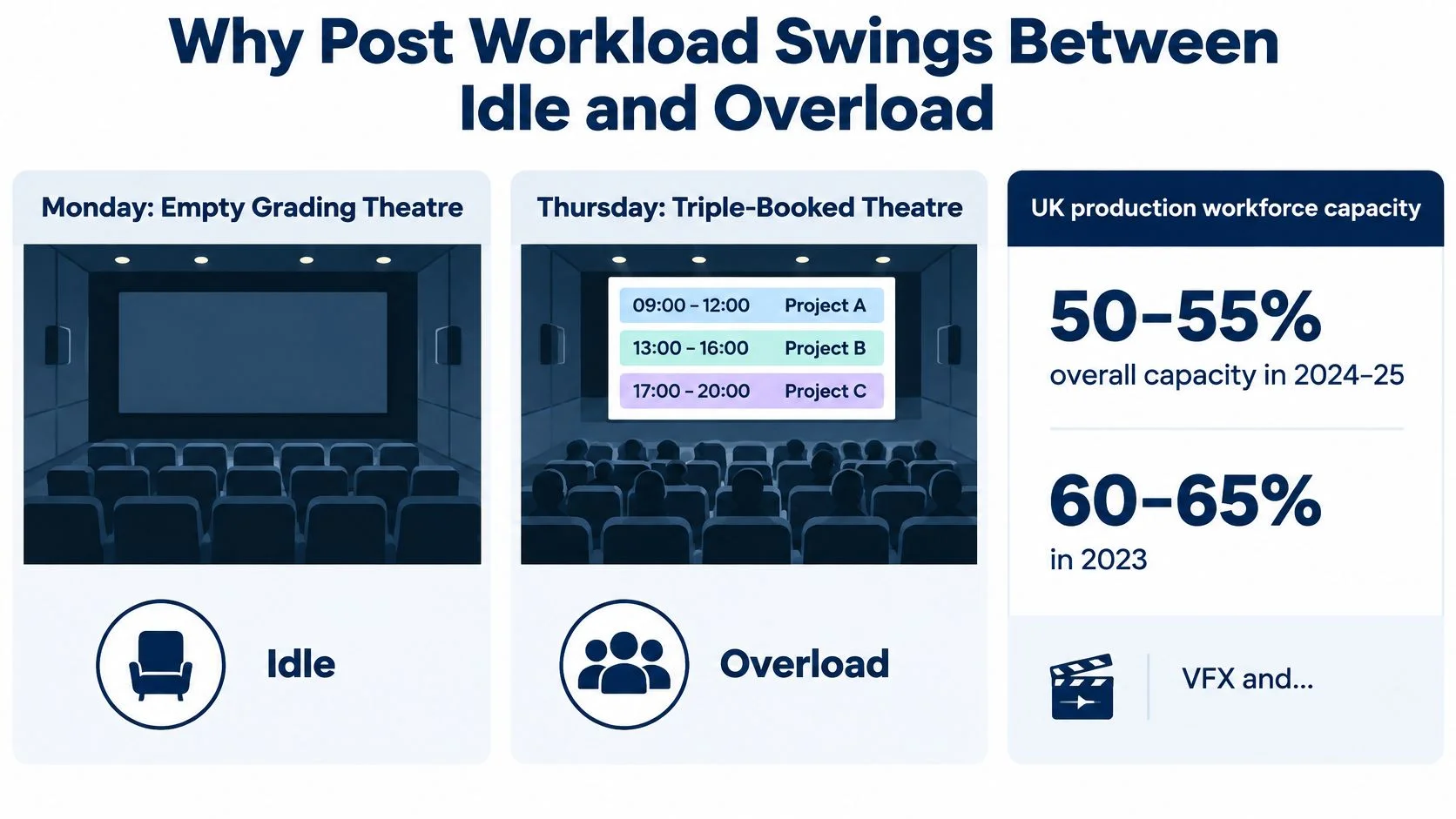
A grading theatre sits empty on Monday morning. The colourist is on standby, the producer is chasing a lock, and the suite next door is dark because editorial slipped over the weekend. By Thursday the same theatre is triple-booked, two clients want attended sessions, and the online editor is being asked to start a delivery that hasn't been approved.
That swing is normal in post. It isn't a sign that coordinators aren't trying hard enough. It's what happens when start dates move, approvals bunch up and finishing work can't begin until someone upstream lets go.
The Average Hides Both Weeks
The wider market makes the swing sharper. The 2025 ScreenSkills and Ampere analysis reported by Screen Daily found that the UK production workforce operated at only 50-55% of overall capacity in 2024-25, down from 60-65% in 2023. VFX and post-production fell particularly sharply, from 45% capacity in 2023 to 30% in 2025.
Read that as a head of post, not as an economist. Low average use across a year doesn't mean your senior colourist is free on the Thursday you need her. It often means freelancers have taken other work, a series starts late, and three deliveries land in the same fortnight with nobody warmed up and no cover booked.
Editors, colourists, dubbing mixers, VFX artists and coordinators don't experience an average. They experience gaps where they can't bill, followed by compressed deliveries where every note is urgent. A single utilisation figure describes neither week, and it tells you nothing about whether the spare hours you can see are usable.
What Counts as Real Capacity
I'd define workload management in a post studio in plain terms. It's the weekly practice of comparing committed hours with hours available, after leave, skill, room, client, security and location limits, while keeping deliberate slack for a slipped start or an extra review round.
- A free person in the wrong craft isn't capacity: An available online editor doesn't cover a Baselight grade, and a VFX artist without clearance for a title can't take its shots.
- A free room without its operator isn't capacity: The theatre is only bookable when the colourist, the calibrated display and the licence are there at the same time.
- A gap before a locked delivery isn't spare: It's the buffer that absorbs the reconform, the legal check and the export that fails at 6pm.
A plan at 100% has nowhere to put a sick day. The work still moves, it just moves into overtime.
Filling every bookable hour is therefore the wrong target. The target is a slate you can deliver without relying on heroics, with specialist slack held back on purpose and released only by a named decision. That takes four things working together, a capacity check with thresholds, a short policy people can quote, a scheduling routine that holds people and rooms in one place, and a bottleneck review that looks past hours.
Before you change anything, export last month's bookings and split them by role and room. Look for the weeks where one name appears on two deliveries and the weeks where a suite sat idle while its operator was double-booked elsewhere. That export is your starting picture, however untidy it looks.
How to Measure Real Capacity Before You Book
Run this check before you accept another job, not after the producer has told the client yes. It takes one coordinator, one schedule and the discipline to stop when the numbers say stop.
The Six-Step Weekly Check
- List people and critical rooms, then subtract what's not available: Start with contracted hours for each person and each finishing room. Take off leave, training and contracted non-project time, and what's left is available hours for that week.
- Assign only work that matches skill and role: A free online editor isn't spare capacity for a Baselight session, and a junior mixer isn't cover for a final theatrical mix. If the craft, seniority or client approval doesn't match, the hours don't count.
- Add the work that always follows the first pass: Book review rounds, exports, QC and a note contingency alongside the assembly or first grade. If you only count the first version, you've under-booked every job by the revisions you know are coming.
- Divide demand by available hours, by person and by room: Do the sum separately for each specialist and each critical suite for the week. A studio total hides the one mixer at 140% behind three edit assistants at 60%.
- Mark the week amber or red instead of absorbing it: Use the thresholds below and write the colour on the plan. A silent overrun is still an overrun, it just surfaces later as overtime.
- Rebalance, then show the people affected: Cut scope, move the date or book freelance cover, and put the revised week in front of the team who'll work it before the client hears yes. If they can't see how it fits, it doesn't fit.
If you're building this from scratch, this explanation of what capacity planning covers in a scheduling workflow sets out the demand and supply side in one place. For the staffing decisions behind the numbers, the staffing guidance for growing businesses from LeaveWizard is a useful companion when you're deciding whether a gap needs a hire, a freelancer or a date change.
Read the Table as a Decision Rule
Amber and red capacity thresholds for a post week
| Signal | Amber | Red | Move |
|---|---|---|---|
| Demand versus available hours | 85% to 100% of available hours | Over 100% of available hours | Cut scope, move the date or add crew |
| Overtime on the same role | One agreed overrun | Repeated overtime | Treat the plan as infeasible |
| Parallel jobs for one specialist | Two jobs, one clearly primary | Two full-time bookings | Sequence or split the role |
| Booked but unusable time | Up to 10% for wrong skill, site or client | Unusable slack for two weeks running | Do not count it as spare capacity |
| Revision and QC hours | Inside the agreed rounds | Extra rounds not in the plan | Add hours before saying yes |
Amber means you can proceed with your eyes open and a named owner watching it. Red means the booking doesn't get confirmed until something else gives. That isn't caution for its own sake, because the CIPD 2025 Good Work Index, which surveyed 5,017 UK employees in January and February 2025, found that 69% of workers who said their workload was far too much reported a negative impact on mental health, compared with 14% among those saying workload was about right.
Four Traps That Make the Numbers Lie
- Counting booked hours as productive hours: An eight-hour booking includes set-up, client waiting time, renders and hand-offs. Treat the whole block as creative output and you'll over-commit every suite.
- Ignoring revision cycles: Notes rounds are work, not goodwill. Leave them out and the second round lands on top of the next job.
- Giving one specialist two full-time jobs: It reads as 50% on each production's plan and 100% twice over in the person's week. Neither producer sees the collision until both want changes on the same day.
- Waiting for absence before acting: By the time someone is off sick, the overload has been visible in overtime and slipped internal deadlines for weeks. Act on the forecast, not the absence.
Take a small example. Say an online editor has four available days in a week after leave, and a job needs six days of online work plus two note rounds. That week is red before anyone discusses effort or goodwill, and the honest moves are a later date, a second editor or a smaller scope.
Workload Policies That Survive a Slipped Delivery
Thresholds only help if they survive contact with a slipping series and a producer under pressure from a broadcaster. Write the rules down as short sentences, pin them to the planner legend, and stop renegotiating them in message threads at 9pm.
Five Rules Worth Pinning Up
1. The booking rule. Nothing above amber is confirmed without a named trade-off in scope, date or extra crew. The trade-off is written on the booking itself, so anyone opening the plan can see what gave way to make room. If nobody can name the trade-off, the job isn't confirmed, whatever was said in the corridor.
2. The specialist rule. Colour, mix, online and finishing leads stay single-threaded unless a second named person covers the overlap. One lead, one live delivery at a time. A second job can sit in prep, but it doesn't get attended sessions, final exports or sign-off from the same person in the same days.
3. The change rule. Notes after the agreed round are new hours, priced or scheduled before the work starts. They aren't folded into the same day because the client is already in the building. This sounds commercial, but it's mainly a capacity rule, because unbooked revisions are where finishing weeks often double.
4. The slack rule. Hold 10-15% of specialist hours unbooked in any week that already has a live delivery. In a five-day finishing week that's roughly half a day to a day held back for the slipped start, the failed QC or the extra mix fix. Release it late if the week runs clean, but don't sell it on Monday.
5. The escalation rule. Repeated overtime, or two red weeks on the same role, means the plan is structurally infeasible and goes to the managing director. It doesn't go to the person working late, and it isn't solved by asking them to be more organised. The slate, the staffing or the dates are wrong, and only someone who can change those should own the decision.
Write it as one sentence: If a rule needs a paragraph to explain in the moment, it won't hold in the moment.
Workload decisions meet the wider discipline of managing risk across a production slate, because a red week is a risk with a date on it, not a surprise. Naming it early gives you options that disappear once the client has been promised the slot.
The Friday Mix Test
Say a drama's final mix is booked for Friday, and a second production asks to hold the same dubbing mixer for a grade-dependent layback starting Monday, with the grade itself still not locked. Under the specialist rule, that hold is refused or restaffed, because the mixer would carry a live delivery and an unstarted one that can slip straight into it. Nobody has to argue about commitment or attitude. The rule already exists, the coordinator points at it, and the conversation moves to the actual choices, a second mixer, a later start or a grade lock in writing.
Notice what the policy does there. It protects the coordinator from having to win an argument with a senior producer, and it protects the mixer from being volunteered by people who won't work the weekend. Good policies move conflict from people to paper, where it's cheaper.
Who Owns What
Ownership needs to be as explicit as the rules. The head of post sets the thresholds and the slack percentage, and reviews them when the slate changes shape. Coordinators apply them on every booking without asking permission each time, because a rule that needs approval to use isn't a rule.
Producers hear the trade-off in the same conversation as the yes. Not afterwards, not in a follow-up email, and not once the client has announced the date internally. If a job can only fit by moving another job, the producer taking the slot hears whose work moved and agrees to own that conversation.
Review the five rules once a quarter against the weeks that went wrong. If a rule was overridden three times, either the rule is wrong for your slate or the override has become the actual policy. Change the sentence on the legend or enforce it, but don't leave a rule up that nobody believes.
How to Schedule People Rooms and Automation
Policies fail when they live in a document and bookings live somewhere else. The routine below puts people, rooms, kit and licences on one schedule so a coordinator can apply the rules while booking, not audit them afterwards.
Six Scheduling Moves
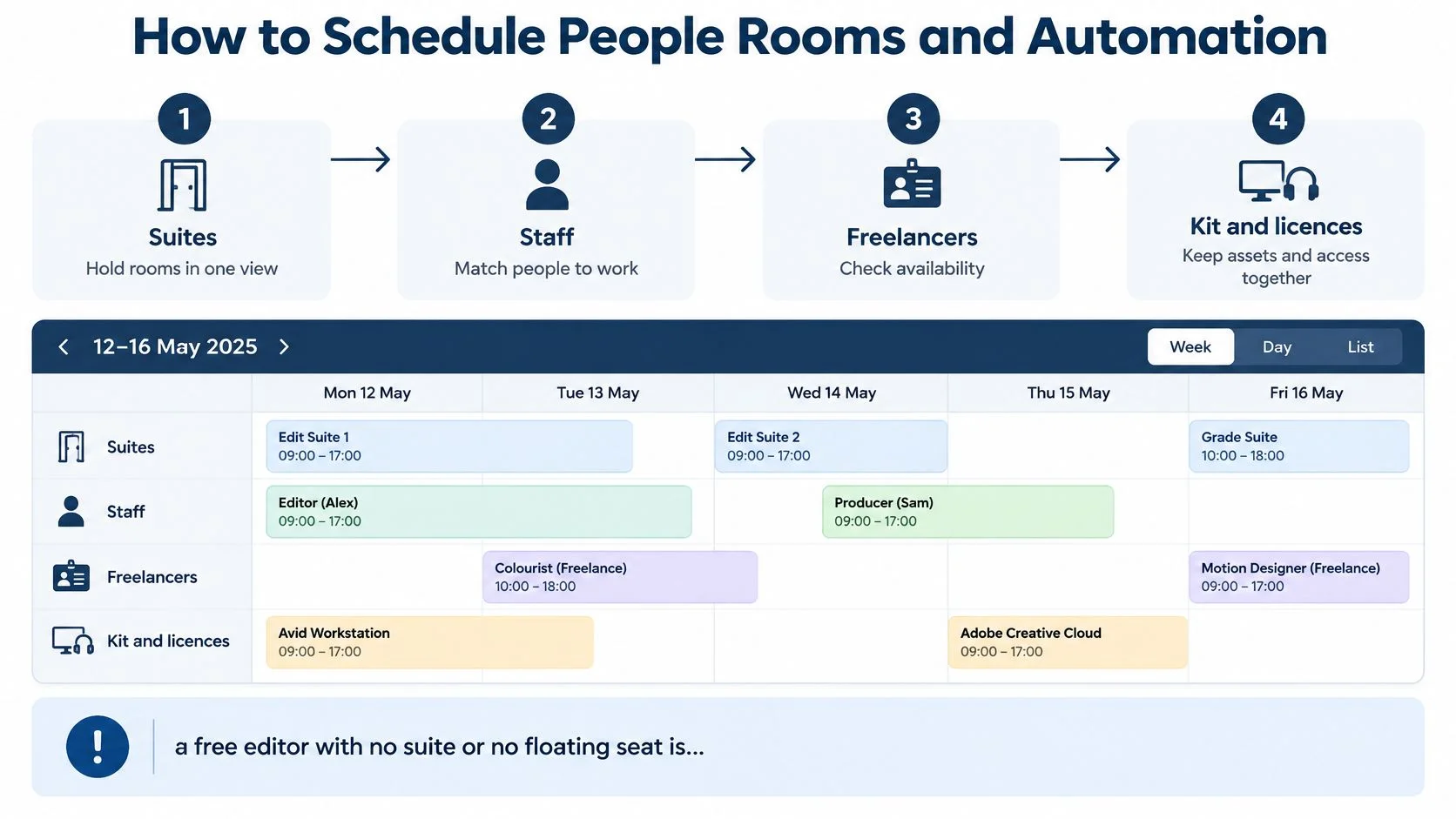
- Hold everything in one view: Suites, staff, freelancers, kit and licences belong on the same schedule. A free editor with no suite or no floating seat isn't available, and you'll only see that if the seat count sits next to the booking.
- Lock milestones before filling gaps: Lay the week out as milestones with delivery dates fixed first. Gaps get filled around locked deliveries, not the other way round.
- Place fixed shifts and rotations first: Put room shifts, dubbing rotations and contracted freelancer days down before project bookings. Allow a swap only when it's written on the plan, so cover doesn't exist purely in two people's messages.
- Automate the repetitive checks: Set warnings for a booking that crosses red, leave that overlaps a locked mix, and a licence seat count that's exceeded. These are arithmetic checks, and software should do arithmetic.
- Record time against the booking: Log actual hours where the estimate lives, so next week you can compare estimated and actual hours by role. Without that comparison, your estimates never improve.
- Give leads a filtered view: Colour should see its bays and colourists without reading the whole studio. A view people will open beats a master plan they avoid.
Done this way, the six steps are the operating routine on the live schedule, not a parallel tracker a coordinator maintains for reporting. The moment you keep a second spreadsheet for the actual numbers, the actual numbers are the ones nobody else can see. If you want the underlying method, this guide to scheduling resources across people and facilities covers the sequencing in more depth.
One Documentary, Worked Through
Say you're running a 10-episode documentary with two edit suites, one grade theatre available three days a week, and a dubbing mixer on a four-day rotation. Editorial runs continuously, but finishing only exists when episodes lock, so the grade and mix load arrives in bursts.
Lock the delivery dates for episodes one to three first, then place the mixer's rotation and the theatre's three days. The remaining windows show you the truth quickly, two episodes can finish in a week, a third cannot, however free the edit suites look. So you sequence locks to feed finishing at the rate finishing can take them, instead of locking four episodes and storing up a collision.
Automation earns its keep on the boring collisions. Leave booked over a locked online day should flag the moment it's entered, and a fifth floating seat booked against four licences should warn before an artist sits down to no licence. A coordinator shouldn't have to remember either of those while the phone is ringing.
Some decisions stay human. Whether to hire a second colourist for the final block, or push two episodes by a week, is a judgement about money, client trust and quality that no warning should make for you. I would hire the colourist when the red weeks repeat across a block, and move dates when it's a single pinch. Automation's job is to show you the pinch early enough that both options still exist.
The hand-off rule is simple. The coordinator updates the live plan the same day a date moves, and work stops being confirmed in side channels. If it isn't on the schedule, it isn't booked, and that sentence has to apply to producers as firmly as it applies to juniors.
How to Spot Bottlenecks Before the Deadline
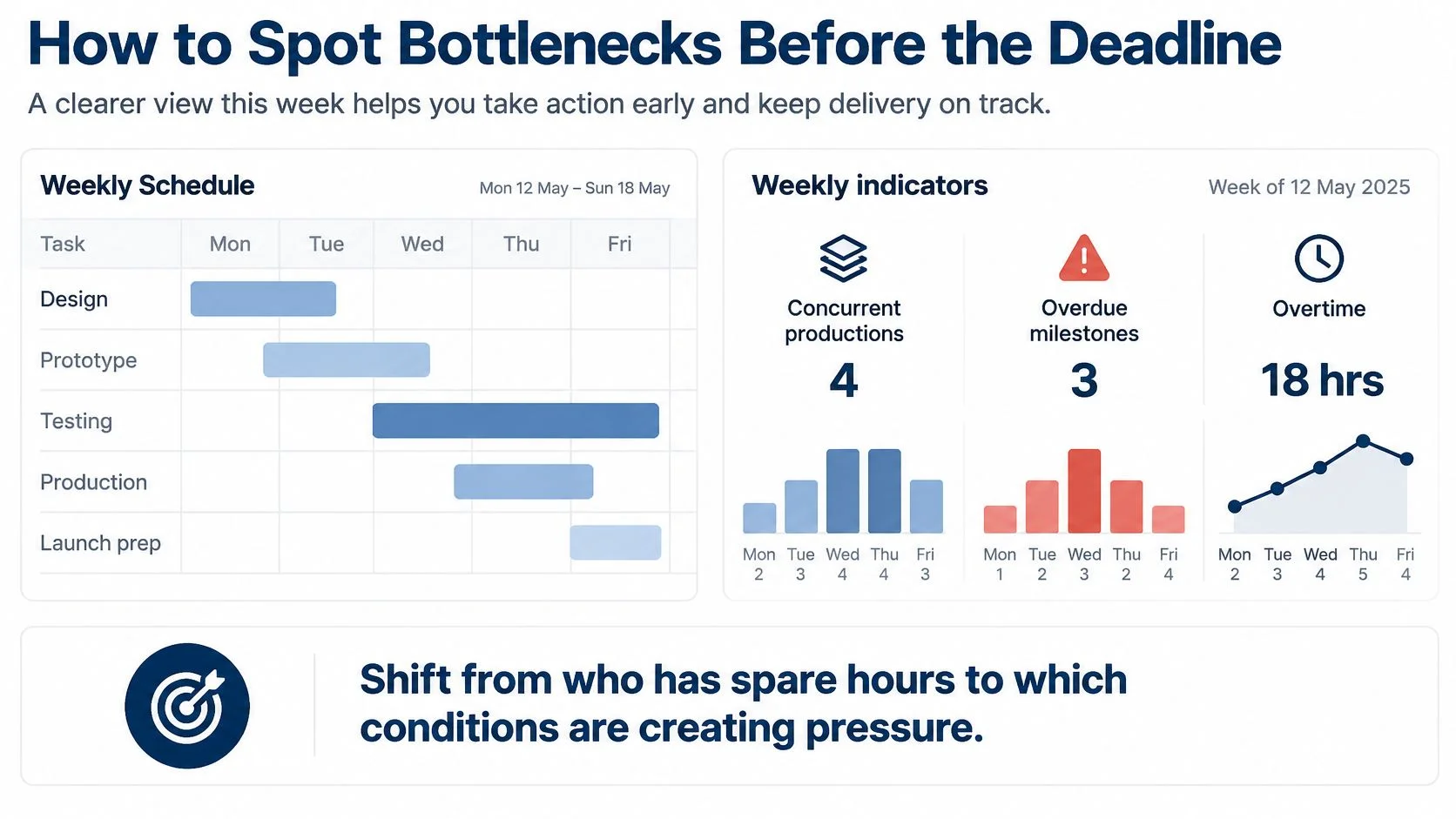
Who has spare hours is the wrong first question. The better question is which conditions in the workflow are generating pressure, because a team can show healthy utilisation while drowning in hand-offs, blocked approvals and late notes.
Indicators Worth Reviewing Weekly
Keep the list short enough to read in one meeting. Count concurrent productions per specialist, overdue milestones, overtime hours, unplanned priority changes and unresolved resource conflicts. Add blocked approval time, after-hours exports and rework hours, because those three expose coordination load that a booked-hours total hides completely.
- Concurrent productions: Three live titles on one coordinator means constant context switching, even if the hours add up.
- Blocked approval time: Hours where a room and operator wait on a client decision aren't productive capacity, they're expensive standing still.
- After-hours exports: Regular evening exports mean the plan has no contingency inside the shift.
- Rework hours: Rising rework usually means notes were never scoped, not that operators got slower.
Use the Health and Safety Executive Management Standards as the rhythm for the conversation. HSE defines workload, work patterns and the work environment as part of Demands, and says organisations should provide adequate, achievable demands within agreed working hours, match skills to job demands and keep jobs within employees' capabilities. Its initial benchmark was that 85% of employees should indicate they can deal with Demands, Control and Support, while the initial target for Role, Relationships and Change was 65%.
Treat those figures as a sense-check for an anonymous pulse, not as a studio KPI to paste onto a dashboard. In practice the cycle runs like this, check demands against agreed hours, check whether people can influence how the work is done, check staffing and peer support, test role clarity when the slate changes, agree one correction, then look again at the next team meeting. A utilisation percentage alone can conceal excessive context switching, inadequate control or a skill mismatch sitting underneath a tidy number.
The Monday Diagnosis
Bottleneck signals and the move this week
| Signal | What it usually means | Move this week |
|---|---|---|
| Same specialist on two deliveries | Capacity that is not real | Sequence the jobs or add cover |
| Waiting on client approval | Blocked time counted as work | Park the booking and free the room |
| After-hours exports | No contingency in the plan | Book the export inside the shift |
| Rising rework hours | Notes were never scoped | Open a change booking |
| Overtime two weeks running | The slate is infeasible | Cut scope or hire |
| Idle suite, busy freelancer | The constraint is the person or the licence | Rebook the constraint, not the room |
| Unplanned priority change | Hidden coordination load | Log it and recount the week |
Read the table in the Monday review and make one move that week. Not seven, and not a working group. If the same specialist sits on two deliveries, sequence them or add cover before Friday, and write the change on the plan in the meeting.
Escalate when forecast demand exceeds contracted capacity, or when the same overtime repeats on the same role. Don't wait until a deadline is already missed, because at that point your options have narrowed to overtime and apology. The forecast is the cheapest moment you will ever get to fix the week.
Finish by pairing the schedule with absence and overtime trends, reviewed together rather than in separate reports. Poorly managed conditions are linked with poorer health, lower productivity and increased sickness absence, so a dashboard that only shows bookings will always notice stress late. If overtime rises for three weeks while utilisation looks flat, believe the overtime.
Weekly Habits That Keep the Plan Honest
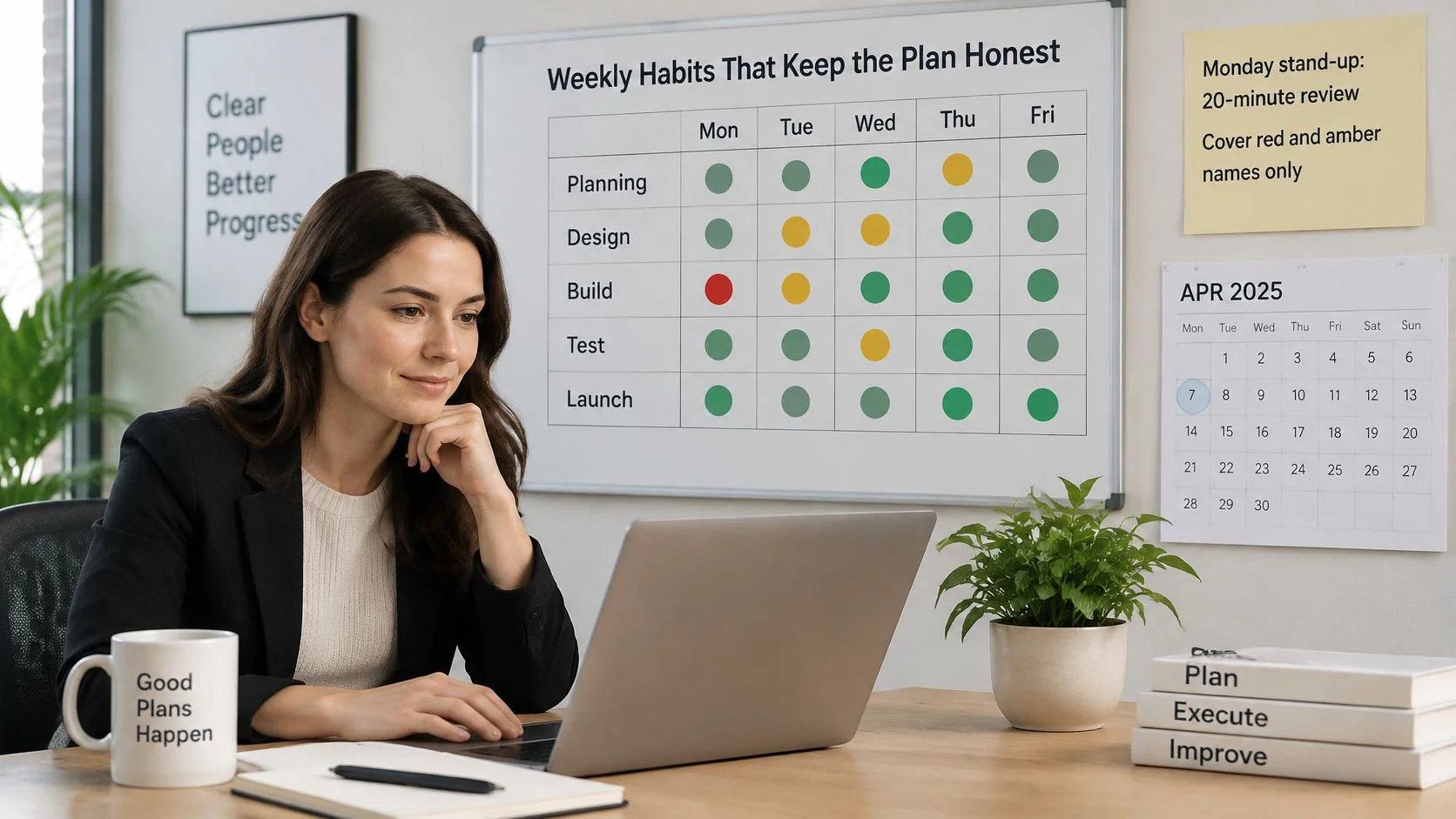
Thresholds drift back to heroics unless someone runs the same small habits every week. None of these needs a new meeting structure or a wellbeing programme. They need a coordinator with permission to keep the plan truthful.
Five Habits for the Coordinator
- Monday stand-up, twenty minutes: Coordinators review only the red and amber names and the roles behind them. Green weeks don't get discussed, which keeps the meeting short and keeps attention on the people carrying risk.
- Monthly pulse, one question: Ask anonymously whether demands feel achievable within agreed hours, and read the answers next to overtime and absence trends. A pulse read in isolation flatters you, a pulse read against overtime doesn't.
- Spare-capacity test before counting a gap: Separate genuine spare time from time that can't be used because of the wrong skill, site, client or security restriction. Only the first kind gets offered to a producer.
- Credit the logging, not the absorbing: Recognise the coordinator who logs a sixth revision as new work. If praise goes to the person who absorbs extra rounds, your data will keep hiding the actual load.
- Use quiet periods on purpose: When a show goes quiet, spend the gap on templates, kit checks and training. Don't sell that time twice by pencilling two possible jobs into the same hole and hoping only one lands.
The pulse matters because perceived workload tracks health closely. The CIPD Health and Wellbeing at Work report draws on the UK Working Lives survey, where 47% of employees who considered their workload "far too much" had experienced anxiety or depression caused or worsened by work, compared with 15% among employees who considered their workload "about right". CIPD also reported that workload was cited in nearly half of work-related stress cases, alongside excessive deadlines and responsibility.
If people get thanked for absorbing work silently, the schedule will never show you the truth.
Keep a four-week rolling forecast alongside the habits. Four weeks is long enough for a probable start-date slip to become visible before it collides with the previous show's online week, and short enough that coordinators will maintain it. Update it in the Monday stand-up, in the same pass as the red and amber names.
Escalation follows the policy you've already pinned up, repeated overtime or two red weeks on a role goes up, not sideways into another late night. The habits exist to surface that moment in week one, while a freelancer can still be booked at a normal rate.
Close the week with a one-line scorecard that fits on the planner where everyone can see it, available hours, committed hours, red roles, blocked hours, unplanned changes. Five numbers, updated weekly, will tell a head of post more about the health of the slate than a monthly utilisation report ever will.
Put One Live Schedule in Charge This Month
Make one decision this month. Stop treating the shared calendar or the master spreadsheet as the place where work is confirmed.
Those tools aren't failing because coordinators maintain them badly. They fail because two people can edit them at once, leave sits somewhere else, and nobody can tell which version a producer promised a client from. Every studio running finishing work out of a spreadsheet is one copied tab away from double-selling its only grading theatre.
What the Single Schedule Has to Hold
Make one live schedule the record for suites, staff, freelancers, kit and licences, and show every yes, move or hold there on the same day it happens. That's the arrangement we build freispace around, a single live schedule showing suites, staff, freelancers, kit and licences in one view, so a booking either exists for everyone or it doesn't exist at all.
Record timesheets against each booking, and put leave and absence on the same plan. Then next week's available hours stop being a guess a coordinator reconstructs from three sources on a Monday morning. Estimated and actual hours sit together, which is the only way your estimates for a grade, a mix or an online get more accurate over a series.
Let department leads check live bookings, utilisation and budgets themselves, within the permissions they already have. orgAI answers questions on live bookings, utilisation and budgets within each user's existing permissions, which means a lead can ask who is red next week without waiting for an exported sheet. Fewer exports means fewer stale copies of the plan circulating with decisions attached to them.
Run It for Four Weeks Before Adding Anything
Run the capacity check and the amber and red rules on that schedule for four consecutive weeks before adding any further process. No new reports, no extra approval layers, no second tracker for a particular client. Four weeks gives you one full cycle of a delivery landing, a slip happening and a trade-off being named.
If a threshold proves wrong, change it at the Monday review where everyone can hear the reasoning. Don't override it on one show because that producer shouts loudest, because a silent override teaches the whole studio that red is negotiable. Change the number in the open or hold the line.
The practical next step is a single working session, not a programme. Load next month's deliveries onto the live schedule, mark the red roles with the people who hold them in the room, and agree the trade-off for each one before any client is told the date still holds. You'll leave that session with a shorter yes list and a much better one.
Put next month's slate on one live schedule and run the red and amber check before the next date is promised, with suites, staff, freelancers, kit, licences, leave and timesheets held in the same view so available hours are never a guess. freispace is built for exactly that post-production routine, and orgAI can answer leads' questions on live bookings, utilisation and budgets within their existing permissions. Visit the site, load your next four weeks, and mark your first red role before a client hears yes.