
Could your team be busy all day and still lose time between one decision and the next? A conventional to-do list can show what needs doing, but it won't tell you what's blocking progress, who should decide, or when work is ready to move.
What Task Management Really Means
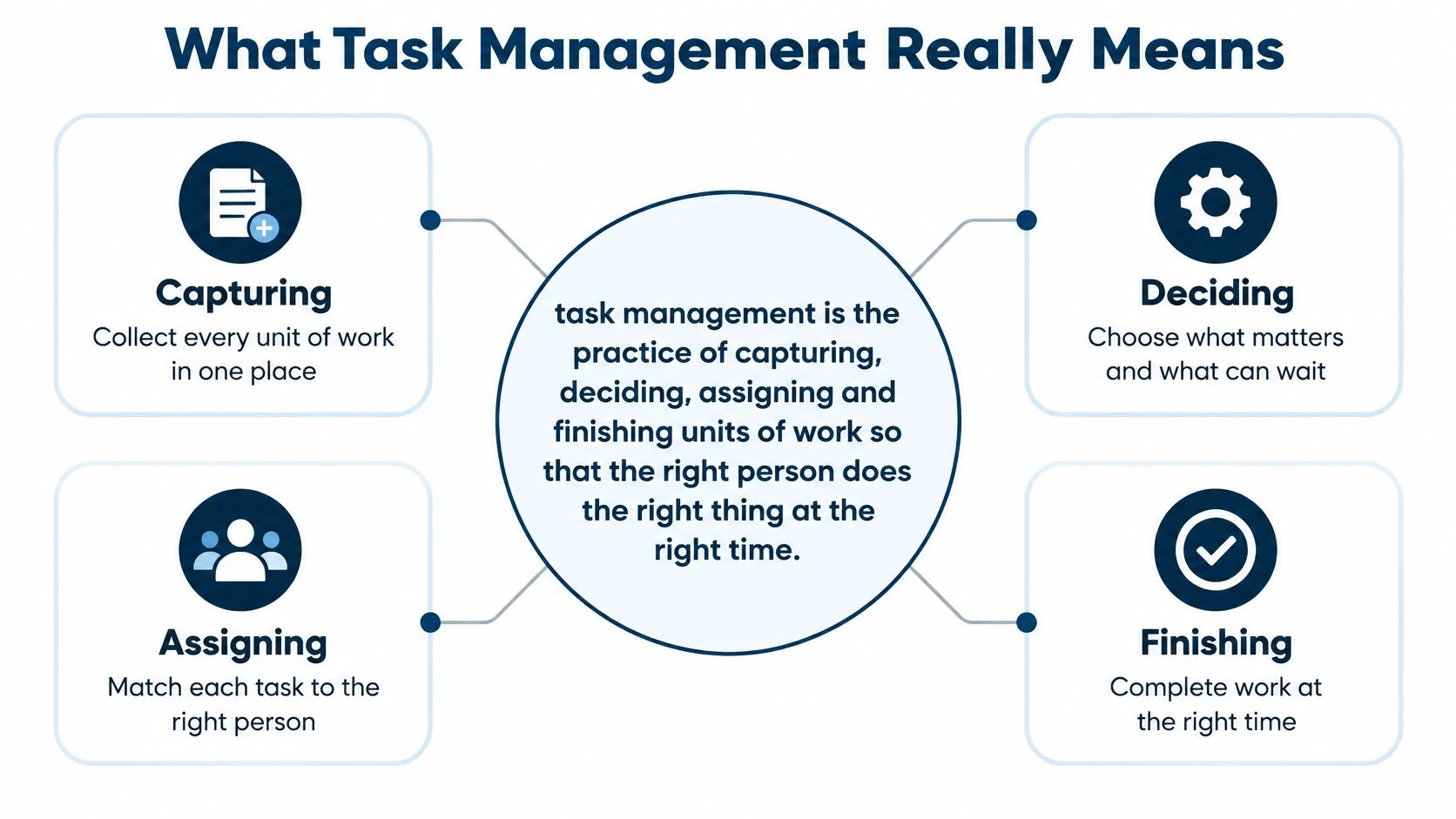
Task management is the practice of capturing, deciding, assigning and finishing units of work so that the right person does the right thing at the right time. Think of a railway signal box: trains share the same network, and a controller decides which one moves next, when it can move and which line it should use. Without those decisions, even a well-maintained railway can end up with trains waiting in the wrong places.
A to-do list records what exists. Task management decides the order, owner and deadline, then checks whether the work is finished and accepted. In a post-production team, “client notes” might sit on a list for days. Managing that task means clarifying which notes need action, assigning an editor, setting a return date and checking that the client has approved the result.
Every task needs a clear outcome, a single owner and a date before it can move. “Fix colour grade” leaves too much open to interpretation. “Grade reel 2 to broadcast spec, owner Sam, approved by Friday 14:00” gives Sam a finish point and the team a point at which to check progress.
This work isn't just an administrative extra. The Association for Project Management's 2024 study of the UK project profession estimated that the profession employed approximately 2.32 million full-time-equivalent workers in 2024. That scale reflects how much organisations rely on people coordinating work, schedules and delivery, including in complex production environments. For a useful perspective on how work, tasks and invoices can be connected in agency operations, see this guide to software linking scope, tasks, and invoices.
Start with a check you can do now: count the open tasks across current work that have no owner or no date. Those are the first items to fix.
The Five Stages and Where Work Stalls
| Stage | Question it answers | Typical output | Common failure |
|---|---|---|---|
| Capture | What needs doing? | One inbox or list | Tasks live in heads, chats and email |
| Clarify | What does done look like? | Task with outcome and deadline | Vague titles such as “look at budget” |
| Prioritise | What goes first? | Ranked short list | Everything marked urgent |
| Assign | Who owns it? | Single named owner | Shared ownership, so nobody acts |
| Track and close | Is it finished and accepted? | Status, date and sign-off | Tasks left open and quietly stalled |
The stages form a flow, not a one-way checklist. A task starts in capture, gets clarified and ranked, then goes to an owner. If the reviewer rejects it, it returns to clarify so the team can agree what needs changing. Sending it straight back to the owner without resolving the feedback only repeats the same uncertainty.
Clarify is where a lot of avoidable rework begins. “Fix colour grade” might mean correcting a technical issue, matching a reference, or changing the creative look. Three people can read the same title and prepare for three different jobs.
A stronger version names the work and its acceptance point: “Grade reel 2 to broadcast spec, owner Sam, approved by Friday 14:00.” Now the colourist can work towards a defined result, and the person reviewing it knows what to check.
Fix the point where work waits
Some tasks move through these stages quickly. A complex sequence with several approvals may need more discussion. Don't assume every task should take the same time to get ready; measure how long work waits at each stage and look for the recurring hold-up.
These habits address common stalls:
- Too many priorities: Limit the day to three top tasks. A long list of “urgent” items doesn't tell anyone what to do first.
- No single owner: Name one owner for every task. Others can contribute, but one person must move it forward.
- Vague titles: Start each title with a verb and a finish point, such as “Confirm music cue with client”.
- No review rhythm: Hold a weekly 20-minute review to resolve blockers and reset priorities.
- Estimates never checked: Compare planned and actual time each month, then adjust future estimates.
Naming an owner or rewriting a title can be done quickly. Building a useful estimating habit takes longer because the team needs to record and compare actual work. Software won't fix a team's unclear decisions by itself. A tool makes good habits easier to keep, but people still need to use them consistently.
Map your last three projects against the five stages. Find the stage where work waited longest, then change one habit there first.
How to Prioritise Work Without Guesswork
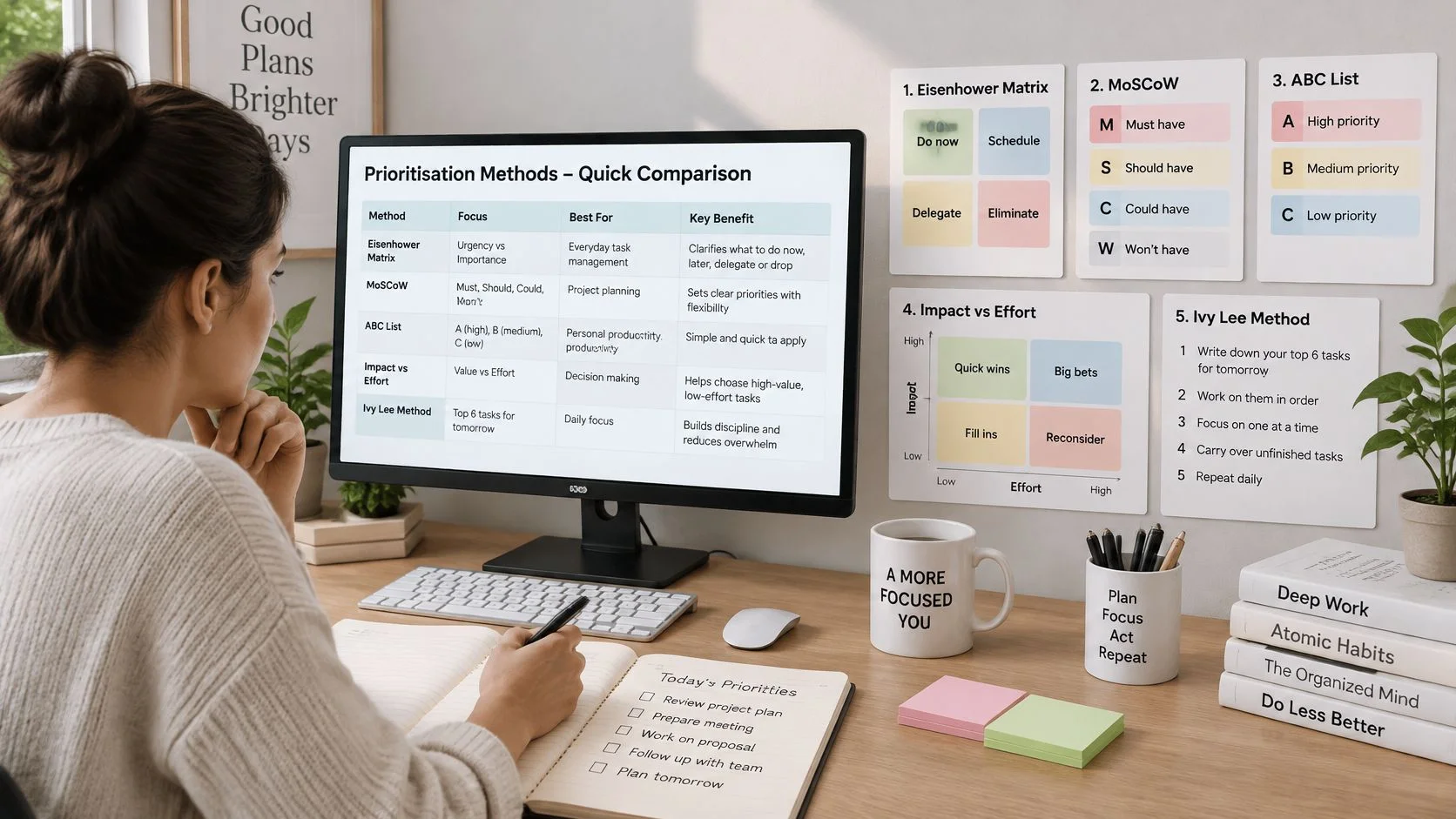
A useful priority method makes a decision clear: what should happen first, and why? Match the method to the choice in front of you.
| Method | Best for | How it sorts | Watch out for |
|---|---|---|---|
| Eisenhower matrix | Mixed urgent and important work | Urgent versus important, four quadrants | Important but not urgent items are rarely scheduled |
| MoSCoW | Scope decisions in a fixed project | Must, should, could, won't | Too many items labelled must |
| ABC list | Personal daily lists | A (must), B (should), C (could) | Over-labelling everything as A |
| Impact versus effort | Choosing between improvements | High impact and low effort first | Estimates that are guesses |
| Ivy Lee method | Focused daily work | Six most important tasks, in order | Days where the first task overruns and the rest slip |
Use MoSCoW when a project team needs to agree what belongs in scope. Use impact versus effort to compare possible improvements. An ABC ranking can help organise an individual's daily list. To connect daily choices to wider goals, consider prioritising work that advances strategy.
The Ivy Lee method ranks six tasks, then works through them one at a time. That gives you an ordered queue, not six equal top priorities. The top three are the day's real priorities; the remaining tasks follow in order if time allows. If the first task overruns, reassess what still fits rather than treating the original list as fixed.
When two tasks seem equally important, compare what each one holds up. If a sound editor is waiting for picture lock, confirming that decision may take precedence over work that affects only your own next step. A clear view of how to manage workload effectively can help show how unfinished tasks and over-commitment affect the wider team.
The cost of a poor priority list includes lost attention. In its February 2024 pilot online Time Use Study of public-sector workers across Great Britain, the UK Office for National Statistics found that workers spent an average of 16% of their working time multitasking, rising to 20% among frontline supervisors. Each switch asks people to redirect their attention, so unclear priorities can add friction even when everyone appears busy.
Choose one method for the next two weeks. Use it consistently, then note where it clarifies the next decision and where you remain unsure.
Assigning Work and Owning Outcomes
A task with two owners often has no owner at all. People may both assume the other person is handling the next step, or they may wait for the other to decide. Name one person to move each task forward, then make the other roles clear.
A simple role split helps. The responsible person does the work, the accountable person signs it off, the consulted person gives input, and the informed person needs to know the result. For a grading session, the colourist is responsible, the producer is accountable, the editor is consulted and the client services lead is informed.
Assignment also depends on capacity. Capacity means the time a person can give the task, not an empty-looking slot in a calendar. Check what else they're committed to, whether the work needs a specialist skill and whether they can complete it without disrupting existing deadlines. Sending every new task to the strongest person can create a bottleneck around that person and leave others without a chance to build skills. A clearer view of resource management helps teams match work to real availability.
Make the handoff explicit
Use this routine when passing work to a colleague:
- State the outcome in one sentence.
- Confirm that the owner accepts the task.
- Set one date, not a range.
- Agree how the work returns for review.
- Record the handoff where the whole team can see it.
Step two matters most. An accepted task has a person behind it. An assigned task may only have a name in a list, without agreement on the work or the time available to do it.
Audit one current task today. Check whether it has a clear owner and a date. If either is missing, ask the team to agree them before the task moves on.
Tracking Progress and Spotting Problems Early
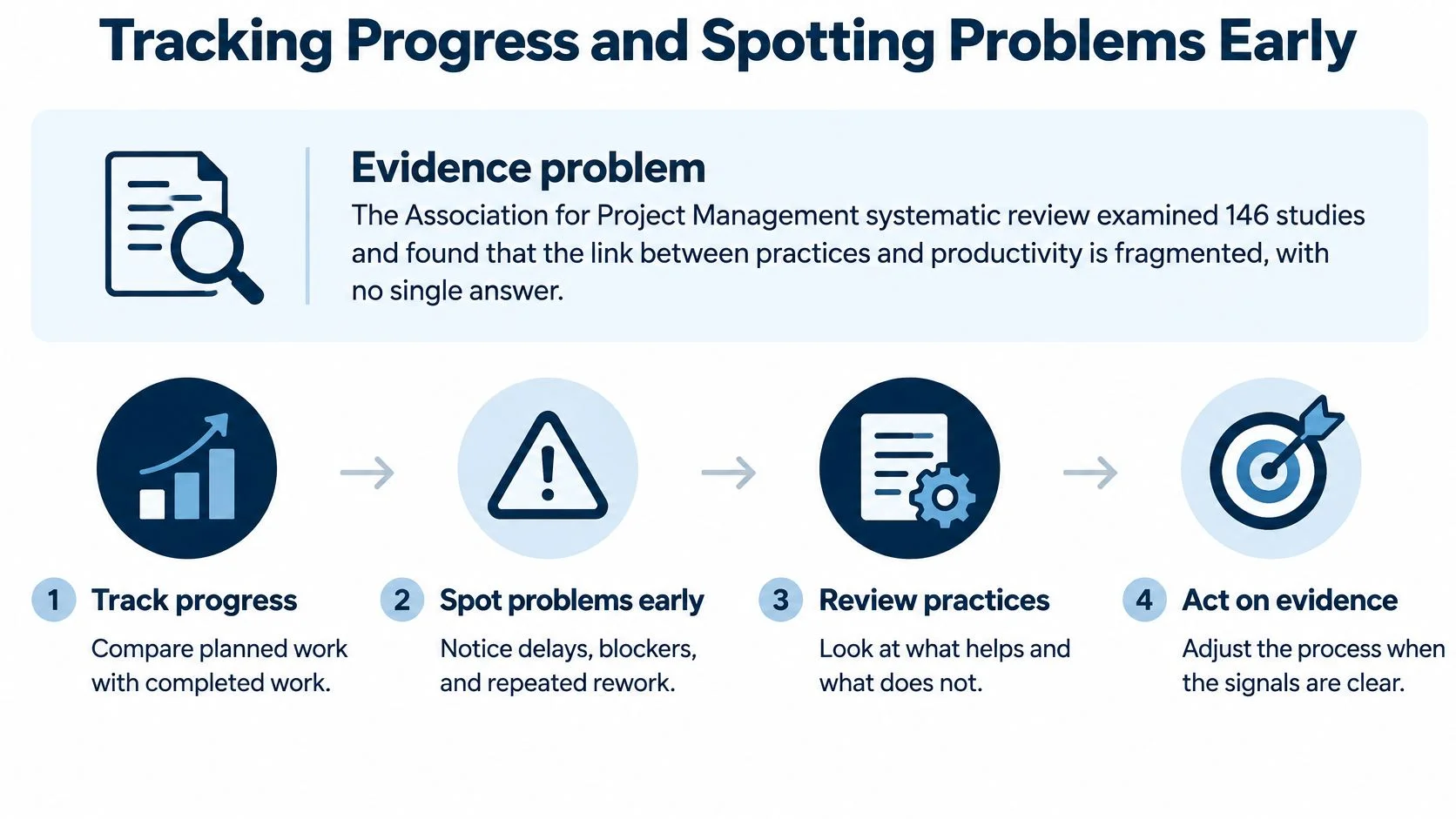
Measuring whether management practices improve productivity isn't straightforward. An Association for Project Management systematic review examined 146 published studies and found that the evidence connecting project-management practices to productivity is fragmented, with no single framework for measuring the relationship. The APM productivity report makes the case for treating task management as an operating system you can measure, rather than just a list of work.
Give every task a consistent set of fields:
- Work type: A standard category, such as edit, sound, colour or QC.
- Accountable owner: The person responsible for moving the task towards completion.
- Planned effort and actual time: What the team expected, and what the work took.
- Dependency status: Whether the task can start or is waiting on another decision.
- Rework count and approval latency: How often the work returns, and how long approval takes.
- Delivery outcome: Whether the result was accepted and delivered.
These fields help distinguish throughput, the number of tasks completed, from utilisation, how busy people are. A team may complete more tasks while also taking on more rework or overtime. That isn't necessarily an improvement. Compare planned and actual effort by team each month, alongside schedule adherence, so you can see whether estimates and delivery are moving together.
Prefer system-generated timestamps to memory. People often remember a difficult task more clearly than a routine one, so retrospective estimates can distort what happened. A timestamp records when a task changed status or went for approval, giving the team a firmer basis for finding delays.
Watch for early warning signs
- A task has passed its date without a status change.
- Approval has been waiting for more than two days.
- The same task has returned for rework twice.
- Planned effort has been exceeded by more than a quarter.
Treat these as prompts to investigate, not proof that someone has failed. Find out whether the task was unclear, blocked by a decision or estimated poorly. Then fix the cause that the team can control.
Pick One Method and Run It for Two Weeks
Pick a starting point that matches the size of your team. If you work alone, use an ABC list and limit your daily top tasks. For a small team, give every task one owner and set a weekly review. For a larger team, use a shared tracker that records the work type, accountable owner, planned effort, actual time, dependency status, rework count, approval latency and delivery outcome.
Then run a short trial:
- List every open piece of work.
- Clarify the five most important tasks until each has an outcome and a date.
- Choose one method from the comparison and use it to set the order.
- Assign an owner to every task.
- Review after two weeks, comparing planned and actual time.
A two-week trial gives you something concrete to discuss: which tasks moved, where work waited and whether the estimates were realistic. If you're looking for a shared planner for studio or post-production work, freispace lets teams organise tasks and to-dos, set deadlines and priorities, and see live plan-versus-actual budgets on each project instead of relying on a month-end spreadsheet. For teams adapting their delivery process, this guide to the agile methodology workflow offers another way to think about how work moves and gets reviewed.
Write down the task that's currently waiting on a decision. Give it a clear outcome, one owner and a date, then let that be the first task in your trial.
freispace brings task management, deadlines and project budgets into a shared view, helping post-production teams see what's moving and where work is waiting. Visit freispace to explore how it can support the way your team plans and delivers work.