The grade is slipping, the sound team wants a confirmed turnover, and the client still expects delivery on the agreed date. Your bookings looked workable until someone checked the colourist's availability against another title. Now you're deciding whether to buy external capacity, move a review or absorb overtime.
Risk management in a project means making those decisions before the team runs out of options. In post-production, that requires more than a register of possible problems. You need exposures tied to bookings, milestones and budget lines, with someone authorised to act. AI workflow failures and carbon-intensive recovery choices belong in that same conversation, not in separate policy documents.
The Six Stages of Project Risk Management
Say a grade slips by two days because nobody logged that the colourist was booked on another title. A delivery penalty follows before the producer has reviewed the risks. The booking conflict was the immediate problem, but the management failure happened earlier: nobody owned the uncertainty.
Treat risk work as a continuous loop, not a document you complete at kick-off. Each stage should produce something the next person can use.
Risk management stages, outputs and owners
| Stage | Output | Typical owner | When it runs |
|---|---|---|---|
| Identify | Risk log with one line per exposure | Producer or post coordinator | At initiation and before each phase |
| Score | Likelihood and impact scores from 1 to 5 | Department heads | After identification, then monthly |
| Quantify | Contingency reserve in money and days | Producer with finance | Before budget sign-off |
| Plan responses | Mitigation, trigger and owner for each high risk | Named risk owner | Before the phase starts |
| Monitor | Updated scores and reserve used to date | Producer | Weekly and at each stage gate |
| Review and close | Lessons log and released reserve | Head of post | At delivery |
These are suggested operating rules, not prescribed industry thresholds. The monthly scoring session recalibrates the whole register; weekly monitoring updates active exposures whenever circumstances change. Don't leave a deteriorating supplier risk untouched because its formal scoring meeting hasn't arrived.
Make each handover usable
Identification gives department heads something concrete to assess. Scoring tells the producer where to spend attention, while quantification gives finance a basis for approving reserve. Response planning converts concern into action, and monitoring checks whether that action still fits the project.
For a useful comparison outside post-production, GM GROUP Services' risk planning for events and venues offers another operational setting in which teams must prepare before a fixed delivery moment. Use that perspective to challenge whether your plan addresses what people will do, rather than merely naming hazards.
At close-out, record which assumptions were wrong, which responses worked and what the next estimator should change. Release unused reserve only after outstanding delivery obligations have been checked.
Working-log test: Every open risk needs an owner, a score and a next review date. If any is missing, the entry isn't ready to manage.
The producer owns the process, but shouldn't become the default owner of every technical, creative and commercial exposure. Assign responsibility to someone who understands the cause and can obtain a decision.
How to Identify Risks Before Work Starts
Start with the schedule open, not a blank list headed technical, financial and operational. Walk from ingest to delivery and ask what could prevent each task finishing as planned. A conform waiting on a locked cut is a different exposure from an online edit tied to a single suite, even if both end up labelled technical.
Bring the people who know the work into that walk-through. The coordinator knows booking clashes; the assistant editor knows media inconsistencies; the engineer knows which integration hasn't been tested. The producer needs all of those views before committing the final plan.
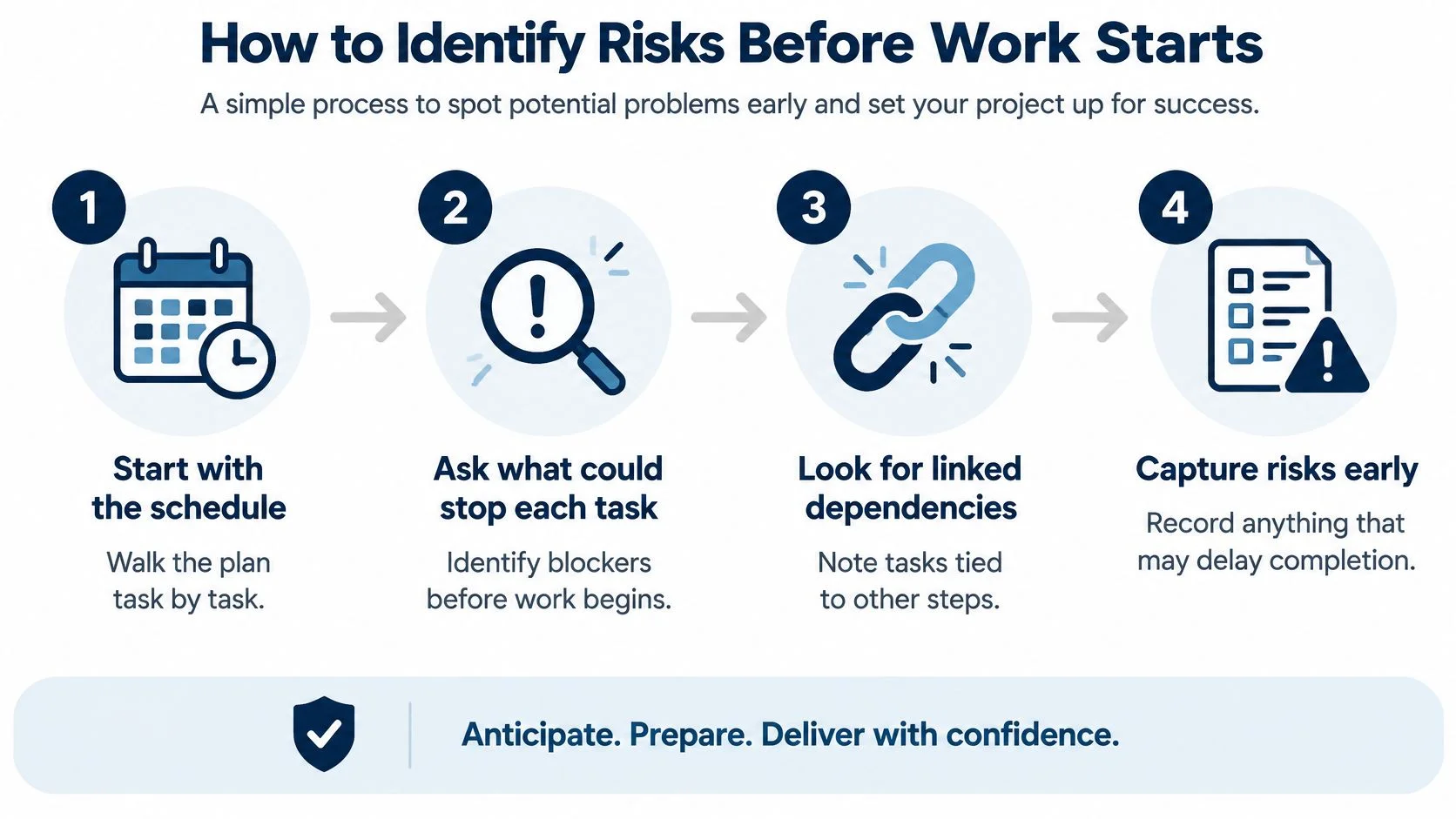
Ask questions against actual tasks
Dependencies. Which task waits on another department, supplier or client decision? For a conform, record who supplies the locked sequence and what happens if that handover contains unresolved changes.
Resources. Which named person, room or licence has no workable substitute? A sound mix booked around a single mixer needs an availability check and an alternative, not merely a confirmed room.
Assumptions. What did the quote assume about media volume, render demand and revisions? Compare those assumptions with the current brief, especially where a creative change creates work across several departments.
Capability. Which tools or AI-assisted steps can the assigned team operate and verify? An engineer's successful demonstration doesn't establish that every shift can recover a failed batch.
Client commitments. Which deadlines are contractual, and who can approve a change? Record the commercial consequence from the actual agreement rather than assuming a late delivery will attract a penalty.
Distinguish a dependency from a risk. The dependency is that the grade follows conform; the risk is that missing source media prevents conform finishing before the booked grade. A clear explanation of what a project dependency is helps coordinators make that distinction without filling the register with ordinary sequencing relationships.
Put AI uncertainty into the delivery plan
AI adoption is a capability and delivery exposure, not a saving you can assume at quotation. In ScreenSkills' Powering Production report, 47% of film respondents expect AI to change working practices in their department, while 23% are unsure of the impact. Ask what those different levels of confidence mean for the people assigned to this project.
For an AI-assisted transcription or cleanup step, record tool reliability, permitted handling of client material, output verification, vendor dependency and reversibility. Name the person who signs off the result. Keep the manual route schedulable until the proposed workflow has passed a representative test.
Don't count prospective time savings as available capacity before validation. Test difficult material, not just a convenient sample, and include correction time in the result. A fast initial output followed by extensive human repair may leave the delivery plan worse off.
For a different operational perspective, ABCO Security Services Australia's Australian security risk analysis guidance is a useful companion when thinking about access, assets and vulnerabilities. Keep that security lens alongside the schedule walk, particularly where external tools or suppliers handle client media.
Capture risks at initiation, while you can still change the quote, sequence or staffing. As evidence arrives, replace assumptions with test results, confirmed bookings and accepted handovers.
Finish each entry with a cause, possible event and consequence. For example: because source-media completeness hasn't been checked, conform may stop for replacements, putting the grade booking at risk. Add the affected milestone and a named owner so the entry can move directly into assessment.
Scoring Risks and Building a Heatmap
Use likelihood multiplied by impact to prioritise attention. As a suggested local method, score each dimension from 1 to 5 and place the result on a 5-by-5 heatmap. These are ranking categories, not measured probabilities or a financial forecast.
For example, a freelance colourist with a possible availability conflict might receive likelihood 2 and impact 5, producing a score of 10. A laptop failure with a ready replacement might receive likelihood 3 and impact 2, producing 6. Under the proposed bands below, the colourist exposure needs funded action before the laptop exposure.
Risk score bands and the response each needs
| Score (likelihood x impact) | Rating | Response required |
|---|---|---|
| 1-4 | Low | Accept, note in the register and review monthly |
| 5-9 | Medium | Named owner and written response within the week |
| 10-15 | High | Funded mitigation and trigger, reviewed weekly |
| 16-25 | Critical | Immediate escalation, decision deadline and approved response |
Define the scales before scoring
Write down what each category means for this project. For an illustrative impact scale, 1 could mean half a day of recoverable re-rendering, while 5 could mean missing a contractual delivery date with a penalty. Define the intermediate categories using consequences the team can recognise.
Do the same for likelihood. Use descriptions such as exceptional, possible and expected, supported by booking evidence, test results or comparable delivery records. Don't convert those descriptions into percentages unless you have a defensible basis.
Where a risk affects schedule, cost, quality and security differently, record those consequences separately. Use the most serious credible consequence for escalation rather than averaging away a delivery-threatening result.
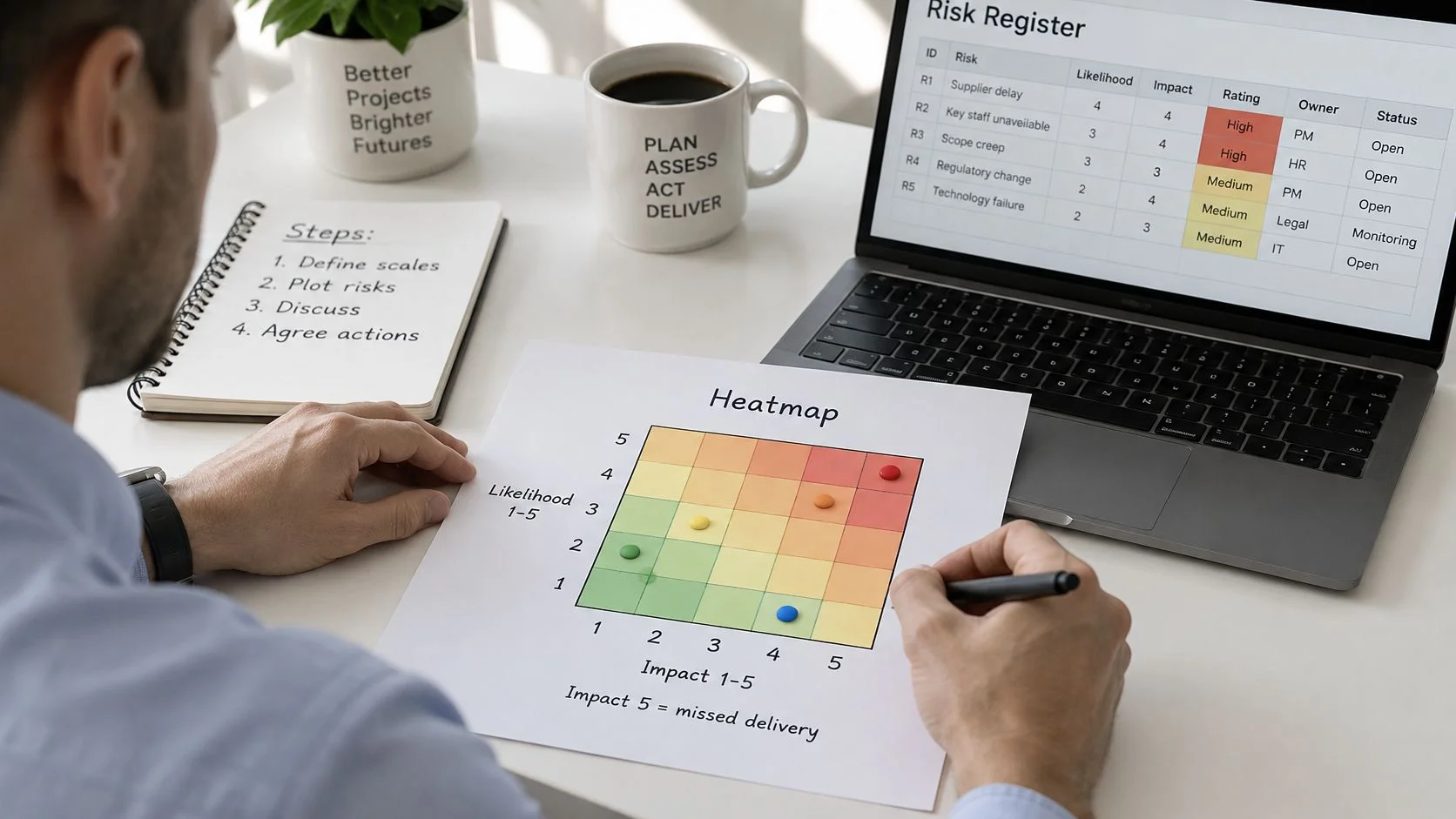
Don't let the colour hide the consequence
A Journal of Construction Engineering and Management study of 30,950 construction projects found a long right-hand tail of unusually large cost overruns, concluding that major overruns involve different risk dynamics from ordinary overruns. That supports examining extreme scenarios separately, not treating every exposure as routine variance.
For a post-production schedule, ask what happens if linked problems occur together. A late client approval, an unavailable colourist and a replacement supplier's onboarding requirements may all consume the same remaining delivery window. Scoring them independently won't reveal that shared constraint.
Place each risk ID in the appropriate likelihood-and-impact cell and colour the cells by response band. Keep the heatmap generated from the same register, or maintain both in the same shared file. A polished slide copied from an outdated log creates false reassurance.
Record both inherent risk, before controls, and residual risk, after controls that are operating. A proposed backup booking doesn't justify a lower score until somebody confirms availability and the required commercial approval.
A green cell isn't permission to ignore a catastrophic consequence. Escalate an exposure when its potential outcome exceeds the producer's authority, whatever the multiplication says.
Close the scoring review with practical checks: no critical risk without an escalation date, and no high risk without a named owner. Resolve disagreements by examining the evidence and consequence, not by splitting the difference between competing scores.
Quantifying Contingency for Budget and Schedule
Treat the approved budget and delivery plan as forecasts with uncertainty, not promises that every assumption will hold. Contingency is an explicit allowance for identified uncertainty. It isn't spare margin, and it shouldn't become an invisible fund for unapproved creative changes.
The UK Treasury's Green Book supplementary guidance on optimism bias provides the following capital-cost uplifts, including 200% upper and 10% lower uplifts for equipment or development projects.
Optimism-bias uplifts for capital costs by project type
| Project type | Upper uplift | Lower uplift |
|---|---|---|
| Standard buildings | 24% | 2% |
| Non-standard buildings | 51% | 4% |
| Standard civil engineering | 44% | 3% |
| Non-standard civil engineering | 66% | 6% |
| Equipment or development projects | 200% | 10% |
Reading rule: These are capital-appraisal categories, not standard contingency rates for an edit, grade or sound mix. Use them to challenge optimism in a technology programme only after documenting whether the category is appropriate.
Establish the comparison before the allowance
Start with completed projects that resemble the proposed work. Compare original estimates with final cost and duration, keeping scope changes visible rather than treating every difference as estimating error. Match complexity, integration requirements and organisational capability, not merely the project title.
Then analyse this project's specific exposures. A workflow rollout may face integration failure, migration effort, scarce engineering capacity, supplier dependency and changing requirements. Link each exposure to the work it could add and the milestone it could delay.
A useful estimating record includes:
- Comparable outturns. Preserve the original estimate, actual result and explanation of the difference.
- Exposure assumptions. State what must happen for an additional cost or delay to arise.
- Shared causes. Identify risks that could occur together, such as a failed integration extending both consultancy and internal staffing.
- Release evidence. Define which accepted test, completed migration or supplier commitment would justify reducing reserve.
Don't automatically stack a full optimism allowance on top of a risk model that already captures the same uncertainty. Explain how the allowances relate, and have finance review potential double counting.
Calculate the uplift correctly
Consider a hypothetical scheduling-tool rollout with a base capital estimate of £50,000, provisionally classified as equipment or development. Applying the table's upper uplift would add £100,000, giving a total of £150,000, not £100,000. At the lower uplift, the addition would be £5,000, giving £55,000.
Those are illustrative calculations, not a recommended budget range for scheduling software. The difference shows why the classification and the evidence for reducing an uplift need scrutiny. Choosing a convenient row or moving straight to its lower value doesn't control the underlying risks.
Keep schedule contingency distinct from the cost calculation. Capital-cost uplifts don't establish how many days a migration or integration will take. Model the dependency path, specialist availability, testing and rollback requirements to determine the time allowance.
For ordinary production spending, budgeting a film provides the wider context in which labour, facilities and delivery costs must remain visible. Put the approved risk reserve on its own budget line rather than distributing it across departmental estimates.
Reduce reserve when evidence removes uncertainty, not because the team has reached a reporting date. A successful migration rehearsal may justify reducing migration exposure; it doesn't remove an unrelated supplier risk. Record who approved each release and retain a forecast of the remaining exposure.
Mitigation Plans, Triggers and Named Owners
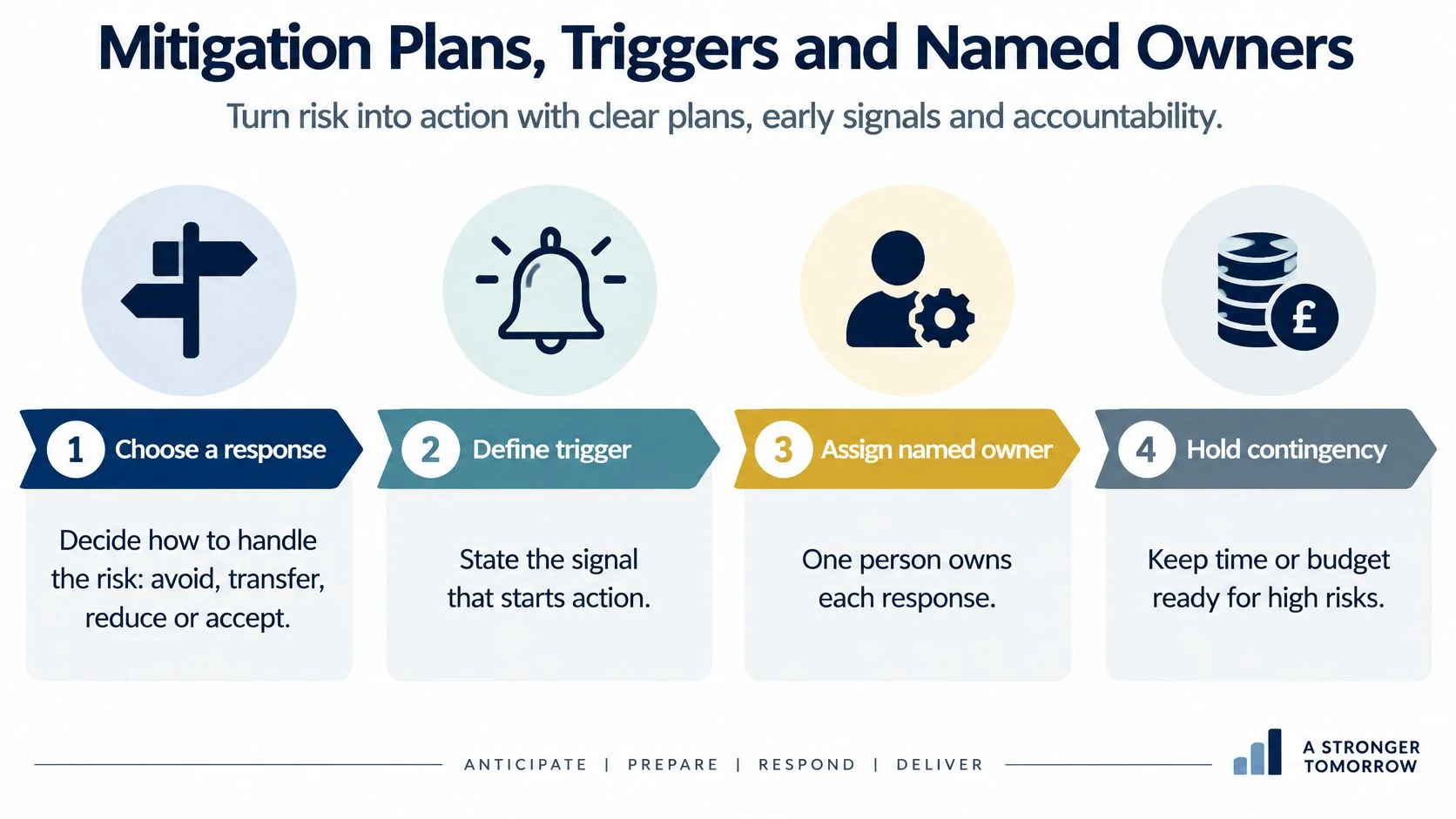
Work through high and critical exposures in consequence order. The response must tell the owner what to do, when to do it and what authority they have. Writing monitor closely in the mitigation field doesn't change the plan.
Turn each response into an instruction
Choose the response. Avoid the exposure by changing the workflow, transfer an agreed financial consequence, reduce likelihood or impact, or accept it with reserve. Outsourcing a task doesn't automatically transfer your obligation to deliver to the client.
Write a dated action rather than an aspiration. For example, confirm a backup colourist before the primary booking's release deadline, including rate, availability and access to the project. Keep the evidence with the entry.
Set a measurable trigger. Illustrative triggers could include a render queue exceeding two days, client approval still missing five working days before review, or booked hours exceeding 90% of the allocated task budget. Choose thresholds that leave enough time to recover on your schedule, rather than copying those examples unchanged.
Name a single accountable owner. Several people may perform actions, but someone must recognise the trigger, initiate the response and seek approval if the cost exceeds their authority. Give that person an escalation route.
Define the contingency rule. Distinguish drawing down reserve to execute a response from releasing unused reserve back to the business. Release only when evidence shows the exposure has cleared or the completed mitigation has reduced the remaining need.
Include carbon in the recovery decision
Carbon exposure belongs beside cost and schedule because the same operational choices affect all of them. BAFTA albert's 2025 report, based on more than 2,500 productions in 2024, estimates that the UK screen industry generated nearly 175,000 tonnes of CO2 annually. Its action areas include travel, energy, materials and waste, culture, and data.
Say a review plan requires repeated travel, and a late creative change makes another visit likely. Remote review may avoid that journey, but the producer should first check secure access, viewing conditions, approval authority and the time needed to prepare the session. A remote meeting that cannot produce an accepted decision isn't a complete mitigation.
Record the estimated emissions, financial cost and delivery effect of each feasible option. Use a project-approved carbon threshold as a decision trigger, with a named approver for exceptions. Don't present an unmeasured alternative as lower-carbon based only on the impression that it is less resource-intensive.
The same discipline applies to duplicated storage, repeated renders and emergency supplier changes. Ask whether the proposed recovery creates avoidable rework, and compare the whole workflow rather than an isolated task.
For owner-managed facilities, AmbitionCFO's guidance on assessing internal controls in founder-led businesses offers a relevant management lens. Keep the risk owner's accountability distinct from approval authority, especially when the proposed response changes spend or commercial commitments.
Action test: If the trigger fires during the next shift, can the named owner act without first reconstructing what everyone meant?
A mitigation without an owner or trigger may look complete in the register. In practice, it leaves the coordinator making the same emergency calls the register was supposed to prevent.
Monitoring Cadence and Reporting Metrics
Set a fixed review rhythm, then shorten it around exposed handovers and imminent delivery. A weekly meeting is a management checkpoint, not permission to delay reporting a trigger that fires today. The owner should update the entry when the evidence changes.
The UK government's peer review of optimism-bias research reports mean UK IT project cost overruns of 9% and schedule overruns of 78%. Those are not forecasts for a post-production automation rollout, but they support giving its duration assumptions serious scrutiny rather than monitoring spend alone.
Use a rhythm that supports decisions
- Weekly risk review. As a suggested starting routine, examine the ten highest-scoring open exposures, check triggers and record reserve movements. Include any lower-scored exposure with a severe consequence or an imminent decision.
- Stage-gate reforecast. At picture lock, turnover, technical acceptance and delivery readiness, rebuild the remaining forecast using actual productivity, approved changes and unresolved work.
- Immediate exception reporting. Notify the producer when a trigger fires, a critical booking becomes unavailable or a supplier withdraws a commitment. Don't wait for the dashboard cycle.
- Historical comparison. Test the forecast against comparable completed work, separating edit, VFX, sound, conform, review and delivery rather than using a single project-wide average.
Track rework separately from initial execution. Otherwise, an apparently improving render or edit rate can conceal additional correction passes. For AI-assisted tasks, count the time needed to inspect and repair outputs before declaring a productivity gain.
Report exposure, not just activity
The producer's dashboard should include:
- Ownership coverage. Every high and critical risk should have a named accountable person. Treat gaps as actions to resolve, not administrative omissions.
- Critical-path float. Show the remaining time before delay affects delivery, with the assumptions behind that calculation.
- Contingency remaining. Display approved reserve, committed drawdowns and the forecast exposure still to cover.
- Triggers fired. Count recent activations using a consistent reporting window, and state whether the agreed response started.
- Forecast against commitment. Show expected completion beside the client delivery date, including outstanding approvals.
- Recovery cost. Identify the incremental overtime, external capacity or supplier premium needed to protect the date.
Financial progress needs context too. A calculation of earned value can help distinguish money spent from work achieved, provided completion measures represent accepted outputs. Hours booked against an unfinished conform aren't equivalent to a conform ready for grade.
Escalate any dependency path forecast to finish after the committed date. Also escalate when remaining exposure exceeds the available reserve, even if current spend remains within budget. The decision may require changed scope, additional funding or a negotiated delivery adjustment.
Keep the producer's report to a suggested single page: the current heatmap, reserve position, forecast delivery and the three triggers nearest to firing. Put supporting detail behind it. The page should make the required decision visible, not merely demonstrate that somebody updated a spreadsheet.
Build Your First Risk Register This Week
Choose a live project with an approaching handover and give the team a bounded setup exercise. Don't wait for a company-wide template, a new reporting system or agreement on every possible category. A small register that changes a booking decision is more useful than a complete register nobody opens.
Run a short pilot
Walk the next delivery path. For this suggested pilot, capture ten material exposures with the coordinator and relevant department leads. Include any unvalidated AI step and any recovery choice likely to change travel, energy use or data handling.
Score the entries using written scales. Resolve ambiguous descriptions before placing IDs on the heatmap, and record the evidence behind disputed assessments.
Fund the largest exposures. Select the two high or critical risks with the greatest credible cost consequence. Estimate their reserve from comparable work and project-specific scenarios; use the capital-uplift table only where the project classification fits.
Give the top three entries dated actions, measurable triggers and accountable owners. Confirm that those owners accept the role and know who can authorise expenditure.
Book the review before closing the file. A suggested thirty-minute weekly slot is enough to establish the habit if owners update their entries beforehand. Confirm the first meeting and the decisions expected from it.
Keep the evidence close to the work
Store the register where the team already checks bookings, tasks and budgets. Avoid a parallel reporting process that requires coordinators to reconstruct the same position manually. Use task IDs and booking references so an owner can find the affected work immediately.
In freispace, Resource Management covers suites, studios, personnel, resources and licences, while Budgeting & Controlling keeps budgets, costs and workloads visible. Budgets show live plan-versus-actual on every project, instead of a month-end spreadsheet, giving the review a current financial basis.
Judge the pilot by decisions made: a backup secured, an assumption tested, a change priced or a delivery commitment renegotiated early. Start with one project, maintain the review habit for a suggested four-week trial, then extend the register to the rest of the slate.
freispace brings resource scheduling, project planning and live budget control together, with project carbon emissions calculated from the same schedule. Visit freispace to explore how your team can keep the bookings, costs and delivery work behind each risk visible in its daily planning.