
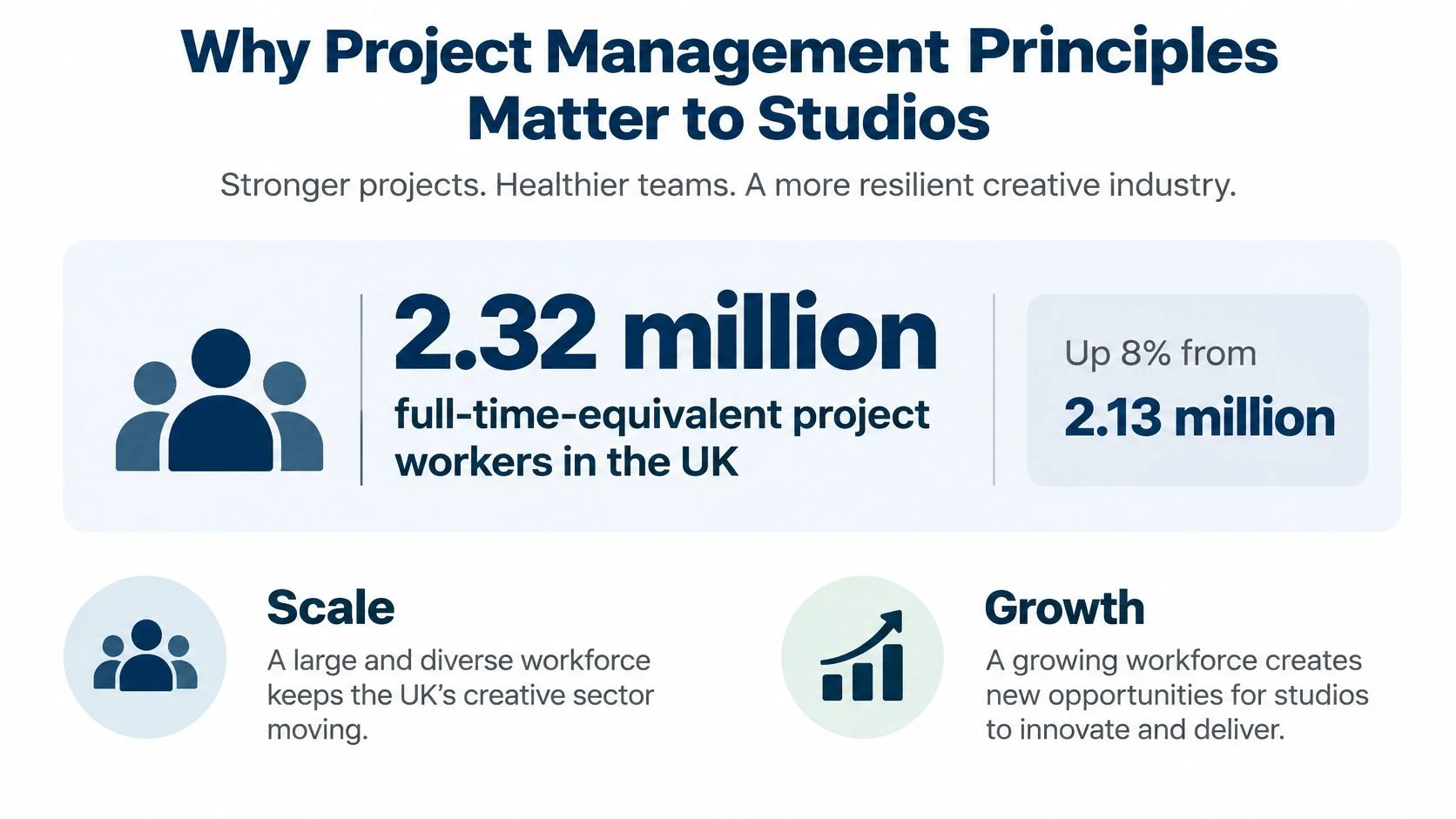
The UK's project-management profession generates an estimated £186.8 billion in annual gross value added, according to the Association for Project Management's 2024 Golden Thread research, which also estimated approximately 2.32 million full-time-equivalent project workers across the UK. Inside a post-production studio, that discipline comes down to something tangible: making sure the right suite, freelancer and approved material are ready on the same day.
Why Project Management Principles Matter to Studios
Say your online editor is booked, but picture hasn't locked. The grade room sits empty while the producer chases approval, then an extra version arrives without an agreed price. Those aren't separate diary problems. They're failures to connect objectives, stakeholders, scope and cost.
Project management principles are operational controls, not paperwork added after the creative work. They determine who can approve a change, which booking must move and whether the studio can absorb the consequences without handing the overrun to a freelancer.
Start with the handover, not the calendar
In early 2022, our qualitative surveys at freispace found that the majority of companies relied on shared calendars or massive Excel spreadsheets to organise their processes. A calendar can show a booking without showing whether the work is ready to enter that room.
For useful comparisons beyond post-production, AIDictation's real-world examples of project workflows provide a way to think about activities and handovers. Translate any workflow into a studio question: what must be approved before the next person starts?
Practical rule: A booking isn't a complete plan until its inputs, decision owner and acceptance criteria are visible.
Keep the KPI table below open while planning your next job. Use it to connect the booking to delivery, money and workload, rather than treating each as a separate conversation.
Nine Principles and the KPIs That Prove Them
Project management principles, studio controls and KPIs
| Principle | What it controls in post | KPI to review | Typical failure |
|---|---|---|---|
| Scope | Locked brief, deliverables and paid revision rounds | Approved changes raised before the work starts | Extra versions appear in the grade with no approved change |
| Time | Milestones, dependencies and the delivery date | Schedule variance against picture lock, online and delivery | Dates move in chat and never on the plan |
| Cost | Quote, committed bookings, actuals and forecast | Forecast at completion versus the approved budget | The overspend appears only at month end |
| Quality | Specs, review notes and QC acceptance | First-pass acceptance and rework hours | Notes never become pass or fail criteria |
| Risk | Late picture, kit failure, extra renders and no-shows | Open risks with an owner, trigger and dated action | Contingency is buried inside the task estimate |
| Resources | Suites, operators, licences and freelancers | Utilisation read with overtime and skills concentration | The same colourist or suite is double-booked |
| Communication | One status and a log of decisions | Age of open decisions and overdue dependencies | Parallel email threads become the plan |
| Stakeholder management | Client, agency, producer and department leads | Named decision owner and agreed response time | Everyone can say yes and nobody owns the call |
| Sustainability | Fair workload and emissions tied to the schedule | Overtime share and CO2e per project | Maximum billable hours is the only target |
Read each row as a decision
Take scope. A producer asks for another social version while the colourist is already working. The useful question isn't whether the request is small. It's whether someone has approved its effect on the booking, price and delivery commitment before the colourist starts.
Count approved changes raised before work begins, but keep the underlying requests visible too. A tidy change log proves little if artists are completing unrecorded extras. Ask the department lead to reconcile requests, approvals and work completed.
The same distinction matters for schedule variance. Record the difference between the agreed milestone and the current forecast, together with the dependency causing it. A green status chosen by someone who hopes the client will reply isn't a measure of progress.
Some entries combine measures because a single figure can mislead. High utilisation alongside rising overtime tells a different story from high utilisation within agreed working hours. Likewise, first-pass acceptance needs the rework record beside it, otherwise a department might appear successful while repairing work before formal review.
Define the measure before collecting it
Each KPI needs a clear definition, a source and an owner. For overtime share, agree which hours count as overtime and which total you're comparing them with. For first-pass acceptance, decide whether acceptance means internal technical approval, client approval or delivery-platform acceptance.
Use these operating rules:
- Give each measure an owner. The producer can own change approval, while the department lead owns rework classification.
- Record evidence at the point of work. Use booking records, approved notes and tracked hours rather than reconstructing events at project close.
- Attach a response. An overdue decision should prompt contact with its owner, not merely change a dashboard colour.
- Keep environmental assumptions visible. CO2e comparisons need consistent boundaries and calculation methods, not just a total.
Cost measures also need a reliable definition of completed work. If you want to connect budget consumption with delivery progress, our guide to the calculation of earned value explains that distinction. Don't treat hours spent as proof that the same proportion of the deliverable is finished.
For the next job, choose a primary KPI from each row and assign responsibility for updating it. Leave decorative dashboard measures alone until these controls lead to decisions. A useful KPI changes what the producer does next.
Run Principles as a Controlled Lifecycle
A studio plan needs repeated approval points, not just an impressive scheduling session before work begins. Keep the original baseline visible while updating the live forecast, so the team can distinguish an agreed change from an unnoticed slip.
Establish the baseline and the gates
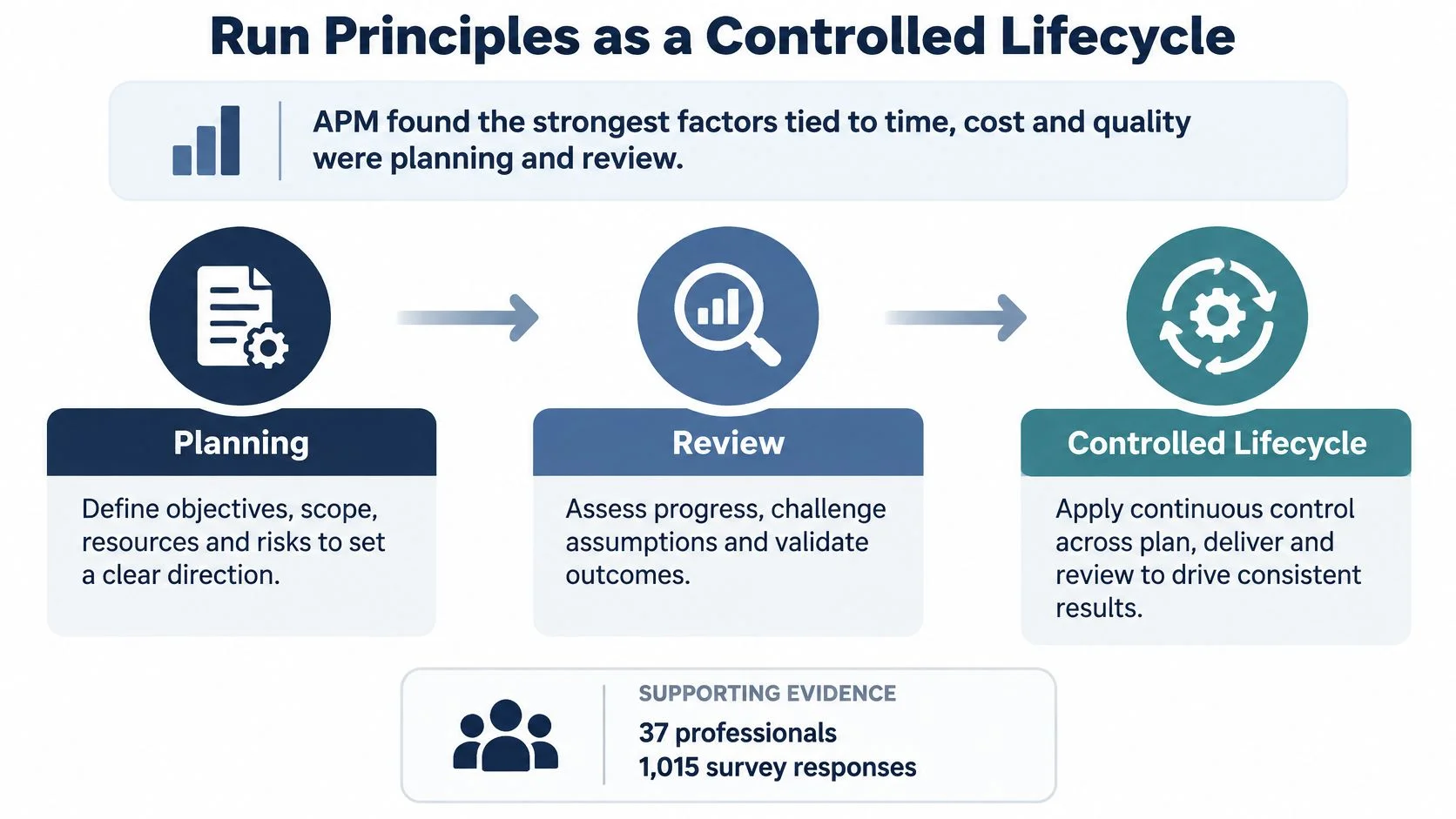
Approve the baseline before releasing work. APM's Conditions for Project Success identified planning and review, defined goals, effective governance, competent teams and commitment to success as the factors most consistently associated with time, cost and quality outcomes, yet only 4% of respondents rated planning and review as excellent and 14% described it as poor or absent. Write down scope, dependencies, capacity, milestones, budget and acceptance criteria before confirming crews and releasing offline work. If discovery work is needed to settle the brief, authorise that explicitly rather than treating an unsettled brief as approval for the whole job.
Divide delivery into reviewable stages. The history of PRINCE2 describes continuing business justification, defined responsibilities, controlled stages and management by exception as central ideas. Apply those ideas to assembly, picture lock, sound, grade, VFX, online and delivery. These aren't necessarily sequential departments: sound preparation and VFX can overlap editorial, but the handover conditions must be explicit.
Separate creative and technical authority. Name who approves the storytelling decision and who accepts the technical deliverable. A client's enthusiasm for a cut doesn't confirm that the media, handles, specifications and rights information are ready for finishing. Where those owners disagree, name the person who resolves the conflict.
Review variance before committing the next stage
Agree tolerances at approval. Define which schedule or budget movements the producer may manage and which require escalation. Include qualitative triggers too: changing a delivery specification or requiring unplanned weekend work can warrant approval even when the financial variance looks modest.
Compare the live job with its baseline at each gate. Check actual hours, suite use, outstanding dependencies and the forecast for the next stage. Ask department leads about remaining work, not just work completed. A conform that's nearly finished may still depend on missing source material with no confirmed arrival.
When requirements move, record the change before releasing affected work or confirming the next booking. State what changed, who requested it, the affected deliverables and the decision on money and dates. Keep unaffected work moving where its inputs remain valid.
The software should support this routine rather than dictate it. If your team uses Apple computers, Tintd's guide to compare project management apps for Mac can help frame a shortlist; test candidates against an actual picture-lock handover and approval process.
A vague brief gives artists room to interpret requirements differently. A review gate gives the producer a chance to resolve that ambiguity while resequencing, additional resource or reduced scope remain practical choices.
Plan Capacity Without Burning Out Freelancers
Filling every suite hour can shrink future capacity. If the plan depends on repeated late nights, you may complete the current delivery while making it harder to retain the people needed for the next one.
ScreenSkills estimated the UK off-screen screen workforce at 183,000–194,000 people in 2024, as reported by British Cinematographer. That workforce estimate isn't a pool of interchangeable people available to your studio. A free room doesn't create a qualified mixer, and an available editor doesn't automatically provide finishing cover.

Find the constraint by skill
Post-production bottlenecks move. During assembly, the constraint might be editorial availability; near delivery, it might be a particular finishing operator, licensed workstation or review room. A studio-wide utilisation figure can hide that movement.
Run a weekly resilience check against confirmed work and credible incoming demand:
- Availability by skill. Compare booked hours with available hours, including leave, agreed working patterns and freelancer commitments elsewhere.
- Work already absorbed. Check overtime worked, not the hours originally booked.
- Scarce-task cover. Identify who can complete the specialised task, who needs supervision and whether an alternate has the required access.
- Continuity exposure. Mark work that would stall if a particular person became unavailable.
- Booking certainty. Distinguish a tentative hold, a confirmed engagement and an unanswered availability enquiry.
Our explanation of capacity planning provides the underlying planning logic. For a studio, the important addition is to treat availability as a human agreement, not a blank space waiting to be filled.
Build a peak-week plan people can work
Say picture changes arrive during a busy sound week. The continuity mixer knows the material, but moving all the changes into their evenings would create an unrealistic plan disguised as a convenient booking.
Protect an agreed day length for that mixer. Confirm a named alternate for suitable preparation work, including their rate, availability and handover requirements. Leave some recovery space around the bottleneck room instead of selling the same flexibility to competing projects.
A reserve arrangement needs clarity. If you need someone to remain available, agree the terms rather than assuming a freelancer will decline other work for an informal hold. If the alternate isn't confirmed, show the exposure on the plan.
An apparently efficient schedule isn't fair if freelancers make it work by absorbing unrecorded overruns at night.
Idle time deserves interpretation too. A room may be empty because the work hasn't arrived, because the qualified operator is elsewhere, or because the slot is too fragmented for the job being sold. Those call for different decisions.
Use quieter periods for documented handovers, cross-training and maintenance where commercially practical. Don't assume the answer to underutilisation is to load more work onto the same scarce specialist.
The retention test is straightforward: if the schedule only works when the same people repeatedly skip rest days, the resource principle has failed, even if the files reach the client.
Record Cost and Risk as Separate Data States
A quote, an approved budget and a final outturn describe different things. A producer who compares them without checking their contents can mistake a pricing decision for a delivery forecast.
The Infrastructure and Projects Authority's benchmarking approach, described in the government's data analytics and AI in project delivery guidance, supports distinguishing estimates, tender returns and outturn costs, while recording whether risk, uncertainty and contingency are included. Apply that discipline to the commercial's grade-and-online budget before analysing whether it's healthy.
Keep the budget fields distinct
Budget and risk fields to keep separate
| Data state | What it includes | Commercial-job illustration |
|---|---|---|
| Planned hours and cost | Approved baseline after the brief is locked | Agreed grade and online allocation for the approved versions and review rounds |
| Committed cost | Booked suites, operators and freelancers not yet all worked | Grade suite and colourist confirmed for the agreed finishing block |
| Actual cost | Time and costs already incurred | Completed grade sessions, online hours and incurred render charges |
| Remaining estimate | Work still to do, re-estimated now | Revised conform, outstanding fixes and final exports after a late picture change |
| Forecast at completion | Actual plus remaining estimate | Expected final cost above the approved budget while delivery can still be adjusted |
| Contingency | Known-unknowns kept outside the task estimate | Allowance for extra renders and additional client revisions |
Keep the client quote beside these fields, but don't treat it as another name for cost. The quote is a commercial offer. The internal forecast describes what you expect to spend delivering it.
Committed cost also needs care. Once a booked session has been worked and recorded as an actual, don't add the full booking to actuals again. Separate the unworked commitment and include the relevant future cost in the remaining estimate.
Read the commercial before it closes
Say the commercial has consumed its included review rounds and the client changes picture after the grade. The colourist has completed the approved work, online needs another conform, and the producer has authorised some extra rendering against contingency.
The wrong response is to keep the original artist estimate on the dashboard and call it the expected final cost. That ignores both work already incurred and the changed task still to come.
The right response is to update the remaining estimate with the department leads. Compare the forecast at completion with the approved cost budget and the quoted revenue. Then decide whether to re-quote, reduce a deliverable, negotiate timing or approve a deliberate margin reduction.
- Schedule variance signals that booked effort may no longer match the sequence.
- Bottleneck utilisation exposes limited room to absorb the additional work.
- Overdue dependencies identify inputs that may create paid waiting or repeat sessions.
- Rising change volume prompts a commercial review before the final invoice.
Our guide to risk management in projects helps connect those triggers to named responses. Contingency should fund an authorised response to uncertainty, not conceal an estimate nobody wants to revise.
Build internal benchmarks by project type, department and delivery phase. Compare like with like, including the same treatment of contingency and the same completion state. Never fold contingency back into the artist estimate merely to make the total look calm.
Three Post Jobs and What the Principles Changed
These are hypothetical studio jobs, not customer case studies. Each shows a decision a head of post can make when the booking plan and the work stop matching.
A documentary changes after picture lock
Say a documentary series is approaching finishing when the commissioner requests additional interviews for an episode. Editorial needs to reopen the cut, but the online booking still appears as confirmed.
If the producer passes the request to the editor, finishing inherits an unpriced change and an unreliable input date. Moving the whole series to accommodate it would also disturb episodes whose materials are ready.
The producer holds the affected episode at its approval gate. Editorial scopes the addition, finishing identifies the consequences, and the commissioner receives a change proposal with a revised handover. The producer then protects the bookings for episodes that can proceed independently.
Decision to copy: Release unaffected episodes to finishing, but don't release the reopened episode until its revised scope and handover are approved.
The improvement isn't that nobody changes their mind. It's that the team contains the consequences instead of allowing an episode-specific request to displace every downstream booking.
A sound calendar looks busier than the studio
Consider a sound house whose shared calendar is covered in project bars. Short-form work leaves gaps between sessions, while long-form projects all rely on the same mixer.
The apparent capacity problem is misleading. Some rooms are available, but the required operator isn't; elsewhere, an available operator lacks a complete brief or the necessary kit. Selling another room booking won't resolve those mismatches.
The head of sound puts rooms, operators and kit on the same working plan, then checks which gaps are usable for preparation, pickups or suitably staffed sessions. They agree a workable limit with the long-form mixer and arrange a proper handover for work another operator can take.
The decision: sell complete, deliverable sessions rather than empty room hours. The team can then distinguish spare physical space from capacity it can responsibly promise to a client.
A VFX commercial confuses changes with defects
Say the client rejects an early VFX submission because it misses a written specification. The studio should correct that defect and record the rework accurately.
Later notes ask for a different creative treatment and additional versions. If the producer labels every note as a quality failure, artists keep revising against their original estimates while the commercial exposure remains hidden.
The VFX supervisor classifies notes against the approved criteria. Corrections stay with the studio; requested departures from the approved treatment go to the producer for pricing and schedule approval. The client gets a clear explanation of which work is corrective and which changes the commission.
The decision: approve corrective work immediately, but route new creative scope through a commercial decision before artists begin it. That protects quality without pretending every preference change was an artist's mistake.
Keep a Human Accountable When AI Schedules
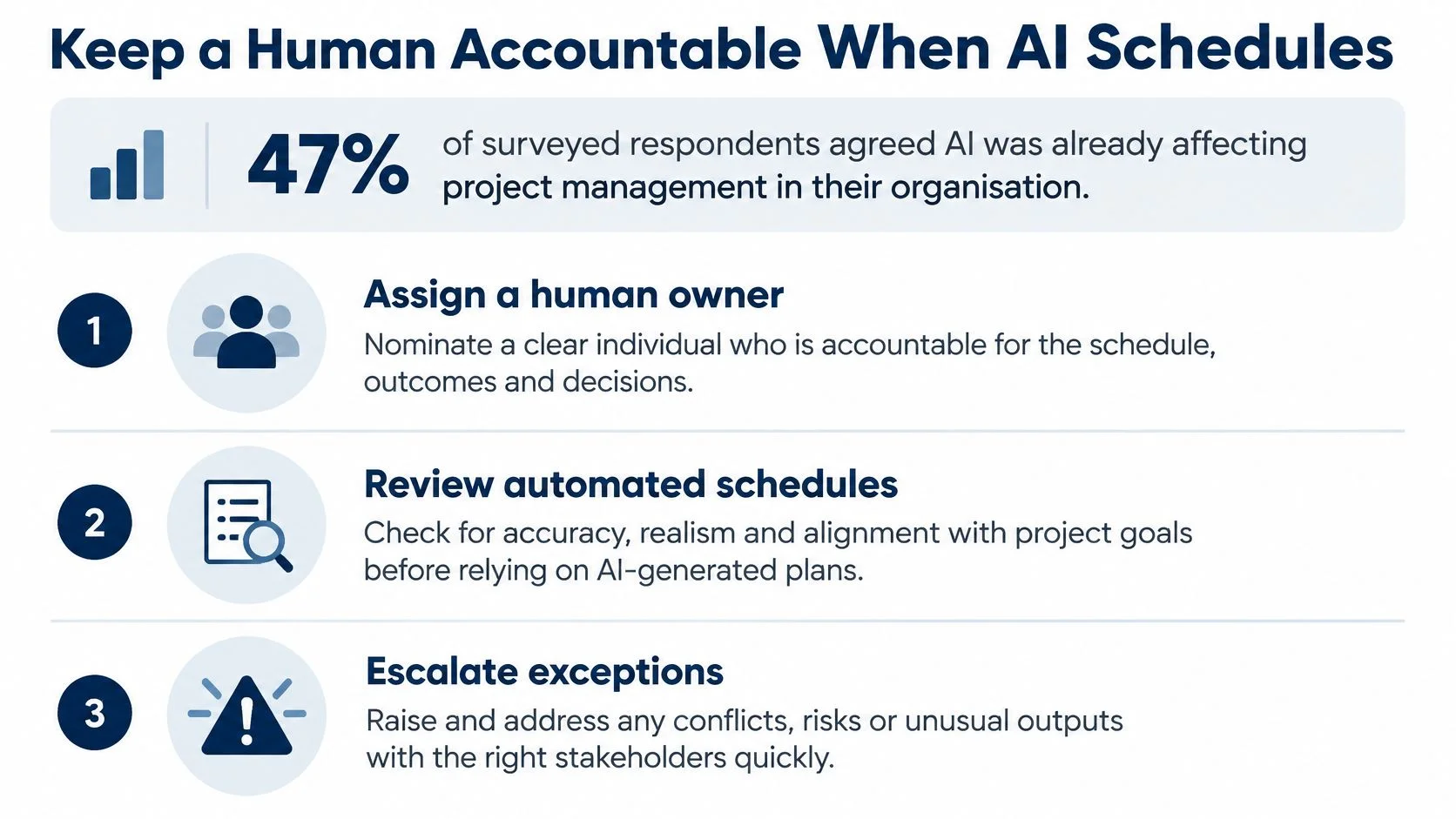
AI scheduling needs decision rights before it needs more freedom to move bookings. In the Association for Project Management's 2025 Salary and Market Trends Survey, 47% of surveyed respondents agreed AI was already affecting project management in their organisation, while 27% identified automation of routine tasks as its largest impact.
A suggested schedule can be fast and still be wrong. It may use stale freelancer availability, overlook a client restriction or repeatedly assign difficult work to the person whose historical record makes them appear most efficient.
Answer the producer's operational questions
Who may approve the move? Give the scheduling producer authority within agreed limits, with department approval where specialist continuity is affected. A recommendation shouldn't become a confirmed engagement or a client promise.
How will someone detect bad inputs? Show the source and last confirmation of availability, rates, skills and restrictions. Mark missing information as missing. Don't let an inferred skill or an old booking stand in for current confirmation.
Where is consent recorded? Keep relevant client and contributor permissions with the project records, including restrictions on material use or automated processing. Don't treat possession of a file as permission to send it into another system.
When must a person override the recommendation? Require review where a move conflicts with agreed working hours, accessibility needs, continuity, contractual commitments or technical suitability. The reviewer should record why they accepted or rejected the suggestion.
Make the decision explainable
Use a governance checklist beside the proposed plan:
- Explainability. State which constraints and priorities led to the chosen slot, including conflicts the system couldn't resolve.
- Approval rights. Distinguish suggestions, authorised changes and confirmed external commitments.
- Audit trail. Retain what changed, who approved it and which people were notified.
- Data provenance. Keep a traceable origin for the hours, availability and skills used in the recommendation.
Premierely's discussion of automating music premiere distribution offers a related context for thinking about repetitive release coordination. In studio scheduling, draw a firm boundary between executing an approved routine and making a new commitment on someone's behalf.
Train reviewers to challenge recommendations, not just operate the interface. Test awkward situations such as a late picture change, an unavailable specialist and a client who hasn't approved the revised date.
Judge success by fewer avoidable booking changes, a fairer distribution of workload and a producer who can explain the delivery plan. Automation without those habits adds opaque priorities, biased bookings and weaker accountability, even when the first draft arrives faster.
Apply the Principles on Your Next Project
Start with a live job, not a company-wide redesign. Choose a project whose producer and department leads can agree what good delivery looks like, then use its first planning week to establish a workable routine.
The aim isn't perfect information. It's a shared record of what's approved, what's uncertain and who has authority to act.
Make the first week concrete
- At the briefing meeting, lock the deliverables and acceptance criteria. Record exclusions and how additional requests will be authorised.
- During planning, place picture lock, sound, grade, online and delivery milestones against real dependencies. Confirm availability rather than filling gaps with assumptions.
- Before releasing bookings, name the creative and technical owners, agree escalation tolerances and label contingency separately.
- During delivery, collect hours and decisions where the work happens. Keep the current forecast distinct from the approved baseline.
- At the weekly review, use the KPI table to select actions, owners and follow-up dates. Keep a person able to override any automated suggestion.
Keep the booking connected to the business
A practical system should connect the resource commitment with the work and its commercial consequences. Otherwise the producer still has to reconcile a diary, timesheet, budget sheet and invoice manually whenever scope changes.
At freispace, we provide modern resource and project planning software for media companies, designed to reduce time spent planning. A booking holds the suite, operator and kit, collects the hours worked, draws down the project budget, and becomes a line on the quote and then the invoice. Gantt-style phases and milestones sit alongside live plan-versus-actual budgets, while automated carbon emissions are calculated for each project from the same schedule.
Test that chain against a real handover. Ask whether a changed booking leaves the operator informed, the expected cost visible and the next decision clear. Software can hold the record, but the producer still has to make the call.
Begin the next planning meeting with the KPI table rather than a blank calendar. Agree which evidence the team will review and what would cause you to intervene. That's how project management principles become everyday studio practice.
freispace connects studio bookings, project planning, tracked hours, budgets and invoicing, with project carbon calculations drawn from the same schedule. Visit freispace and assess it against your next series, commercial or mix, starting with the controls and KPIs your team needs to make reliable delivery decisions.