
The five project management phases are initiation, planning, execution, monitoring and closure. In post-production, they turn a client brief into an approved schedule, controlled bookings, accepted masters and a financially closed job.
The practical test is simple: each phase must earn the right to spend the next phase's money. A promising brief isn't permission to commit a grading suite, and an uploaded master isn't proof that the job is finished.
Why Post-Production Runs on Project Management Phases
The Association for Project Management's 2024 Golden Thread study estimated that project-related roles employed approximately 2.32 million full-time-equivalent workers in the UK and generated £186.8 billion in annual gross value added. Project management is a substantial economic capability, not administrative support.
In a studio, that capability becomes tangible when a client's release date meets a fully booked colourist's diary. Say a documentary arrives with an agreed transmission slot, unfinished archive clearances and a delivery specification still awaiting confirmation. Someone must decide what can proceed, what needs approval and which commitments would expose the studio to unnecessary cost.
Practical rule: A date in the client's email is a constraint to assess, not a schedule you've already agreed to deliver.
Where informal coordination breaks down
Without explicit decisions, coordinators end up managing assumptions. The editor expects another review round, the mixer expects picture lock, and finance discovers the extra work when preparing the invoice.
The consequences are familiar:
- Capacity conflicts: A suite is available, but its operator is committed elsewhere.
- Commercial leakage: Additional versions reach finishing without an approved charge.
- Technical surprises: Delivery notes arrive after the mix has been locked.
The project management phases give those decisions a home. They connect creative work, from offline edit to conform, grade and mix, with the authority to approve scope, commit resources and accept delivery.
The Five Project Management Phases at a Glance
Use this map to identify the question a job is currently answering. The phase isn't defined by how busy the team looks. It's defined by the decision they're preparing to make and the evidence needed to make it.
The five project management phases for post-production
| Phase | Core question | Key activities | Deliverables | Post-production example |
|---|---|---|---|---|
| Initiation | Why are we doing this and can we deliver it? | Define brief, scope, stakeholders and success criteria; check feasibility and rough budget | Project brief or charter, initial budget, stakeholder list | A documentary series brief is agreed before suite time is reserved |
| Planning | How, when and with what will we deliver? | Build schedule and budget, plan resources, assess risks, confirm delivery specs | Gantt schedule, budget baseline, risk register, booking plan | Edit, grade and mix bookings follow offline, online and delivery milestones |
| Execution | Are we producing the agreed deliverables? | Coordinate tasks and bookings, run review cycles, manage changes and client notes | Working cuts, graded and mixed masters, status updates | Editors address rough-cut notes while sound prepares dialogue edits |
| Monitoring | Are we on track against the baseline? | Track progress, cost and quality; manage risks; report and replan | Status reports, updated forecasts, change log | A grade delay triggers an early facilities rebooking |
| Closure | Did we deliver, get paid and learn? | Obtain acceptance, invoice, archive, release resources, capture lessons | Acceptance record, final invoice, archived assets, lessons learned | The client accepts masters and the team reviews the job before releasing remaining commitments |
Give each phase a named owner
A workable starting allocation is:
- Initiation: The producer or client lead owns the brief and commercial intent.
- Planning: The production manager owns the resource, schedule and budget baseline.
- Execution: The post supervisor or coordinator runs the agreed workflow.
- Monitoring: The project manager owns variance reporting and escalation.
- Closure: The account or finance lead coordinates acceptance, reconciliation and administrative completion.
In a smaller studio, someone may hold several roles. Write their name against each responsibility anyway. Owning the schedule doesn't automatically mean having authority to approve an unbudgeted booking.
Overlap is normal, ambiguity isn't
These phases form a cycle of control rather than a strict assembly line. Monitoring runs alongside execution, and a substantial client change can require renewed planning before work continues.
A broadcast commercial might compress initiation and planning into a short approval process. A returning documentary series needs checkpoints around commissioning, rough cuts, picture lock and delivery. Keep the paperwork proportionate, but retain the decisions.
Each owner should confirm readiness before the next commitment is released. That doesn't mean stopping all activity at every checkpoint. It means distinguishing approved work, conditional work and work that must wait.
Initiation and Planning Before You Book a Single Suite
Initiation defines the commitment
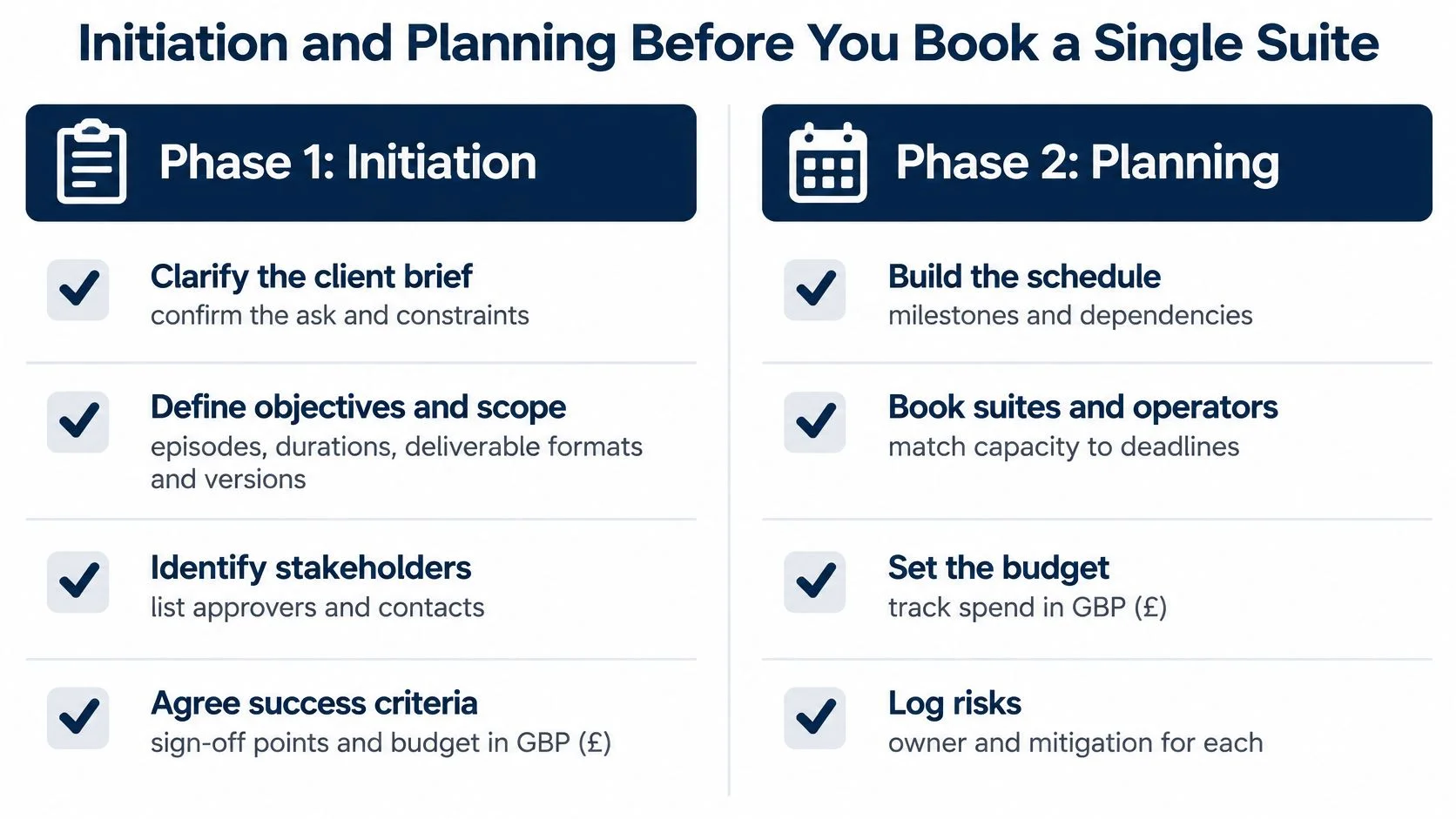
Start by translating the brief into something the studio can price and deliver. Record programme or episode requirements, durations, versions, languages, deliverable formats and exclusions. Identify who supplies assets, who consolidates notes and who has final approval.
Success criteria must include more than creative satisfaction. Confirm the required technical specifications, acceptance process, delivery destination and commercial assumptions. If the client hasn't supplied a specification, assign responsibility for obtaining it rather than leaving the field blank.
For a hypothetical documentary series, the signed charter should authorise planning before anyone reserves suite time. That signature confirms what the studio is investigating and preparing to commit, not an unlimited promise to accommodate future requests.
Planning makes the dependencies visible
Build a work breakdown structure covering offline, conform, online, grade, sound edit, mix, QC, mastering and delivery. Estimate work at the level where you can assign an owner and identify a prerequisite.
Don't draw a Gantt bar called finishing and assume the departments will coordinate underneath it. Show picture lock, asset receipt, review deadlines and technical checks as explicit dependencies. A production schedule example can help translate that sequence into a usable planning layout.
Check people and facilities together. An available grading room doesn't establish capacity if the colourist, licence or required monitoring configuration isn't available. Include asset preparation, turnovers, exports and QC time rather than scheduling only attended creative sessions.
The UK Government Functional Standard for Project Delivery requires approval gates to authorise subsequent stages and commit their resources, with continuing justification, affordability, deliverability and acceptable risk assessed. Apply that discipline to studio commitments rather than treating government guidance as a private-sector legal requirement.
Don't continue an unaffordable finishing plan simply because the offline has already cost money. Escalate, reduce scope or secure approval for a revised commitment.
Check the gate before kick-off
Require the following before releasing production bookings:
- Approved scope: Deliverables, exclusions, review allowances and acceptance criteria.
- Capacity confirmation: Named operators, suitable suites, kit and external facilities.
- Baseline schedule: Dependencies, milestones, approval deadlines and delivery allowance.
- Budget authority: Agreed costs, purchasing permissions and change approval.
- Owned risks: Likelihood, impact, response action and an accountable person.
- Communication route: A recognised approver and a method for consolidating client notes.
A risk register only helps if someone acts on it. For colourist availability, name the alternative and the point at which you'll activate it.
Execution and Monitoring During the Delivery Push
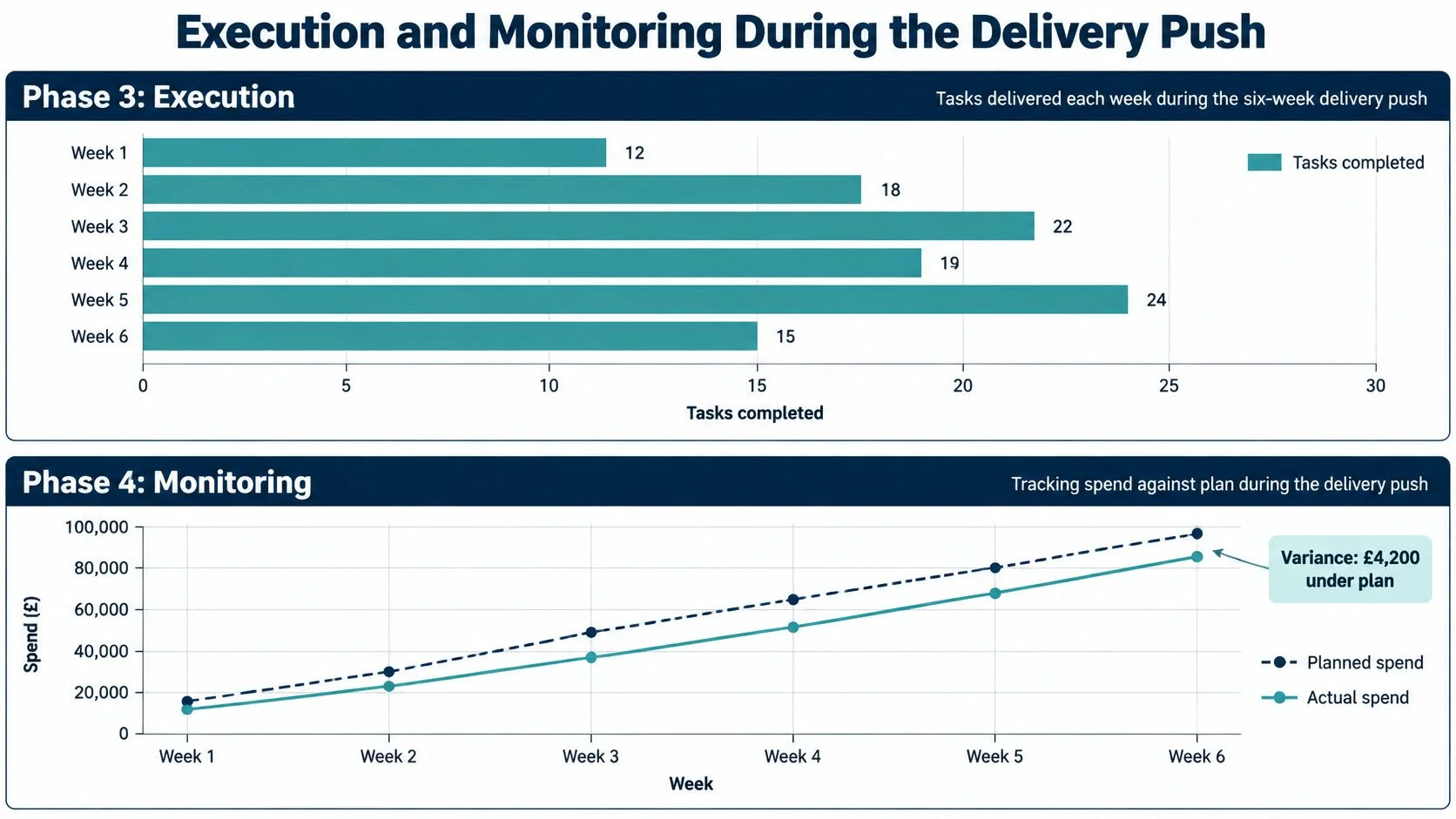
Execution turns the approved plan into cuts, conforms and finished masters. Assign tasks with deadlines and priorities, brief operators with the correct assets, and give each review a clear purpose: creative direction, picture lock, technical approval or final acceptance.
Keep client notes attached to an identifiable version. Ask the designated approver to consolidate conflicting comments before the operator starts. Otherwise, the studio pays for interpreting disagreement while the booking clock keeps running.
Treat the booking as the operational unit
A booking holds the suite, the operator and the kit, collects hours worked, draws down the project budget, and becomes a line on the quote and then on the invoice. Keep those records connected so a moved session doesn't leave its costs or billing assumptions behind.
Change control belongs inside this daily workflow. Before accepting an additional version or reopened sequence, establish its effect on labour, downstream work and delivery. Record who approved the change, then update the forecast without erasing the original baseline.
Monitor outcomes, not just activity
The government benefits management workbook treats benefits as lifecycle controls, with defined measures, ownership and tracking beyond implementation. For a studio, the useful application is to assign an owner, baseline, target and review date to each operational measure.
Monitoring measures for post-production projects
| Measure | What it shows |
|---|---|
| Schedule adherence | Actual milestone dates against the baseline schedule |
| Resource utilisation | Booked and worked hours for suites, operators and kit against availability |
| Overtime hours | Hours beyond the baseline allowance that signal a schedule or capacity problem |
| Rework | Work redone after review against the baseline rework rate |
| Invoice-cycle time | Time from delivery to invoice against the agreed invoicing target |
| Margin variance | Forecast and actual margin against the budget baseline at each gate |
| Carbon per deliverable | Emissions per delivered master against the project carbon baseline, alongside cost and schedule variance |
Suppose a series grade moves later while the mix date remains fixed. Monitoring should prompt a check of turnover dependencies and alternative finishing capacity before the mixer receives an unusable slot. Rebooking early may carry a cost, but compare that cost with overtime, cancellation exposure and disrupted delivery.
Watch leading indicators, particularly booked versus available suite hours, overdue approvals and missing assets. Spent budget tells you what has happened; a capacity conflict tells you what needs a decision.
A low spend figure isn't automatically good news. It may mean the team hasn't started work that the schedule assumes is complete.
Closure From Final Sign-Off to Lessons Learned
Closure starts with acceptance, not with a successful upload notification. Check the delivered package against the agreed formats, loudness requirements, captions, language versions and naming conventions. Save written client acceptance against the actual master versions, with any outstanding exceptions explicitly assigned.
Close the money and release the operation
Finance should reconcile recorded time, supplier charges and approved changes before raising the final invoice. Close or resolve purchase orders and identify disputed amounts while the production team can still explain them. Track payment separately if it remains outstanding after operational completion.
Release remaining suites, freelancers and equipment commitments so other projects can use that capacity. Archive masters, project files, supporting media and documentation with a searchable index and an agreed retention arrangement. Archiving isn't optional housekeeping when a client may need a recut, reuse or compliance copy.
Handover check: Another coordinator should be able to locate the accepted master and understand its status without asking the original operator.
Turn the result into a better estimate
Run the lessons review while the decisions are still fresh. Ask which estimate was wrong, which approval stalled, what rework cost and which workaround should become standard practice.
Capture supplier activity and carbon information while it's still traceable. Hand over client-owned assets and credentials through an approved secure route, not inside an unprotected archive note.
The closure pack should contain:
- Acceptance record: Approved deliverables and any agreed exceptions.
- Financial record: Final invoice, reconciled costs and unresolved payment actions.
- Archived project: Indexed assets, project files and retention ownership.
- Lessons document: Specific estimating or workflow changes for the next bid.
Assign actions to people. A retrospective that records problems without changing a template, estimate or approval process won't improve the next job.
Where AI Fits Into Each Phase
According to the UK government's 2026 AI adoption report, 32% of UK businesses reported using at least one AI technology in 2026, compared with 16% in 2025. That's a reason to define governance, not permission to let a scheduling assistant commit studio capacity.
AI can organise information and propose options. It can't take responsibility for promising a client that a particular editor can absorb a difficult revision within the remaining booking.
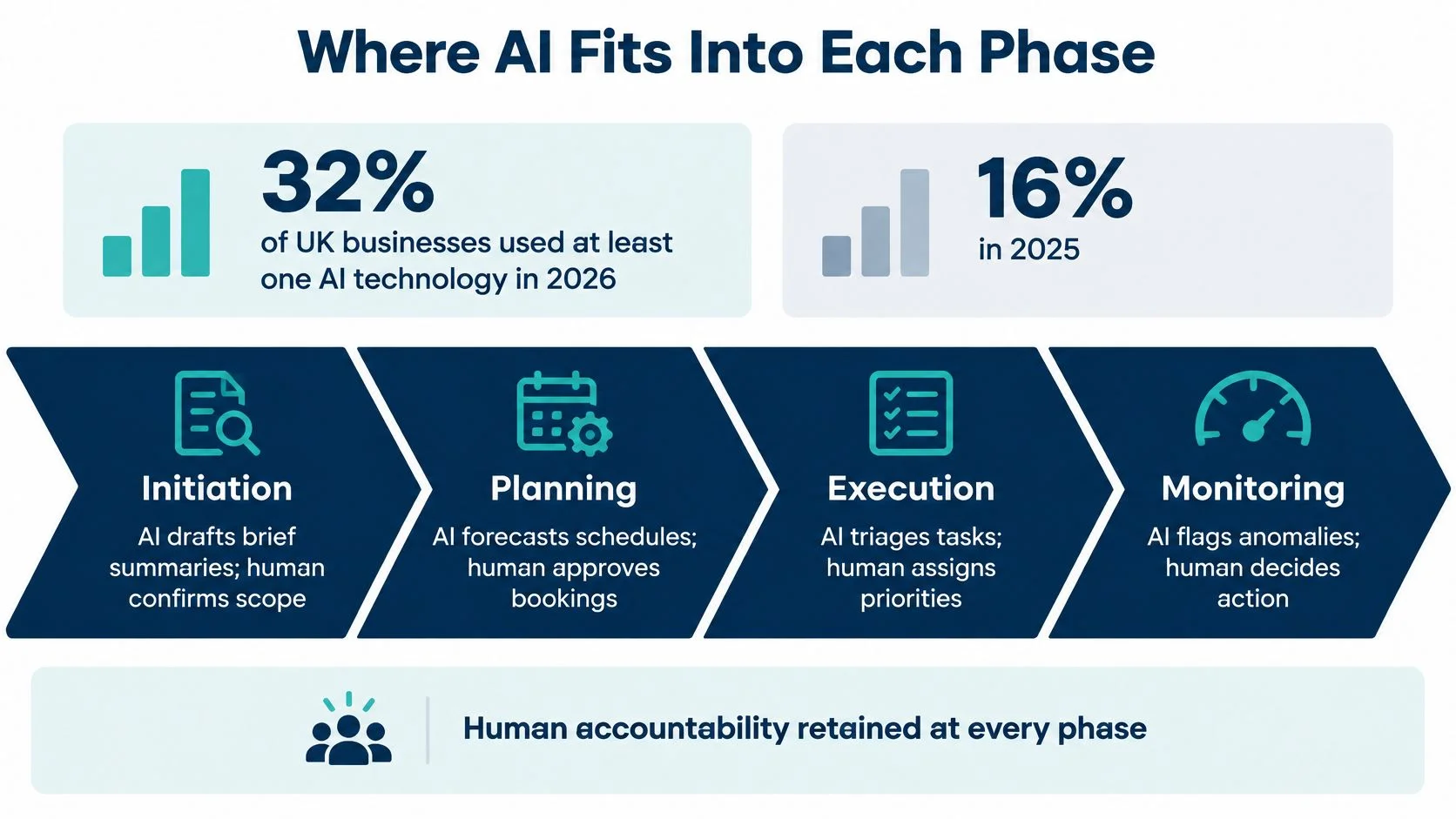
Where AI fits in each project phase
| Phase | AI may | Human decides |
|---|---|---|
| Initiation | Draft scope summaries and analyse briefs | Project manager signs off the brief |
| Planning | Propose schedules and resource scenarios | Planner stress-tests them against suite availability and creative judgement |
| Execution | Automate updates, reminders and exception alerts | Named project manager acts on each exception |
| Monitoring | Forecast slips and flag utilisation anomalies | Team checks data quality before acting on a forecast |
| Closure | Assemble an auditable handover record | Client sign-off and the lessons review stay with people |
Validate the proposal before approving it
An apparently efficient schedule may omit client attendance, turnover preparation or a specialist's restrictions. Test proposed plans against actual booking rules, including which tasks can overlap and which require approved assets.
Forecasts also inherit weaknesses from their inputs. Missing time entries can make work appear cheaper than it is; stale task statuses can make a delayed conform look ready for grade. Check those inputs before moving people or escalating a predicted overrun.
Use AI integration in post-production to establish where assistance enters the workflow and which approvals remain mandatory. Keep confidential briefs and client assets within the studio's approved information-handling arrangements.
AI proposes, people decide. Retain the proposal, material assumptions and approval record when a recommendation changes a commitment. Ethical judgement, data literacy and stakeholder handling matter more than producing an impressive-looking schedule that nobody has validated.
Bringing Carbon Into Every Phase Decision
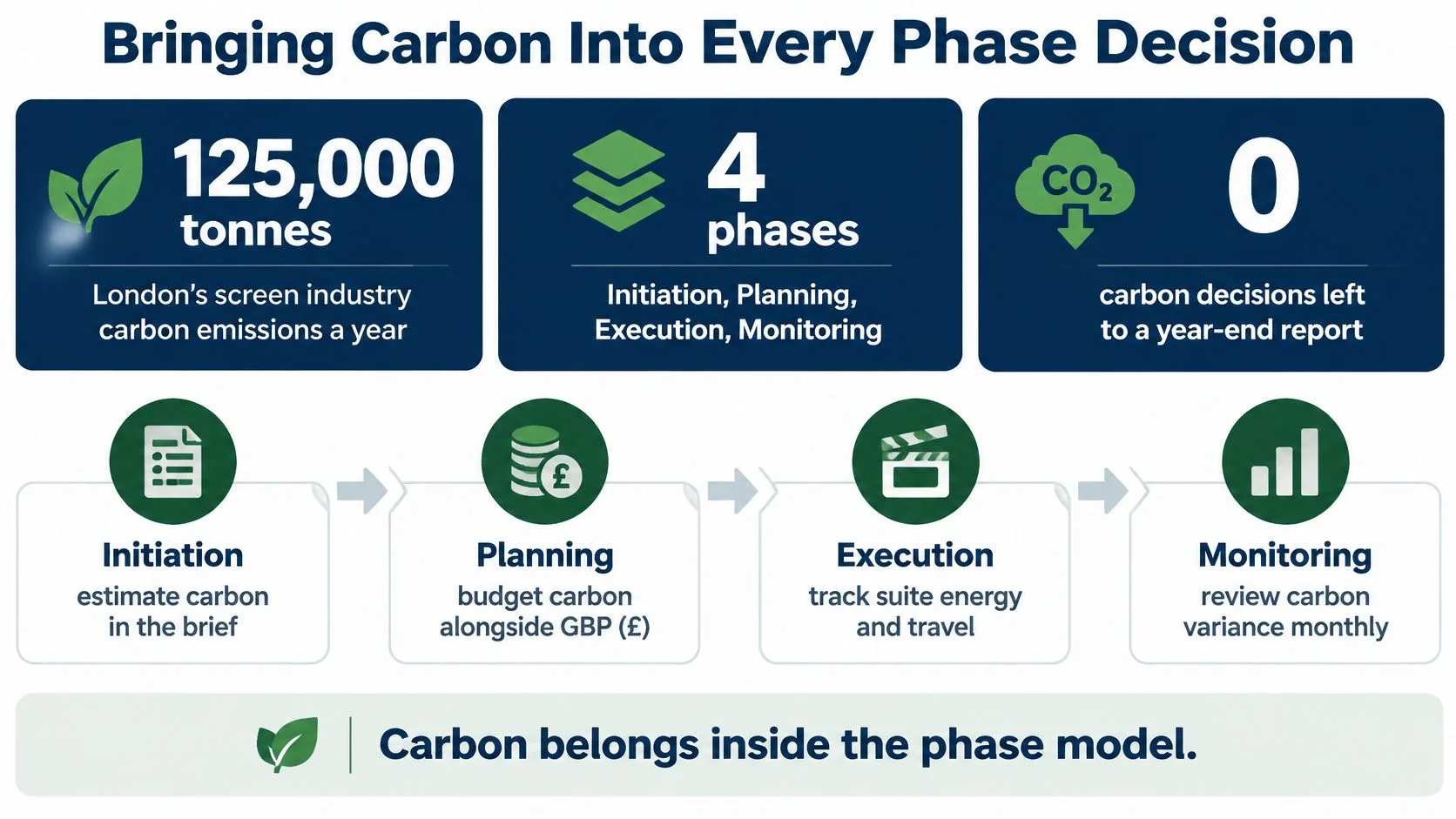
London's Green Screen report estimates approximately 125,000 tonnes of annual carbon emissions from London's screen industry, including about 14,000 tonnes from post-production, with data centres representing almost half of post-production's footprint. Those are London figures, but the operational question applies to any studio using rendering, storage and transfer services.
Carbon belongs in delivery decisions because coordinators and supervisors influence those activities through workflow choices. Waiting until financial year-end makes it harder to connect emissions with the booking, render or supplier decision that caused them.
Give carbon a boundary and an owner
At initiation, define what the project will count: suite energy, rendering, storage, transfers, travel and relevant supplier activity. Record exclusions and estimation methods so apparently comparable projects don't use incompatible boundaries.
During planning, compare workflow options rather than assuming remote or cloud-based work is automatically preferable. Remote review may avoid travel, but the comparison should also include additional transfers and storage. Assess render scheduling against energy information, turnaround requirements and the risk of rerendering unapproved work.
Keep activity traceable through delivery
During execution, retain records of energy-intensive renders, storage growth and repeated transfers. Agree how shared infrastructure will be allocated to projects, and distinguish measured consumption from estimates.
Monitoring should compare carbon variance with the approved boundary and baseline. If activity rises, investigate the cause before prescribing a fix: duplicate exports require a different response from an unavoidable increase in approved deliverables.
At closure, capture supplier information and record which workflow choices should change. A practical carbon emissions tracking approach needs operational records, not just a final total.
Digital post-production isn't automatically low-carbon. Treat carbon like cost: assign ownership, document assumptions, include material exposure in the risk register and review it at approval gates. Don't trade away technical quality or delivery reliability without an explicit decision.
Putting the Five Phases to Work in Your Studio
Initiation, planning, execution, monitoring and closure should become a shared working vocabulary, not a new reporting burden. Start with a project whose deadline and approver are clear enough to test whether the controls help.
Set up a contained pilot
- Write the brief first: Use the initiation checklist and obtain approval before reserving suites.
- Name the owners: Tell coordinators and department leads who can approve each transition and who handles exceptions.
- Choose a small monitoring set: Start with schedule adherence, resource utilisation and margin variance, adding another measure only when someone will act on it.
- Schedule the retrospective now: Put the lessons review in the calendar before delivery pressure consumes the available time.
Keep gate reviews focused on decisions. Ask whether the next commitment remains affordable and achievable, which assumptions have changed and what needs approval. Don't turn the meeting into a read-through of every task.
Let the system support the habit
The planning environment should reflect how the job is controlled. At freispace, our Gantt-style project planning includes phases and milestones, while budgets show live plan-versus-actual on every project rather than relying on a month-end spreadsheet.
Tools won't resolve unclear authority. A coordinator still needs permission to challenge an unsupported deadline, and a producer still needs to approve the commercial consequences of a reopened cut.
Pilot the phases on a project this quarter rather than attempting an immediate studio-wide rollout. Review where the team hesitated, where approvals arrived too late and which records supported decisions. Expand once the process helps people make commitments confidently, not because the templates have been completed.
freispace connects resource scheduling, phase-based project planning, time tracking, budgets and invoicing, with carbon emissions tracking alongside the operational workflow. Visit freispace to explore how your studio could manage its next project from approved brief to final financial close.