Let’s be honest, every studio owner knows the feeling. It’s that late-night scramble, digging through an endless email chain for the latest client feedback. It’s the sinking realisation that a project's budget has quietly vanished, eaten away by untracked hours and sneaky scope creep.
It’s the silent burnout of a talented team stretched thin across overlapping deadlines and clunky workflows. This is the daily reality of creative chaos.
This disorganisation isn't just frustrating; it comes with a steep, often hidden, price tag. The real cost isn’t just measured in lost revenue. It’s in the creative energy wasted on admin instead of the actual craft. It’s in the missed opportunities because your best people were accidentally double-booked. It’s in the strained client relationships that come from totally preventable delays.
When you’re stuck in this cycle, the studio is constantly reacting, putting out fires instead of building something solid for the future.
Shifting from Reactive to Proactive
Bringing in a more structured approach isn’t about layering on corporate bureaucracy. Far from it. It’s about creating a single source of truth that actually empowers your team.
The whole dynamic shifts when everyone knows exactly what they need to do, when it’s due, and how their piece fits into the bigger picture. This kind of clarity is what good project management delivers.
The pay-off for a media studio really stacks up in three key areas:
- Operational Gains: Clear sightlines on who’s doing what, smoother communication, and workflows you can actually repeat.
- Financial Control: Spot-on quotes, real-time budget tracking, and better cash flow because invoicing happens on time.
- Creative Liberation: Less admin bogging down your artists, freeing them up to focus on quality and innovation.
The Power of a Centralised System
Think of it like the difference between a film crew using walkie-talkies versus just shouting across a noisy set. A dedicated system cuts through the noise and turns it into clear, actionable information.
The impact isn’t just theoretical. The numbers back it up. Recent stats show that proper project management software saves employees an average of 498 hours per year. That’s time you can pour straight back into creative and strategic work. What’s more, a massive 77% of high-performing projects use these tools, showing a clear link between having the right system and getting great results. You can discover more insights about project management statistics and their impact on efficiency.
A good framework doesn't stifle creativity; it protects it. By taking care of the logistical headaches, it creates the space—both mentally and operationally—for your team to consistently produce their best, most imaginative work.
Achieving Operational Clarity and Control
For any post-production studio, the line between chaos and control is razor-thin. What makes the difference? Visibility. Gaining real operational clarity means you can stop guessing and start seeing your entire operation in real-time. It’s knowing exactly who is working on what, when their deadlines are, and how much capacity they have left.
This level of control is one of the first, most tangible benefits you’ll see from proper project management. Think of it like a film director having a single, unified monitor showing every camera angle at once, instead of having to sprint between sets just to keep up. That’s the kind of strategic oversight project management brings to a studio, replacing frantic searching with focused direction.
This clarity becomes the bedrock for improvements across the board—operationally, financially, and creatively.
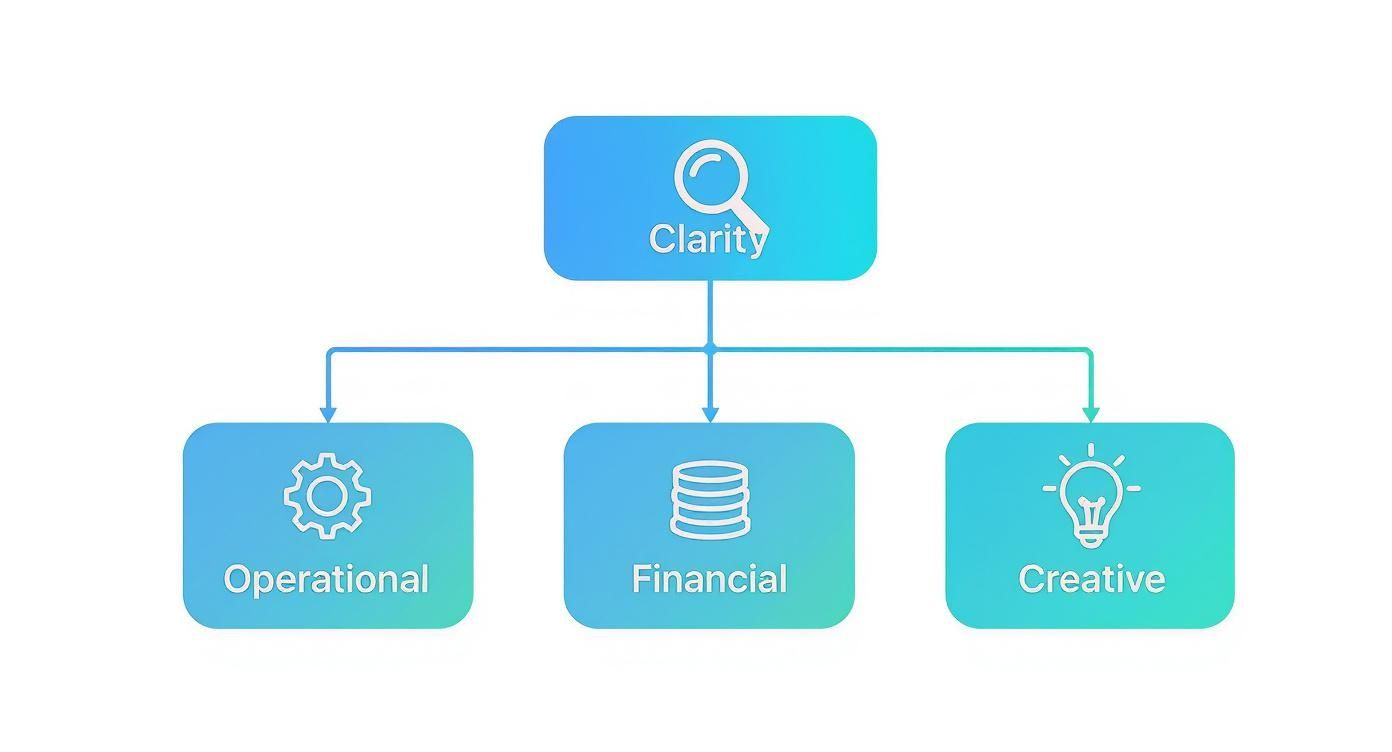
As the diagram shows, clarity isn’t just a nice-to-have; it’s the root from which all other benefits grow, feeding directly into every part of your studio's performance.
Ending the Resource Scramble
One of the most common headaches in a busy studio is the daily resource scramble. Without a central system, it’s frighteningly easy to overbook your star colourist or assign a crucial piece of kit to two different projects at the same time. This creates bottlenecks, forces last-minute compromises, and ultimately, puts the quality of your work at risk.
Resource planning tools put a stop to this. They give you a clear, visual map of your team's availability and workload, making sure you can assign the right talent to the right task without causing clashes. This is about more than just avoiding double-bookings; it’s about strategically deploying your most valuable assets. You can master this with our in-depth guide on software for resource scheduling.
This proactive approach also prevents burnout by keeping workloads balanced. It means that when a high-priority project lands on your desk, you know instantly who has the bandwidth to take it on, turning a potential crisis into a smooth, controlled process.
The table below highlights the night-and-day difference project management makes to common operational challenges.
Operational Gains Before and After Project Management
| Operational Challenge | Without Project Management | With Project Management |
|---|---|---|
| Resource Allocation | Constant conflicts, overbooked staff, and equipment clashes. Last-minute scrambles are the norm. | Clear visibility of team capacity. The right talent is assigned to the right project, preventing burnout and bottlenecks. |
| Project Communication | Information is scattered across emails, chats, and texts. Costly mistakes are made due to miscommunication. | A centralised hub for all project files, feedback, and approvals. Everyone works from the same information. |
| Project Timelines | Timelines are based on guesswork. Delays are common, and clients are kept in the dark. | Data-driven timelines are created based on past performance. Deadlines are realistic and consistently met. |
| Future Bidding | Quotes are based on gut feelings, leading to under-quoted projects and lost profitability. | Bids are built on accurate time-tracking data, ensuring every project is profitable from the start. |
As you can see, the shift isn't just about being more organised—it's about building a more resilient, predictable, and ultimately more successful studio.
Creating a Single Source of Truth
How much time does your team waste digging for that one piece of client feedback buried in an old email thread, a Slack message, or a text? Fragmented communication is a huge drain on efficiency and a major source of errors. A core benefit of a project management system is that it creates a single, undisputed source of truth for every project.
By centralising all project-related communication, files, and approvals, you create an environment where everyone—from the producer to the junior editor—is working from the same script. This kills ambiguity and dramatically reduces the risk of costly rework based on outdated information.
This clarity extends beyond just your projects. The value of structured management is being recognised everywhere. For example, there were approximately 102,100 construction project managers in the UK in the first quarter of 2025, a testament to how vital this role has become in complex industries.
Turning Data into a Strategic Advantage
Guesswork has no place in a sustainable business. To plan for the future, you need hard data about your past performance. Precise time tracking, a core feature of modern project management, gives you exactly that. It captures the actual hours spent on every single task, from the first offline edit to final delivery.
This data is gold for several reasons:
- Accurate Future Bids: You can build quotes based on real historical data, not just a hunch, ensuring profitability right from the start.
- Realistic Timelines: Understanding how long tasks really take allows for smarter pipeline planning and more credible client deadlines.
- Performance Insights: You can spot which stages of your workflow are eating up the most time and find opportunities to improve.
To truly master operational clarity, studios can lean on more advanced solutions. The best software doesn't just track data; it helps you make smarter decisions. For those looking to see what's possible, there's a lot of exciting development in the world of AI-powered project management tools. By turning time tracking from a chore into a source of business intelligence, you move from reactive problem-solving to proactive strategic planning.
Turning Leaky Budgets into Predictable Profits
Operational efficiency isn't just a bit of corporate jargon; it's the direct line connecting your studio's day-to-day hustle with its financial health. For media studios, solid project management is the best defence against those small, often invisible, financial leaks that can quietly sink a project's profitability. It’s about systematically turning unpredictable costs into a forecastable and profitable pipeline.
This whole process kicks off right at the beginning, with the quote. Too often, bids are based on a gut feeling or a half-remembered project that isn't quite the same. This can lead to underbidding that eats away at your margins before the first file is even opened. This is where the financial upside of project management really starts to show.

From Guesswork to Watertight Quotes
Accurate time tracking and resource planning give you the hard data you need to build genuinely watertight quotes. When you know exactly how many hours a senior colourist spent on the last three similar jobs, you can quote with confidence. This data-driven approach doesn't just protect your bottom line; it builds trust with clients by setting realistic expectations from day one.
In a system like freispace, every single tracked hour becomes a valuable data point. This historical insight lets you create templates for common project types, making sure every quote accurately reflects the true cost of your team's incredible time and skills.
But getting the quote right is just the first step. The real magic happens when you maintain that financial control throughout the entire project — and for that, real-time tracking is non-negotiable.
Gaining Real-Time Budget Visibility
The most dangerous budget problems are the ones that sneak up on you. A 20% overspend you only discover at the end of a project is a loss you simply have to swallow. But a 20% overspend spotted halfway through? That’s a problem you can actually solve.
This is the absolute core value of real-time budget tracking. It gives producers and managers a live dashboard showing project spend against the approved budget. As your team logs their time, those costs are immediately reflected, giving you an up-to-the-minute picture of your financial health.
This kind of proactive visibility is a complete game-changer. Instead of reacting to a nasty surprise when you're drawing up the final invoice, you can make intelligent, data-informed decisions mid-project. Maybe that means reallocating resources, shifting priorities, or having an early, honest chat with the client about scope creep.
By connecting what's happening on the ground directly to the financial outcomes, you turn your budget from a static document into a dynamic, living management tool. This level of control is fundamental to effective project financial management and a massive driver of studio profitability.
Streamlining Your Cash Flow
Finally, let's talk about getting paid. Getting paid quickly and accurately is absolutely critical for a studio's cash flow. When your systems are all over the place, it's easy for final hours to be missed, expenses to be forgotten, and invoices to be sent out late. This creates an unnecessary lag between finishing the work and the money hitting your account.
Integrated project management systems fix this by plugging time tracking directly into invoicing. With a tool like freispace, you can generate a detailed, accurate invoice in just a few clicks. Every single billable hour and expense logged against the project is pulled in automatically, which eliminates tedious manual data entry and massively reduces the risk of human error.
This seamless workflow ensures that nothing gets overlooked. It speeds up your entire billing cycle, which has a direct and hugely positive impact on your cash flow. By making sure you get paid for 100% of the work you do, and faster, you build a more resilient and financially stable studio.
Unlocking Creativity Through Structure
There’s a stubborn myth in the creative world that structure is the enemy of innovation. The thinking goes that rigid processes kill the spontaneity needed for truly groundbreaking work. But for any busy post-production studio, the reality is the exact opposite. The right kind of structure doesn’t cage creativity; it liberates it by clearing away the noise.
One of the biggest wins from good project management is how it cuts down the 'mental clutter' that plagues creative teams. This clutter is all the admin that has nothing to do with the actual craft: chasing approvals, sending follow-up emails, piecing together status reports, or figuring out which version of a file is the actual final one. These little tasks add up, chipping away at the deep focus needed for brilliant, innovative thinking.

Automating the Administrative Burden
Modern project management platforms, especially those built for creative workflows, are designed to take this admin burden off your team's shoulders. Just imagine a system where:
- Approval workflows are automated: An editor finishes a cut, and the system instantly sends it to the producer and then the client for review, neatly tracking all the feedback in one place.
- Reminders are sent automatically: No one needs a manager to check in on deadlines because team members get timely notifications about what’s due.
- Status reports are generated instantly: A real-time dashboard shows exactly where every project stands, making tedious manual updates a thing of the past.
By automating these routine tasks, you give your artists, editors, and producers their most precious resources back: time and mental energy. They can stay in their creative flow for longer, focusing on a tricky colour grade or a complex sound design rather than getting bogged down in project admin.
Fostering Psychological Safety for Creative Risks
Creativity absolutely thrives on psychological safety—that feeling of being secure enough to experiment and take risks without a fear of failure. A chaotic workflow does the opposite. When deadlines are vague, deliverables are unclear, and priorities are always shifting, it breeds anxiety and stress, which are poison to the creative process.
Clear project management provides a stable foundation. When everyone knows the project goals, their specific roles, and the exact timelines, the anxiety that comes with uncertainty just melts away. This clarity builds a powerful sense of security and trust within the team.
When the 'how' and 'when' are clearly defined, creatives are free to pour all their energy into the 'what'—the actual creative execution. They can experiment with a bold new visual style or a complex sound mix because the project's guardrails are secure, making creative risks feel possible, not reckless.
The Rise of Intelligent Automation
This process of offloading administrative work is becoming even more powerful. AI and automation are changing the project management game for the better. Recent survey data shows that seven in 10 UK project managers have already brought AI into their workflows, with a similar number reporting better project outcomes as a result. More than 70% believe AI is very or extremely likely to alter their roles by automating tasks like scheduling and resource allocation, freeing them up to focus on strategy. As you can discover more insights about these project management statistics, it's clear that intelligent automation is a massive driver for creative efficiency.
Ultimately, these benefits all circle back to one thing: protecting your team’s most vital asset, their creative energy. By providing structure, automating the administrative noise, and creating a stable environment, you shield your team from the burnout that comes from constant chaos. This ensures they have the focus and stamina to deliver exceptional work, project after project. For those looking to put these ideas into practice, our guide on how to manage creative projects offers a deeper dive into practical strategies.
Look, the ultimate goal of getting your project management sorted isn't just about hitting deadlines or staying on budget. It's about building a studio that's still standing, and thriving, years from now. In today's market, that means thinking about sustainability in a much bigger way—not just for the planet, but for your people and your business model, too.
A resilient studio is one that’s solid from every angle, ready for whatever the industry throws at it next.
This wider view of sustainability is fast becoming a serious competitive edge. More and more clients, especially the big corporate ones, have their own strict Environmental, Social, and Governance (ESG) targets. They don't just want a slick final edit; they want to know they're partnering with a business that’s on the same page, value-wise.
Environmental Sustainability as a Client Winner
Good project management software gives you the tools to actually measure and manage your studio's environmental footprint. With features like carbon tracking, you can finally see the emissions tied to specific jobs, from render farm marathons to crew travel.
This isn’t just about feeling good; it’s a seriously smart business move. Having this data in your back pocket means you can:
- Win over ESG-focused clients: You can show up to a pitch with tangible proof of your green credentials, which is a massive differentiator in a crowded field.
- Spot hidden inefficiencies: A high carbon footprint often points directly to a clunky workflow or power-hungry old gear, flagging up clear opportunities to save cash.
- Build a stronger brand: Showing you’re serious about your environmental impact does wonders for your studio’s reputation.
For example, a platform like freispace can track the carbon output of your tech, turning a vague "green" goal into a hard number you can put right into your proposals.
Protecting Your Most Valuable Asset: Your Team
Beyond the planet, there’s the crucial issue of keeping your team sustainable. Our industry is notorious for burnout, a problem that quietly drains your finances and kills your culture. High staff turnover is one of the biggest hidden costs any studio faces, from recruitment fees and training time to the loss of all that built-up knowledge.
Your best defence against this is solid, intelligent resource management. It’s that simple.
When you can make sure workloads are balanced and deadlines are realistic, you create a saner, healthier work environment. This isn’t just a nice-to-have morale booster; it's a core strategy for keeping your best people.
A studio that systematically prevents overbooking and protects its team from chronic stress is a studio that holds onto its top talent. That stability is what leads to consistently higher-quality work, stronger client relationships, and massive long-term savings.
Creating a Resilient Business Model
When you pull it all together, you get to the heart of it: business sustainability. The operational clarity, financial control, and creative breathing room you gain from proper project management aren't separate wins. They’re the pillars of a business that's built to last.
When your quotes are accurate, your budgets are predictable, and your team is firing on all cylinders, your studio becomes incredibly tough. You can ride out economic slumps, adapt to new tech, and jump on growth opportunities with real confidence.
A well-managed studio isn't just lurching from one project to the next. It's strategically building a profitable and enduring future.
From Chaos to Control: A Studio Transformation
To really get what these benefits look like in the wild, let's follow the journey of a fictional post-production house, ‘Pixel Perfect’. Before they got their act together, their world was a familiar blend of creative brilliance and operational chaos. Projects were juggled across a messy patchwork of spreadsheets, never-ending email chains, and a constant barrage of team chats. It was a state of perpetual fire-fighting.
The ‘before’ picture at Pixel Perfect was stressful, to put it mildly. Resource planning felt like a daily, impossible puzzle. Their lead VFX artist was often double-booked, while junior editors were left twiddling their thumbs. Budgets were a constant source of dread; one major project ran 15% over, a painful truth they only uncovered at the final invoicing stage. They had no choice but to eat the cost. The creative team was on the verge of burnout, spending nearly as much time digging for feedback as they did on the craft they loved.
The Shift to a Central Hub
The turning point wasn’t about adding more rules or bureaucracy. It came when Pixel Perfect brought in a modern project management system, creating a single source of truth that brought clarity to their entire operation. The change was immediate, and it touched on every single benefit we’ve discussed.
The ‘after’ picture shows a studio reborn.
Operational Clarity: The frantic resource juggling vanished. With a shared visual planner, the production manager could see everyone’s capacity at a glance. Tasks were assigned based on real availability, nipping burnout in the bud before it could even start.
Financial Control: Surprise budget overruns became a thing of the past. Real-time budget tracking meant they could monitor spending as it happened. When a client requested a few extra revisions, they could instantly see the financial knock-on effect and have a confident, data-backed conversation about scope.
Creative Freedom: With automated approval workflows and one central place for feedback, the creative team was unshackled from the administrative grind. They could pour all their energy into producing stunning visuals, not chasing down stakeholders for a simple sign-off.
This journey from chaos to control isn’t just a nice story; it’s a blueprint. It shows how the interconnected benefits of project management—operational, financial, and creative—all click together to build a more resilient, profitable, and sustainable studio.
Pixel Perfect’s story proves that adopting a proper system isn’t just about putting out fires. It’s a strategic move that unlocks a studio's full potential, transforming a stressed-out team into a thriving creative powerhouse. And this isn't some far-off dream; it's an achievable reality. The clear visibility, predictable profitability, and protected creative energy are the tangible results waiting for any studio ready to make the change.
A Few Common Questions
Even when you can see the benefits laid out, bringing a new system into the studio feels like a big step. It’s natural to have questions. Here are some straight answers to the things we hear most often from studio managers thinking about a more organised workflow.
Is Project Management Software Too Rigid for a Creative Studio?
This is a big one, and a fair question. But modern platforms aren't about forcing a rigid, corporate process onto your team. Not at all.
The real goal is to provide a stable framework that gets rid of the administrative chaos. It frees up your artists to focus on what they do best: their craft. Think of it as building a solid stage for a performance. The structure gives your talent the freedom and safety to put on an incredible show—it supports the creativity, it doesn't suffocate it.
We're a Small Studio. Isn't This Overkill?
Definitely not. The best systems are built to scale with you, and they’re intuitive from day one. For a small team, the biggest win is building good habits early.
When you implement simple time tracking and clear task management from the start, you stop the bad habits that lead to budget leaks and missed deadlines later on. It helps you build a professional foundation that lets you punch well above your weight as you start landing bigger, more complex projects.
Adopting a system is about future-proofing your operations. It ensures that as your studio grows in size and ambition, your workflows can handle the increased complexity without falling apart, setting you up for long-term, sustainable success.
Can We Really Afford a New System Right Now?
Let's flip that around: can you afford not to? Think about the hidden costs piling up in your current workflow.
How much revenue is leaking out through untracked hours? How many projects have been underbid? What's the real cost of rework caused by simple miscommunication? An effective project management tool pays for itself by plugging these exact financial holes. The numbers don't lie—studies consistently show that studios using these tools have better on-time delivery and see a much higher return on their projects.
For anyone looking to go deeper into the discipline, you can find comprehensive resources on project management that explore these principles in more detail. The initial investment is quickly covered by the gains in efficiency and profit. A good system isn't an expense; it's a direct investment in your studio's financial health and creative future.
Ready to transform your studio's workflow from chaotic to controlled? Discover how freispace can deliver these project management benefits with AI-native tools designed for modern post-production. Start your journey to clarity and profitability today.