Let's be honest—managing the money on a creative project is a constant balancing act. Producers are often stuck between delivering incredible artistic work and sticking to some pretty rigid financial lines. This is where a proper project finance management system becomes the unsung hero of any successful production. It's not just about crunching numbers; it's about building a stable foundation that directly impacts your profitability, client trust, and even your team's sanity.
Why Your Post-Production Budget Needs More Than a Spreadsheet
A structured approach to your finances turns a jumble of data from a source of anxiety into a genuine tool for making smart decisions. When you finally ditch those clunky, error-prone spreadsheets, you get real-time visibility into how your project is actually doing. This means you can spot and tackle challenges head-on instead of just reacting to problems after they’ve already happened.
For producers ready to evolve past basic spreadsheets, getting a handle on proper accounting software is the first big step. Learning how to get started by setting up QuickBooks right the first time can lay a solid groundwork for all your financial workflows.
This very shift—from manual data entry in a spreadsheet to an integrated, visual dashboard—is the heart of modern project finance management. It’s about moving from chaos to clarity.
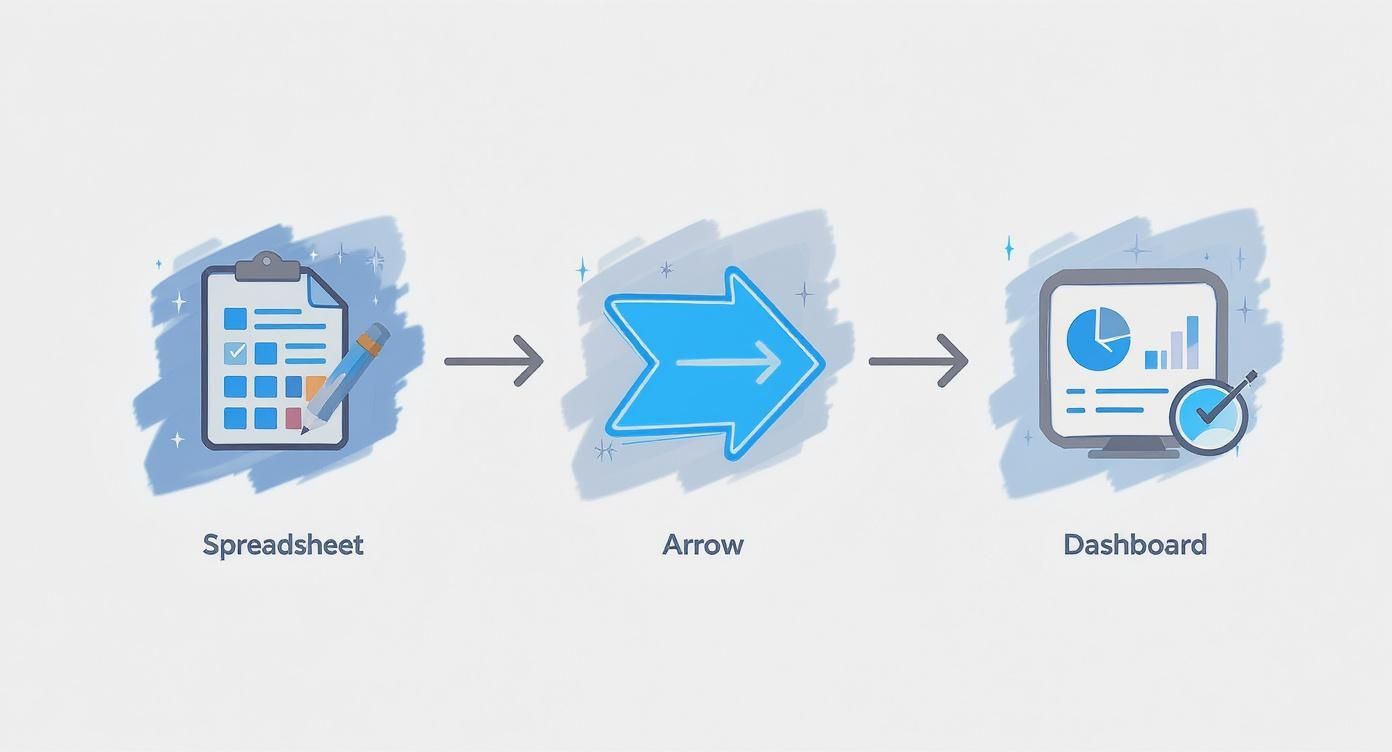
This process visualises how raw financial data, once trapped in separate spreadsheets, can be pulled into a central dashboard to give you a complete, holistic view of your project's health.
Why a Solid Financial Framework Matters
Look, a strong financial framework is about so much more than just avoiding red ink on the final report. It's the system that gives producers the confidence to manage stakeholder expectations and stop scope creep before it completely derails a project. Without it, you're flying blind.
Here’s why it’s so critical:
- It Builds Client Trust: When you can offer transparent, accurate financial reporting, you're showing clients their investment is being managed responsibly. That's huge.
- It Improves Team Morale: Clear budgets and properly allocated resources mean your team can focus on their creative work without the background hum of financial stress.
- It Increases Profitability: With real-time tracking, you can spot and plug budget leaks as they happen, making sure every project actually contributes to your bottom line.
The real power of solid project finance management is turning financial data into a predictive tool. It’s not just about what you’ve spent; it’s about understanding where you’re headed and having the ability to steer the ship accordingly.
This disciplined approach has been proven to work on a much larger scale, too. In the UK, structured project finance management has driven massive government and private sector collaboration, especially for infrastructure. The government's strategy committed £3.4 billion of public capital, which in turn attracted £8.6 billion in private investment.
That's about £2.50 of private investment for every £1 of public funding. This just goes to show the power of a structured financial model to build confidence and secure investment—a principle that applies just as much to our creative projects.
Building a Bulletproof Post-Production Budget
A solid post-production process rests on one thing: a realistic, detailed budget. This isn't just about quoting a number to a client. Think of it as the financial blueprint for the entire project, guiding every decision from creative tweaks to resource scheduling. Getting this foundation right from the start is absolutely essential.
Forget about rigid plans that fall apart the moment a client asks for a revision. The real goal here is to build a living document. One that anticipates changes and gives everyone a crystal-clear financial overview, from the first offline edit right through to final delivery. This all begins with breaking the entire scope down into small, manageable, and billable tasks.
Deconstructing the Project Scope
Before you can even think about putting a price on anything, you need to map out every single moving part of the project. It’s about translating the creative vision into a structured checklist of phases and individual tasks. A vague line item like "VFX" in your budget is a recipe for scope creep and financial pain. You have to get granular.
For instance, instead of one lump sum for VFX, break it down properly:
- Rotoscoping: How many shots are we talking about? What's the complexity?
- 3D Modelling: Which specific assets need to be built from scratch?
- Compositing: Estimate the layers and integration work needed for each scene.
- Motion Graphics: List out the specific animations and their planned durations.
This level of detail isn't just about accuracy—it's also a powerful tool for managing client expectations. It clearly defines what's in and what's out, forming the backbone of a financial plan that can actually adapt when the project inevitably evolves.
Assigning Realistic Time and Rates
Once you have that detailed task list, it's time to put some numbers against it. This is where your experience and historical project data are worth their weight in gold. Ditch the guesswork. Look back at similar projects you've completed to make your time estimates as accurate as possible.
Remember to account for every resource you'll be using:
- Team Members: Not everyone costs the same. Apply different rates for a Senior Editor versus an Assistant Editor.
- Freelancers: Factor in their specific day or hourly rates. And don't forget to budget for potential overtime—it happens.
- Equipment and Software: Do you need specialised hardware like render farms or grading suites? What about specific software licences for this job? Add them in.
Building a budget is a strategic exercise in foresight. You’re not just costing the plan; you're financially modelling the most likely path the project will take, including its potential detours.
For a deeper look into creating financial plans that can handle the unexpected, our guide on budgeting and controlling in post-production covers more advanced strategies. This is all about making your financial management proactive, not reactive.
To give you a clearer picture, here’s a simple budget breakdown for a short commercial. Look at how every phase is itemised with specific resources, hours, and rates, which all adds up to a clear and justifiable total.
Sample Budget Breakdown for a 60-Second Commercial
This table shows a typical cost breakdown, giving a transparent view of where every pound is allocated across the different post-production stages.
| Phase / Task | Resource | Estimated Hours | Rate (£/hr) | Total Cost (£) |
|---|---|---|---|---|
| Offline Edit | Senior Editor | 40 | £75 | £3,000 |
| Colour Grade | Colourist | 16 | £120 | £1,920 |
| Motion Graphics | MGFX Artist | 25 | £65 | £1,625 |
| Sound Design & Mix | Sound Engineer | 20 | £70 | £1,400 |
| Online & Delivery | Online Editor | 8 | £85 | £680 |
| Project Management | Producer | 15 | £60 | £900 |
| Total Labour | 124 | £9,525 | ||
| Render Farm Usage | Fixed Cost | N/A | N/A | £400 |
| Final Budget | £9,925 |
A structured table like this makes it instantly obvious where the money is going. It’s an invaluable tool for talking scope with clients and for your own internal tracking once the project gets underway.
Creating a Living Document
Your final budget should never be a static PDF that gets filed away and forgotten. It needs to be a dynamic tool that reflects the reality of the project as it happens.
When a client suddenly requests an extra round of complex VFX changes, your detailed task list means you can pinpoint exactly what the additional time and cost will be. No more finger-in-the-air estimates.
Using a central platform allows you to update your estimates on the fly, track actual time and costs against your plan, and forecast the final budget in real time. This transforms the budget from a simple quote into the financial pulse of your project, giving you the control you need to deliver profitably and on time.
Right, your budget is locked in. Now the real work begins. We're moving away from a static planning document and into the dynamic, day-to-day reality of managing project finances. This is where you track every minute and every pound against your original plan, giving you a live view of your project's financial health.
This isn't about micromanaging your team. Far from it. It's about building a culture of financial awareness where everyone understands the impact of their work. When your team sees how their time connects directly to the project's bottom line, they become partners in its success. That kind of transparency is the secret to keeping a project on the straight and narrow.
Make Time Tracking Invisible
Let's be honest: the biggest obstacle to accurate cost tracking is getting people to actually log their time. If the process is a pain, they won't do it consistently, and you'll be working with garbage data. The trick is to make it a seamless, almost invisible part of their daily routine.
This is where modern platforms like freispace really shine. They integrate time logging directly into the tools your team is already using. Instead of filling out a timesheet at the end of the week (and trying to remember what they did on Tuesday morning), they can log hours against specific tasks with a couple of clicks. This doesn't just improve accuracy; it gives you incredibly granular data that’s pure gold for bidding on future projects.
Think about a common scenario: an editor spends an extra three hours on a tricky composite.
- The old way: You might only spot the overage when the weekly timesheets land on your desk. By then, the project has already started to veer off-budget.
- With real-time tracking: The moment those hours are logged, your central dashboard lights up. You see the budget for that specific task turning amber, giving you a heads-up to investigate and make adjustments before it becomes a fire you have to put out.
The real power here is turning raw data into an early warning system. A central platform flags potential budget bleeds long before they become critical, allowing you to be proactive instead of reactive.
Wrangling Scope Creep and Other Surprises
No project plan survives contact with reality completely unscathed. The client asks for another round of revisions, or you suddenly need a last-minute software licence. How you handle these financial curveballs is what separates the pros from the amateurs.
When an unexpected request lands, a real-time system lets you see the financial fallout instantly. No more guesswork. You can pull up the current budget and model the change on the fly. Let's say a client wants to add a new animated sequence. You can quickly create a new task, assign resources, and see exactly how it will hit the final cost and timeline. This arms you with the data to have a clear, objective conversation with the client about the extra investment needed.
It's absolutely vital to get these changes down in writing. A simple change order outlining the new scope and associated cost protects both you and your client. It ensures there are no nasty surprises when the final invoice goes out, which goes a long way towards building trust.
Keeping Everyone in the Loop
Your clients and internal stakeholders want to know their money is being well-managed. Regular, clear communication is key, and having real-time data makes this process credible and surprisingly simple. You can forget about manually wrestling with complex spreadsheets that are out of date the second you hit 'send'.
With a unified project finance tool, you can generate clean, concise progress reports that show:
- Budget vs. Actuals: A simple snapshot of planned costs versus what you've actually spent so far.
- Time Usage: How many hours have been burned compared to the original estimate for each phase.
- Projected Forecast: An updated prediction of the final cost, based on your current progress and burn rate.
This level of detail does more than just keep people informed; it builds their confidence in your ability to deliver. When they see a project being managed with this kind of financial precision, they know their investment is in safe hands. It’s a discipline that builds stronger relationships and is often the deciding factor in winning repeat business.
Smart Resource Allocation and Financial Forecasting
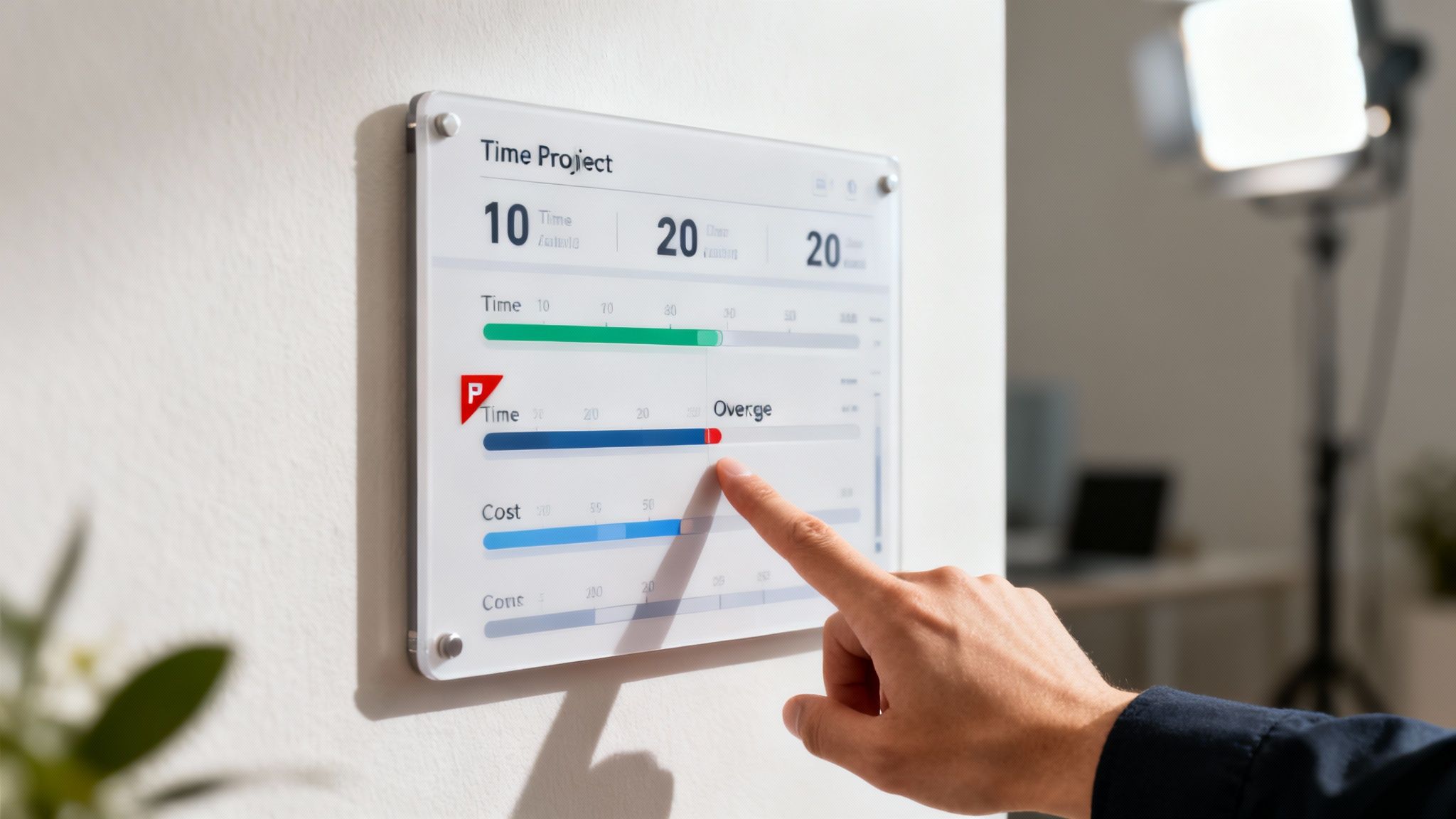
This is where the rubber meets the road. Smart financial management starts long before the first invoice is sent; it begins with how you allocate your most valuable asset: your team's time.
Effective resource allocation is all about assigning the right people to the right tasks at the right cost. This means knowing not just who is available, but also understanding their specific rates—be they internal costs or freelance day rates. By setting these rates from the get-go, you're building a clear financial picture of your project before it even kicks off.
For example, when you assign an editor to a task, you should be able to see the immediate cost implication. Let's say you're plugging in a senior editor for a day. By assigning them an internal rate of £120/hour, you're not just scheduling their time; you're earmarking that exact cost against your budget. This simple step is fundamental to protecting your profit margins right from the start.
Effective project finance management is less about tracking what you've spent and more about predicting where you're going. It’s about using today’s data to make smarter decisions for tomorrow, ensuring every project contributes positively to your bottom line.
Moving From Tracking to Forecasting
Once your resources and rates are dialled in, the real strategic work begins: financial forecasting. This is where you graduate from simply reacting to costs to proactively managing your profitability. By analysing your project's current burn rate—how quickly you're eating through budgeted hours and funds—you can make some remarkably accurate predictions about the final cost and completion date.
Let's say you're halfway through a project's timeline but have already burned through 65% of the visual effects budget. A good forecasting tool will flag this immediately. This isn't a moment for panic; it's a prompt for a strategic conversation. It gives you the hard data you need to either discuss a scope change with the client or shuffle internal resources to pull things back on track.
Modelling 'What-If' Scenarios
The real power of modern forecasting tools is their ability to model 'what-if' scenarios on the fly. Creative projects are fluid, and client requests for "just one more little tweak" are all part of the game. Instead of taking a wild guess at the impact, you can model it with precision.
Imagine a client wants to add an extra round of colour grading. In a tool like freispace, you can build this scenario out in seconds:
- Add the new task: "Client Revision - Colour Grade Pass 4".
- Allocate your resources: Assign your senior colourist for an estimated eight hours.
- See the immediate impact: The system instantly recalculates the project's forecasted cost and completion date.
This transforms a potentially awkward conversation into a straightforward, data-driven one. You can go back to the client with a clear choice: "Absolutely, we can do that. It will add £960 to the budget and push the final delivery by one day. Shall we go ahead?" This kind of clarity is the bedrock of strong client relationships and robust financial health.
Mastering cash flow is a critical skill for any producer who wants to build a stable, growing business. Proactive forecasting helps you see what's coming down the pipeline, preventing the kind of cash flow gaps that can cripple a studio. For anyone looking to sharpen their skills in this area, there are some fantastic resources that can help you Master Small Business Cash Flow Management with practical, actionable strategies.
This proactive approach to planning and forecasting, powered by the right tools, is a cornerstone of effective project finance. For a deeper dive into these ideas, our guide on optimising resource management offers even more valuable insights.
Getting Your Invoices Out and Your Money In
Getting paid accurately and on time is where all your hard work pays off. This isn't just admin—it's the culmination of every careful decision you've made in budgeting, tracking, and forecasting. A solid invoicing process makes sure every single billable minute and expense gets captured, protecting your profits and keeping clients happy.
The goal here is to leave the dark ages of manually piecing together invoices from random timesheets and expense receipts behind. That old way of doing things isn't just painfully slow; it's a minefield of potential errors that can lead to delayed payments and awkward client conversations. The modern approach is to generate invoices straight from your project's tracked data, giving you total accuracy with almost zero effort.
Automate Invoices Directly from Project Data
Picture this: you generate a perfectly detailed, itemised invoice in just a few clicks. That's the power of connecting your invoicing system directly to your time and expense data. It completely removes the risk of forgetting to bill for that last-minute freelance editor or those unexpected software subscription costs.
This kind of automation turns invoicing from a headache into a simple, reliable part of your workflow. It also builds a huge amount of trust with your clients. When the final bill is a perfect reflection of the work they've already seen and approved in progress reports, there's no room for doubt or confusion.
For a deeper dive into how modern tools handle this, you can find more on integrated billing and invoicing solutions.
Picking the Right Billing Model
No two projects are the same, so why should your billing method be? Choosing the right model isn't just a box to tick; it's a strategic decision based on the project's scope, length, and your relationship with the client.
In post-production, a few models tend to dominate:
- Time and Materials (T&M): This is your best friend for projects where the scope feels a bit like jelly—hard to pin down at the start. You simply bill the client for the actual hours worked and resources used. It’s flexible for everyone.
- Fixed-Price: Perfect for projects with a rock-solid scope and crystal-clear deliverables. It gives the client cost certainty, but you’d better be sure your initial budget is spot-on to protect your margins.
- Milestone-Based: A great approach for marathon projects. You tie payments to completing specific stages or deliverables. This is fantastic for your cash flow, as you get paid as you complete major chunks of work.
The trick is to use a system that can handle all of these without breaking a sweat. Your finance management platform should let you set the billing type at the outset and then just spit out the right invoice format based on the project data when the time comes.
Turning Reports into Real Business Intelligence
Your job isn't done just because the invoice is sent. The final, and arguably most important, stage is looking at the numbers. This is where you turn all that raw project data into insights that will make your next project even more profitable.
Good financial reports give you an honest, clear-eyed view of how your business is actually performing. They go way beyond a simple P&L to answer the really big questions. For example, a profitability report might show you that your motion graphics work is a goldmine, but your sound design projects are consistently bleeding money. That's an insight you can act on.
You should be keeping a close eye on key performance indicators (KPIs) like:
- Project Profitability: Which jobs and which clients are actually making you the most money?
- Team Utilisation: Are your most talented people spending their time on billable tasks, or are they stuck in meetings?
- Budget vs. Actuals: Where are your estimates consistently missing the mark?
This data-driven feedback loop is what separates the pros from the amateurs. It helps you sharpen your quotes, allocate your team more effectively, and make the kind of smart decisions that lead to real, sustainable growth.
Weaving Sustainability Metrics into Your Financials

The future of project finance is about a lot more than just pounds and pence. There’s a new, critical layer that every responsible producer needs to get to grips with: sustainability. It's no longer a 'nice-to-have'; clients, especially the big corporate players, are increasingly asking for environmental impact data right alongside the usual financial reports.
This shift is a huge opportunity. When you start integrating metrics like carbon footprint tracking directly into your project financials, you’re not just being ethical. You’re gaining a powerful competitive edge. Presenting a complete picture of a project's true cost—both financial and environmental—positions your company as a modern, forward-thinking partner that's ready for tomorrow's regulations.
Quantifying Your Carbon Footprint
So, where do you start? The first job is to figure out where your carbon costs are hiding. For most post-production houses, the big culprits are usually tied to energy consumption and data management. It’s all about translating your day-to-day activities into measurable CO2e (carbon dioxide equivalent) values.
You can get going by focusing on the most significant areas:
- Render Farm Energy: This is almost always the largest single source of emissions. Track the total kilowatt-hours (kWh) your rendering hardware burns through and apply a carbon factor based on your energy provider's grid mix. It's a surprisingly straightforward calculation.
- Data Storage and Transfer: Every terabyte of data you store in the cloud or send across the network comes with an energy cost. Cloud providers are getting better at offering tools to help you estimate this impact, so ask them for the data.
- Facility Operations: Don't forget the baseline energy used to power your edit suites, central machine rooms, and general office space. A simple way to handle this is to allocate a portion of your facility's overall energy overhead to each project based on its duration or resource usage.
By assigning a carbon "cost" to these activities, you can start building a much more holistic financial and operational view.
The whole point is to make environmental impact a tangible metric within your project finance management. Just like you track an editor's hours, you should be able to track the kilograms of CO2e generated by a big VFX render. This isn't just for a report at the end; it actively drives smarter, more efficient operational choices along the way.
Reporting and Gaining That Edge
Once you start tracking this data, the next move is to weave it into your reporting. Imagine presenting a final project summary that not only shows you delivered on budget but also details the total carbon footprint. Better yet, show how you optimised workflows to reduce it by 15% compared to your initial forecast. Now that's impressive.
This kind of comprehensive reporting hits several key business goals at once:
- Meets Client Demand: It directly answers the growing call for supply chain sustainability data from corporate clients.
- Creates a Differentiator: It immediately sets you apart from competitors who are still only talking about money.
- Builds Brand Reputation: It demonstrates a genuine commitment to responsible business practices, which is invaluable for your brand.
Modern platforms like freispace are already building these features directly into their project management tools, letting you track carbon alongside time and costs without missing a beat. By embracing this evolution, you’re not just managing finances more effectively; you’re future-proofing your entire business.
Common Questions
Whenever you’re looking to bring more structure to your project finances, a few practical questions are bound to come up. It's a common part of the journey. Here are some answers to the things we hear most often from producers making that shift from relying on gut instinct to embracing data-driven financial clarity.
How Can I Get My Creative Team to Actually Track Their Time?
The secret is to make it dead simple. If tracking time feels like a chore or an interruption, it just won't get done—at least not accurately.
The best approach is to use tools that fit right into their current workflow. When logging time is only a couple of clicks away from the actual task they're working on, you'll see adoption rates go through the roof. It's also about framing it correctly. This isn't about micromanagement; it's about everyone pulling together to budget smarter for future creative work. Ultimately, that protects everyone's time and resources.
Is It Really Worth the Cost to Switch from Spreadsheets?
Spreadsheets might feel "free," but they come with some hefty hidden costs. We're talking about human error, countless administrative hours down the drain, and a serious lack of real-time visibility. Even tiny spreadsheet mistakes can snowball into major financial headaches.
A purpose-built project finance tool more than pays for itself. It helps by:
- Preventing budget blowouts with live alerts.
- Cutting down admin time spent on manual invoicing and reporting.
- Making future quotes more accurate by drawing on solid historical data.
The initial investment is a drop in the ocean compared to the long-term gains in efficiency and profitability you'll see.
What’s the Difference Between a Budget and a Forecast?
Getting this right is crucial. A budget is your fixed, approved plan—it’s what you aim to spend. Think of it as the financial map you agree on with the client before anything kicks off.
A forecast, on the other hand, is a living, breathing prediction. It takes what you've actually spent so far and combines it with the remaining planned work to estimate the final project cost. Forecasting is the active, hands-on part of financial management that lets you steer the ship back on course before it's too late.
Put it this way: the budget is your map, but the forecast is your live GPS, constantly recalculating your arrival time based on the traffic right now.
Take control of your post-production finances with freispace. Our platform brings resource scheduling, time tracking, forecasting, and invoicing together into one seamless system. It's designed to give you the clarity you need to deliver profitable projects, every single time. Discover how freispace works.