UK film production spending rose by 56% in 2024, even though fewer films started shooting, according to the BFI's official statistics. That reframes the production of a film: getting a project made isn't a matter of moving from script to camera to edit. It's a matter of securing the right capacity, controlling changes and understanding what each decision costs in money, time and carbon.
For a post-production planner, the important question isn't just when filming finishes. It's whether the people, rooms, equipment and approvals needed afterwards will be available.
What the Production of a Film Means in the UK
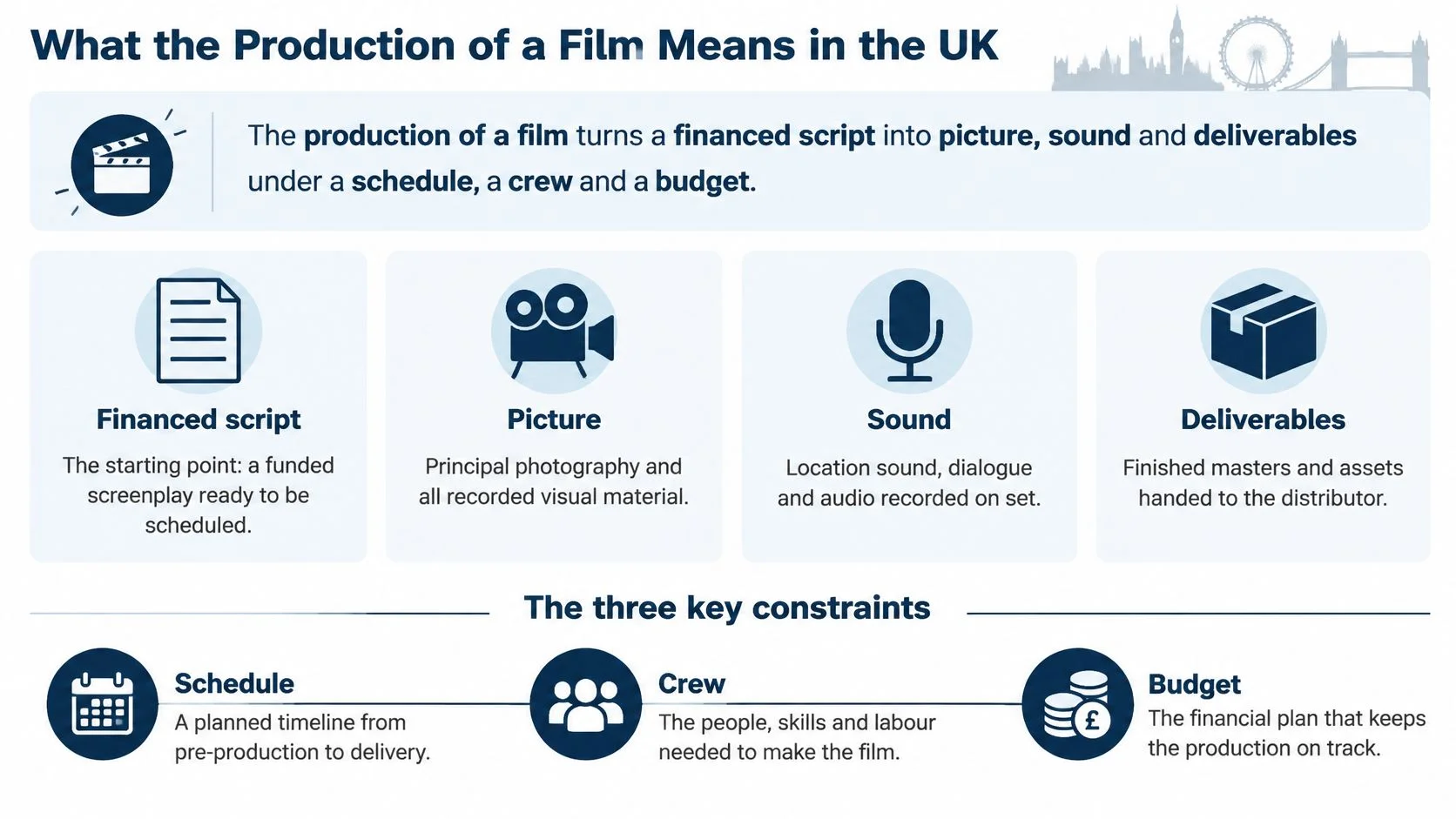
The production of a film turns a financed script into picture, sound and deliverables under a schedule, a crew and a budget. Development is the architect's drawing; production is the site, the trades and the snagging needed before anyone can move in.
The three main phases are pre-production, principal photography and post-production, with development feeding the first and delivery completing the last. The phase table below separates creative progress from the practical ownership that keeps work moving.
Spending isn't the same as available capacity
The BFI figures put that distinction into context: 191 feature films began production in the UK in 2024, generating approximately £2.1 billion in UK production expenditure. That's expenditure associated with UK production activity, not spending exclusively on British-originated films.
A large internationally financed feature and a locally originated independent film can both require an experienced coordinator, a grading theatre and a sound team. Their budgets may be very different, but each planner still needs confirmed access to those resources.
Say an independent feature has secured its director, cast and location. The producer considers the project ready to shoot, but the proposed post supervisor is finishing another title and the preferred sound facility hasn't confirmed its booking. The creative package is ready; the delivery plan isn't.
Measure starts without losing sight of finishing
The BFI records production expenditure against the year principal photography begins. That makes the measure useful for understanding production starts, but it isn't the full lifetime cost of every title completed during that year.
A head of post therefore needs a different operational view from a production-starts chart. That view should distinguish:
- Committed work: Bookings supported by agreed dates, scope and available resources.
- Provisional work: Holds awaiting confirmation, with a named decision-maker.
- Unfunded or unallocated work: Necessary tasks that haven't yet secured money or capacity.
- Completion obligations: Masters, fixes and archive work that remain after the main creative sessions.
Planning principle: A financed film isn't a fully resourced film.
The UK spending pattern points towards fewer, higher-value projects, alongside substantial differences between budgets and financing structures. A shared calendar can show that a session exists, but it can't by itself explain whether the operator is available, the incoming material is approved or the booking has sufficient budget.
Those are production-control questions, not diary questions.
The Three Phases and Who Owns Each One
Phases in the production of a film
| Phase | Typical window | Core outputs | Schedule owner | Main risk |
|---|---|---|---|---|
| Development into pre-production | Before production approval and booking commitments | Script, budget, schedule, crew deals | Producer and line producer | Key capacity still unbooked |
| Pre-production | From approval to readiness for the first shooting day | Locations, kit, insurance, call-sheet arrangements | Production manager and coordinator | Late creative or location changes |
| Principal photography | From the first scheduled shoot to wrap | Rushes, sound, continuity reports | First assistant director and line producer | Overtime, moves and weather |
| Post-production | From incoming footage through approved finishing work | Picture lock, grade, sound, VFX, deliverables | Post supervisor and coordinator | Suite and freelancer clashes |
| Delivery and archive | From approved finishing outputs to accepted handover | Quality-checked masters and archive copies | Post producer | Version sprawl and late fixes |
Read down the schedule owner column before examining the creative outputs. Each row needs someone who can confirm readiness, negotiate a change and tell the next department what has been approved.
The windows are defined by entry and exit conditions rather than fixed durations. For a hypothetical independent feature, you might test a preparation period of eight to sixteen weeks and a shoot of six to twelve weeks, but those are scenario assumptions, not industry benchmarks. Replace them with the script breakdown, location constraints, contracts and confirmed supplier availability.
Read a phase as a commitment
Development produces more than a promising screenplay. Before the producer hands the project into active preparation, the line producer needs a workable budget, a scheduling basis and clarity about which deals remain open.
During pre-production, the production manager and coordinator turn those assumptions into executable arrangements. A location isn't ready because somebody likes it; access, permissions, working hours, transport and practical restrictions need resolving. Call sheets, the daily instructions telling people where and when to work, then become usable rather than aspirational.
Principal photography means the main shoot. The first assistant director manages the shooting day's sequence, while the line producer controls the resource and budget implications. A delayed scene may look like a camera-department problem, but its consequences can extend to transport, location access and the next day's availability.
Separate creative approval from technical completion
Post-production doesn't begin only when the shoot wraps. Editors can work with incoming rushes, the footage recorded during filming, while production continues. The post supervisor must therefore plan an overlap, not place editing after filming in a straight line.
Picture lock means the edit's shot selection and timing have been approved for finishing. Changing those decisions afterwards may require the colour, sound and visual-effects teams to revise work that appeared complete.
Delivery is another distinct responsibility. A finished-looking film still needs the correct masters, supporting assets, technical checks and archive arrangements. Quality control, often shortened to QC, checks whether the supplied files meet the agreed technical specification.
- The outgoing owner confirms completion: State what's approved, what's provisional and what's missing.
- The incoming owner accepts readiness: Confirm that the materials can be used without rebuilding the previous department's work.
- The producer resolves exceptions: Decide whether to accept risk, change scope or move the date.
A department finishing its own work doesn't automatically make the next department ready to start.
Before any phase begins, name one accountable schedule owner. Other people can maintain bookings or contribute estimates, but responsibility for the handover shouldn't be shared so loosely that nobody can approve it.
Pre-Production as a Capacity Forecast
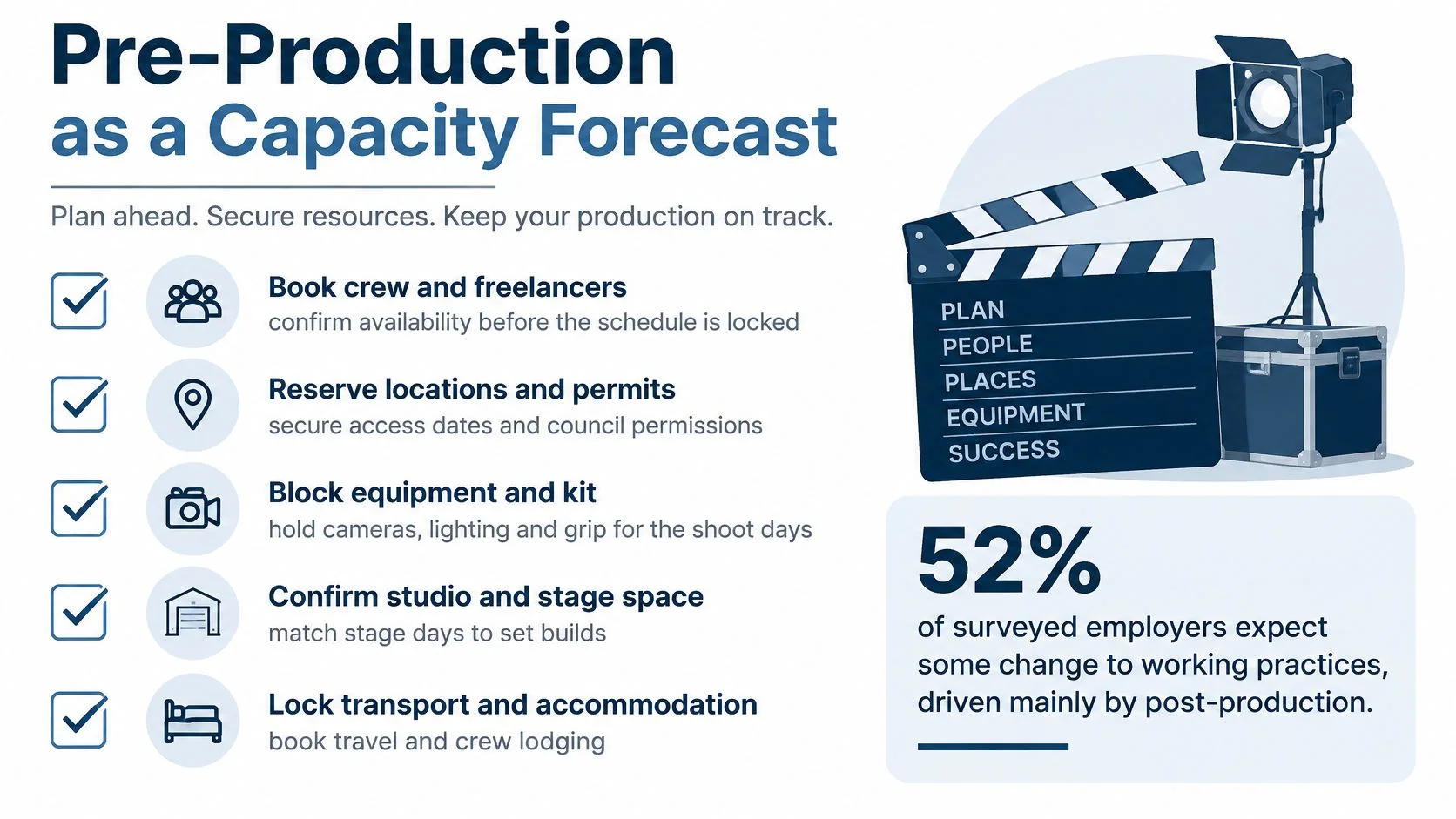
A production can book its headline talent and still lack the people who organise the work around them. Production coordinators, production managers and producers are among the roles showing both skills gaps and shortages, while 52% of surveyed employers expect changes to working practices, driven mainly by post-production and VFX, according to ScreenSkills' Powering Production report.
For a line producer, that makes pre-production a capacity forecast, not a paperwork phase. The task is to establish how much suitable work people can undertake during the period the film needs them.
Book availability rather than names
A crew list shows who might work on the film. A capacity plan shows when they're free, what they're qualified to do and which other commitments could prevent them from delivering.
Treat coordination, production accounts, data handling, assistant editing and VFX production as bookable capacity in their own right. Don't let those functions disappear beneath a general assumption that the production team will cover them.
A practical capacity-planning approach starts with the work that must happen, then matches it to confirmed availability. A freelancer's CV establishes experience, not a reservation.
Booking checklist before locations are locked
- Role and responsibility: Name the work, its owner and the person providing absence cover.
- Actual availability: Record free working periods, existing commitments and any release conditions.
- Booking status: Distinguish an enquiry, a provisional hold and a confirmed commitment.
- Supporting resources: Pair the person with the room, workstation, access and software they need.
- Incoming dependencies: State which files, decisions or approvals must arrive before work starts.
- Fallback arrangements: Identify replacement capacity and the cost of activating it.
- Contingency: Allocate time and money to vulnerable roles before the schedule becomes difficult to change.
Look across projects before confirming a start
Say a coordinator is due to finish an internationally financed feature before joining your film. Their diary appears clear, but their current production still has unresolved delivery arrangements and supplier reconciliations.
Don't treat the scheduled finish as an unconditional release. Ask which responsibilities remain, who will inherit them and whether the coordinator can leave without continuing to support the previous title.
The same reasoning applies to quiet periods. Someone being available now doesn't establish that they'll be available when photography begins. Intermittent demand requires forward bookings, not an assumption that spare capacity will remain spare.
A phase should pass its readiness check only when the next owner has named people, suitable rooms and an executable fallback. An email saying that a supplier should be able to help doesn't meet that test.
Keep task ownership clear when tools change
If an AI tool takes over a preparation task, don't remove the human booking. Someone still needs to check the output, resolve exceptions and approve its use.
For example, automated logging might reduce manual entry while creating a review task for an assistant editor. The planner should change the task allocation and acceptance criteria, not assume that the entire requirement has vanished.
Before greenlight, confirm coordinator cover, post supervisor cover and a written rule for updating the plan when AI changes task ownership. The person approving the workflow change should also identify who remains accountable for its result.
Carbon and Cost of Every Schedule Change
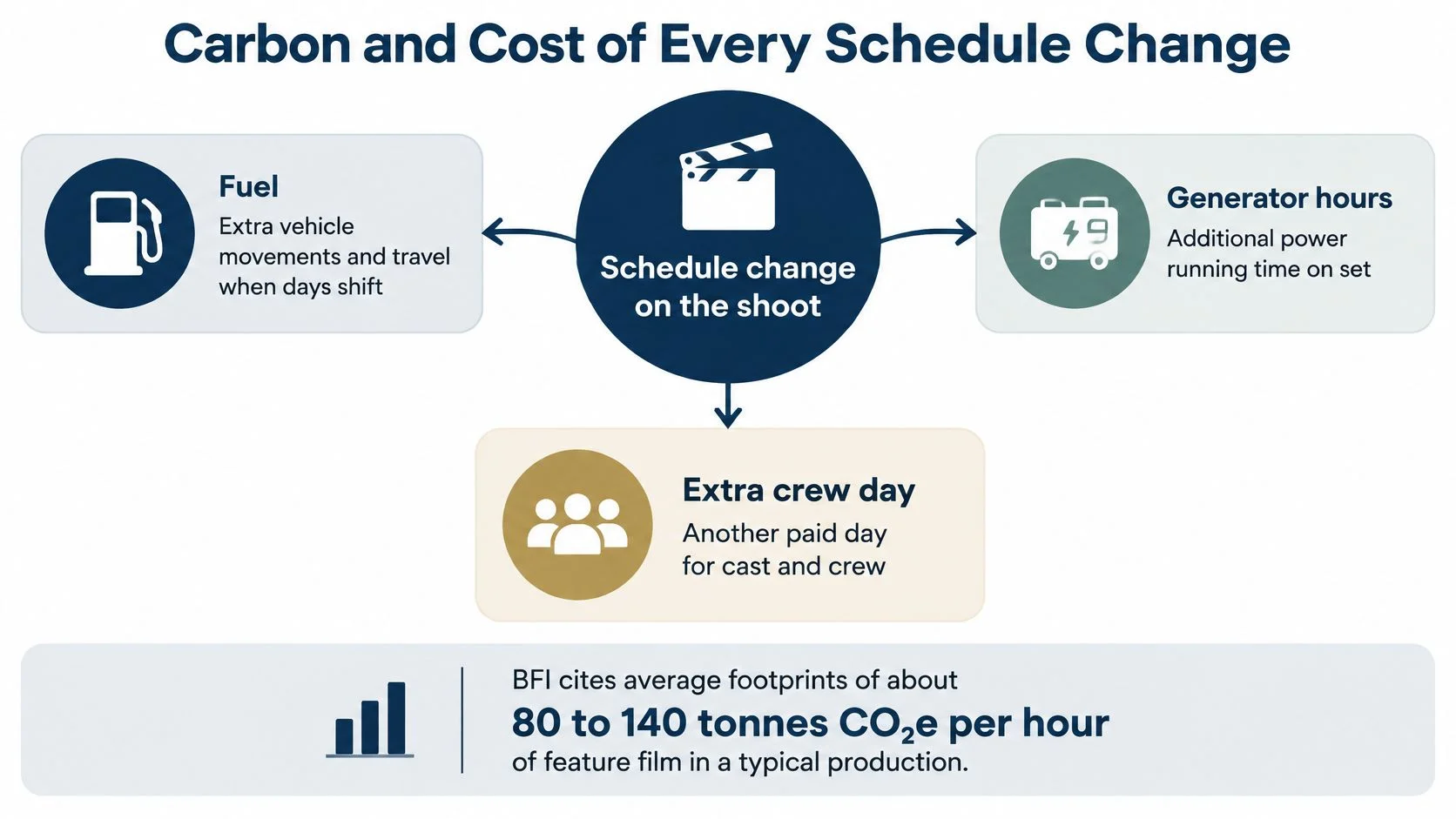
On a shoot, moving a scene can mean another vehicle journey, longer generator use or an additional crew day. The scheduler changes a date; the production team has to organise and pay for the physical consequences.
The BFI sustainability handbook cites average footprints of approximately 80 to 140 tonnes of CO2e per hour of feature film within a typical UK independent-film budget range, and identifies travel and transport, materials, and temporary power as the largest emitting areas. CO2e means carbon dioxide equivalent, a way of expressing different greenhouse gases using a common measure; the quoted range concerns finished screen time, not an hour spent filming.
Follow the physical consequence of a change
A poorly ordered location schedule can require repeated journeys between places that could have been filmed together. Extending the shoot can keep temporary power, accommodation and transport arrangements active for longer. Revising a scene can require new costume, set dressing or construction materials.
That doesn't mean every change should be refused. It means the approving person needs to see more than the revised shooting date.
Say the location manager can group nearby locations into a continuous block without changing the shot list. The production manager should compare that option with the existing route, including access restrictions, cast availability and equipment requirements. Removing a company move, the relocation of the working production unit, is useful only if the revised order remains practical.
Use a lookup before approving the booking
Schedule changes and what they really cost
| Change | Cost and carbon effect | Check before approval |
|---|---|---|
| Extra company move | Fuel, potentially an added crew day, more transport emissions | Whether locations can be blocked instead |
| Overtime day | Labour plus longer generator or facility hours | Whether the call sheet was realistic and the revised working arrangements are acceptable |
| Reshoot | Cast, travel and new materials | Whether usable coverage already exists |
| Extra post review | Suite time, storage and another version | Who must approve, and by when |
| Remote grade instead of a theatre | Potentially less travel, with different facility hours | Whether the client can sign off to the same standard |
Use the table as a prompt, not a substitute for calculation. An extra move doesn't always create another crew day, and a remote review doesn't automatically produce lower emissions. Record the actual transport, facility and technical arrangements before choosing.
The budget assessment also needs the full chain of consequences. A location extension may appear affordable until the production accountant adds transport, catering, equipment and downstream booking changes. A connected film-budgeting workflow should make those related costs visible before approval, rather than finding them in supplier invoices afterwards.
Capture activity while it happens
Assign emissions-relevant fields to each activity. The person recording the booking shouldn't have to reconstruct the production from scattered receipts at wrap.
Useful fields include:
- Place and journey: Location, starting point, destination, travel mode and vehicle use.
- Power arrangement: Generator or battery use, operating time and the source of the recorded consumption.
- Crew requirement: Planned attendance, actual attendance and additional working days.
- Materials: Items ordered, reused, returned or discarded because of the change.
- Revision status: Whether the activity replaces planned work or adds new work.
- Evidence and owner: The supplier record, responsible department and person checking the entry.
Compare the planned activity with what happened at milestone reviews. Keep the basis of the comparison consistent: a supplier's measured consumption and a planner's early estimate shouldn't appear equally certain.
Don't invent a carbon saving from a shorter booking alone. Where consumption information isn't available, mark the estimate and its assumptions so the sustainability lead can review them.
Treat industry estimates at their proper scale
BAFTA albert's ACCELERATE 2025 analysis, based on more than 2,500 productions in 2024, estimates that the UK screen industry produces nearly 175,000 tonnes of CO2 annually. That is a screen-industry estimate, not a feature-film-only total or a forecast of an individual project's footprint.
For a planner, its practical relevance is the breadth of the intervention areas: travel, energy, materials and waste, culture, and data. Procurement matters, but so do the decisions that determine how long resources remain active and how often work is repeated.
A weather-cover set illustrates the problem. Keeping it available can protect the shoot, but somebody must decide when to stand it down, stop unnecessary power use and release materials or equipment. Otherwise, a sensible contingency can continue consuming resources after its useful window has closed.
Approval question: What extra travel, power, materials and facility use does this change create, and who has checked them?
Give shoot and post changes named owners
The line producer should own the shoot-side assessment. The post supervisor should own the post-side assessment once the material enters the finishing workflow. When a decision affects both, neither should approve it without the other's resource assessment.
A reshoot, for instance, may require new footage to be ingested, edited, graded and mixed. The camera booking is only the beginning of the commitment. Include the recipient departments before confirming the shooting date.
During post, record facility usage, review cycles, media transfers, storage duration and deliverable versions beside labour and cost. If a client requests a faster review route, compare its additional facility demands with the slower alternative rather than assuming speed is operationally preferable.
Changing the planning process also needs a controlled transition. Home Post Production moved its whole operation off a legacy scheduling system in 30 days, from 1 October to the end of that month, without dual-running. The relevant discipline is to define when the old record stops being authoritative, so teams don't approve conflicting versions of the same commitment.
Before approving overtime or a revised delivery route, record the decision, its owner and the accepted trade-off. Carbon control becomes practical when it sits inside that approval, not in a separate report prepared after the choice can no longer be changed.
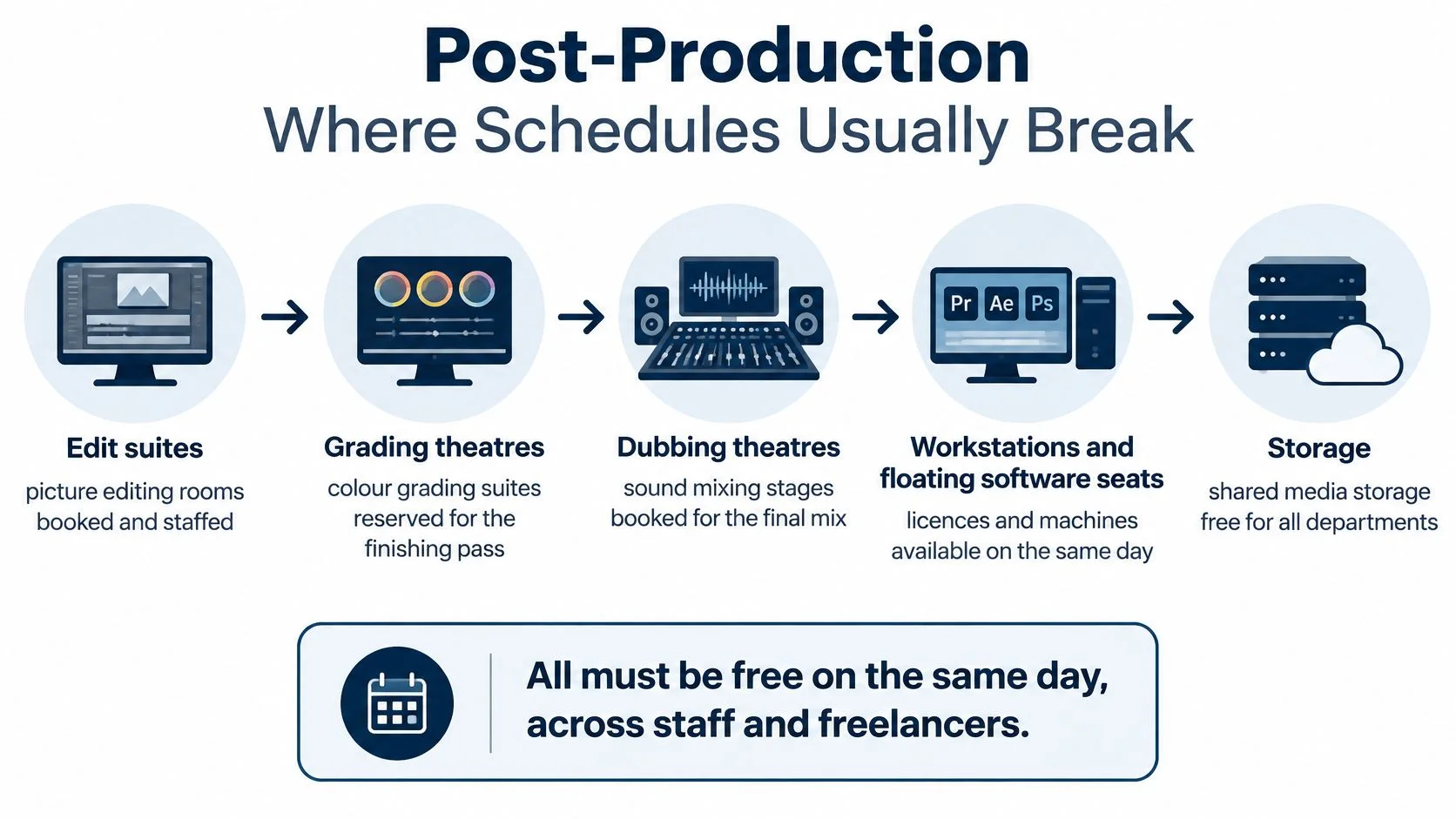
Post-Production Where Schedules Usually Break
Post-production is a shared-facility problem. Edit suites, grading and dubbing theatres, workstations, staff, freelancers, floating software licences and storage must be available together for the task being booked.
A floating licence can be shared between users, but it still has an availability limit. A free workstation doesn't make a session ready if another project is using the required software seat.
Build the sequence around usable handovers
Ingest and protect the material. Copy picture and sound into the agreed working environment, verify the copies and create the required backups before releasing acquisition media. Track drives, camera cards and tapes by identifier, custody and location through to archive.
Book assistant editing before the assembly begins. The assembly is the initial arrangement of footage into the film's sequence. Reserve the assistant editor and suite early enough to organise media, synchronise picture and sound, and resolve missing material before the editor needs it.
Publish an achievable picture-lock date. Give colour, sound and VFX teams visibility of the intended approval point. State which work can proceed provisionally and which tasks must wait for an approved edit.
Make reviews decision-making appointments. Confirm the attendees, approval authority and notes deadline. Record the version shown so nobody applies comments from an obsolete export.
Allocate the supporting digital work. Put facility hours, media transfers, storage periods and deliverable versions beside the creative sessions. A transfer or export that must finish before review belongs on the schedule.
Reconcile approved hours with the budget. Turn authorised work into the project's budget drawdown, meaning the amount consumed from its allocation. The booking, quote and later invoice should describe the same scope.
Catch clashes before a department waits
Consider a freelancer booked across overlapping productions. Each individual project schedule can look feasible while the combined resource schedule is impossible. The planner needs to see the person across all commitments, including provisional holds and absence.
A theatre held for a cancelled review creates a different problem. If the cancellation stays in an email thread, the room remains unavailable to other projects. Release the booking explicitly and tell the coordinator whether the operator, equipment and related sessions should also be released.
Late notes can cause repeated renders, the processing needed to generate finished images. Set a notes deadline and identify who can authorise reopening the work after it passes. A practical project-risk management approach turns those failure points into triggers, owners and responses, rather than a list nobody checks.
AI-native planning software should help expose these situations, not conceal them behind automatic rescheduling. It should flag cross-project clashes, suggest an available qualified operator and retain a live plan that colleagues can inspect.
- Qualification matters: A free person isn't necessarily suitable for the booked task.
- Approval matters: A suggested replacement shouldn't become a confirmed commitment.
- Operational impact matters: A faster review option may require more facility time or repeated processing.
- Traceability matters: Planners need to know who changed the booking and which version they acted on.
Account for work that crosses reporting periods
A high-value feature can finish shooting in one financial year while occupying finishing suites in the next. A facility manager should plan against that remaining workload, not assume that the absence of a current shoot means the project no longer needs capacity.
Keep open commitments visible until their acceptance conditions are met. Otherwise, a title can disappear from the production team's immediate attention while still requiring fixes, reviews and technical resources.
The handover a head of post should demand is precise: one schedule showing the room, the person and the version. If any is missing, the session isn't fully defined.
Put the Whole Production on One Plan
Choose a planning system by testing whether it can represent the commitments your team makes. If people, suites, kit and versions live in separate files, planners will keep discovering disagreements at the handovers.
Apply these acceptance tests before moving a live production:
- A complete booking: The room, operator and kit appear together, and approved hours connect to the project's budget.
- A cross-project view: Planners can inspect conflicts involving staff, freelancers, equipment and floating licences.
- A controlled change: The approver can compare time, cost and carbon consequences before confirming a revised arrangement.
Test the workflow rather than the presentation
Use an awkward booking in the evaluation, not a clean demonstration with no competing work. Try a review that moves after its operator has accepted another job, or a finishing session awaiting an unapproved export.
Ask the planner to identify what's blocked, notify the responsible owner and show the budget consequence. Then check whether colleagues can understand the result without opening a private spreadsheet.
Our modern resource and project planning software, freispace, is designed to reduce time spent planning for post houses, broadcasters, production companies and in-house post departments. Its relevance is practical: the same booking can hold the suite, operator and kit, collect hours worked, draw down the project budget and become a line on the quote and invoice.
That connection matters more than a visually tidy calendar. It gives the coordinator and production accountant a common record of what was booked and what was used.
Make the first trial deliberately bounded
Choose a live title and run a short, defined pilot. Map its suites, staff and review dates into a shared plan, then compare double-bookings and unresolved holds with the old sheet.
Set the success criteria before starting. Count conflicting commitments, missing owners and bookings that require manual reconciliation, rather than judging the trial on whether the interface feels newer.
Start small: Prove that a planner can make a difficult change safely before expanding the process across the company.
Keep a named person responsible for correcting imported information and deciding which record is authoritative. Don't redesign every department's workflow merely to test a better booking process.
Where the problem extends beyond scheduling, our consulting comes from post-production professionals with experience in workflow optimisation, change management and AI implementation. Scope that work around a specific operational problem, such as unclear approvals or resource clashes, rather than beginning with an open-ended company-wide redesign.
The production of a film becomes easier to control when each commitment has an owner, each change has an assessment and each handover has an acceptance condition.
freispace offers resource and project planning that connects the people, rooms and bookings behind film post-production, alongside support from post-production professionals. Visit freispace to discuss mapping a live title into a shared plan and scope the workflow, change or AI implementation support your team needs.