
The grade is booked, the colourist is holding the slot, and the client has just sent another set of picture notes. Your editor can make the changes, but only by pushing the VFX turnover into time another project has already claimed. Meanwhile, the freelance invoice is due before the client's next payment.
That's the working reality of managing project risks in post-production. Schedule, creative scope, specialist capacity and cash are connected. A useful risk process makes those connections visible early enough for someone to act, without turning the coordinator's week into register maintenance.
A Risk Register Template You Can Use Today
A booking is confirmed, the suite is held, and a second round of picture notes arrives before the first invoice clears. The schedule risk is visible. The cash-flow exposure and the specialist capacity hit are easier to miss unless they sit on the same page as scope.
Use a one-page live register beside the schedule. A shared spreadsheet works at first if everyone knows which version is current and the coordinator can filter by owner, stage and status. Keep it short enough for the weekly production meeting and specific enough that someone can act before the next booking.
Every entry needs an owner, trigger and review date. A description tells you what could happen. The other fields tell you who is watching, when they must act and when the estimate gets challenged.
Risk register fields for a post-production project
The scores below are an illustrative working model, not measured probabilities.
| Field | What to enter | Post-production example |
|---|---|---|
| Risk ID and category | Short code plus scope, design, supplier, people, cash or technology | SCP-A, creative scope |
| Description | One sentence naming the cause and the effect | Second client note round lands after picture lock, pushing the grade back |
| Probability | Score from 1, unlikely, to 5, almost certain | 3 |
| Impact | Score from 1, minor rework, to 5, missed delivery with penalty | 5 |
| Score | Probability multiplied by impact | 15 |
| Owner | One named person, not a team | Lead editor, Sam Patel |
| Trigger | Measurable signal that the risk is becoming real | Second client note round logged before picture lock |
| Response and review date | Agreed action plus the next date the owner updates the score | Book a fixed review slot; next review date set in the register |
Take the late-picture-change entry. Creative scope identifies where the uncertainty starts; the description names the downstream consequence, a displaced grade. The lead editor owns the entry because they can recognise whether incoming notes threaten the lock. The producer may still need to negotiate the response, and that negotiation needs the cash effect of moving the grade.
The trigger comes before the damaging event. Logging another note round before lock creates a chance to secure a fixed review slot and consolidate decisions. Waiting until revised picture reaches the colourist turns an early warning into a record of something that has already gone wrong.
Put the next calendar date in the live register, not a recurring review instruction. An overdue entry can look current just because it says Monday.
Track reduced success, not just failure
In written evidence submitted to the UK Parliament on major-project management, more than 90% of respondents considered their most recent project successful to some degree, but only 22% said it wholly met its original objectives. That distinction matters when a studio delivers on time by absorbing unpaid rework or exhausting a specialist who is hard to replace. A project can meet its delivery date and still create a cash gap or a capacity problem that lands on the next job.
Log unavailable specialists, late assets and underestimated render time before they threaten final delivery. Record the exposure they create: extra operator hours, a displaced booking, reduced review time or a payment milestone that slips. Once an event happens, move its immediate consequences into the issue log and keep any unresolved future exposure as a risk.
Practical rule: Keep the live register short enough to read in the production meeting. Archive closed entries with the action taken and whether it worked, rather than deleting the evidence.
Spotting Risks at Every Stage of the Project
Risk identification belongs at each delivery gate, because the uncertainties at booking aren't the same as those at online or invoicing. A confirmed editor doesn't resolve an untested conform workflow. A finished master doesn't resolve an unagreed billing milestone.
The NISTA Annual Report 2024–25 records 31 of 196 assessed government major projects as red and 135 as amber. For a studio, the useful discipline is to reassess readiness as work progresses rather than treating kick-off approval as permanent permission to proceed.
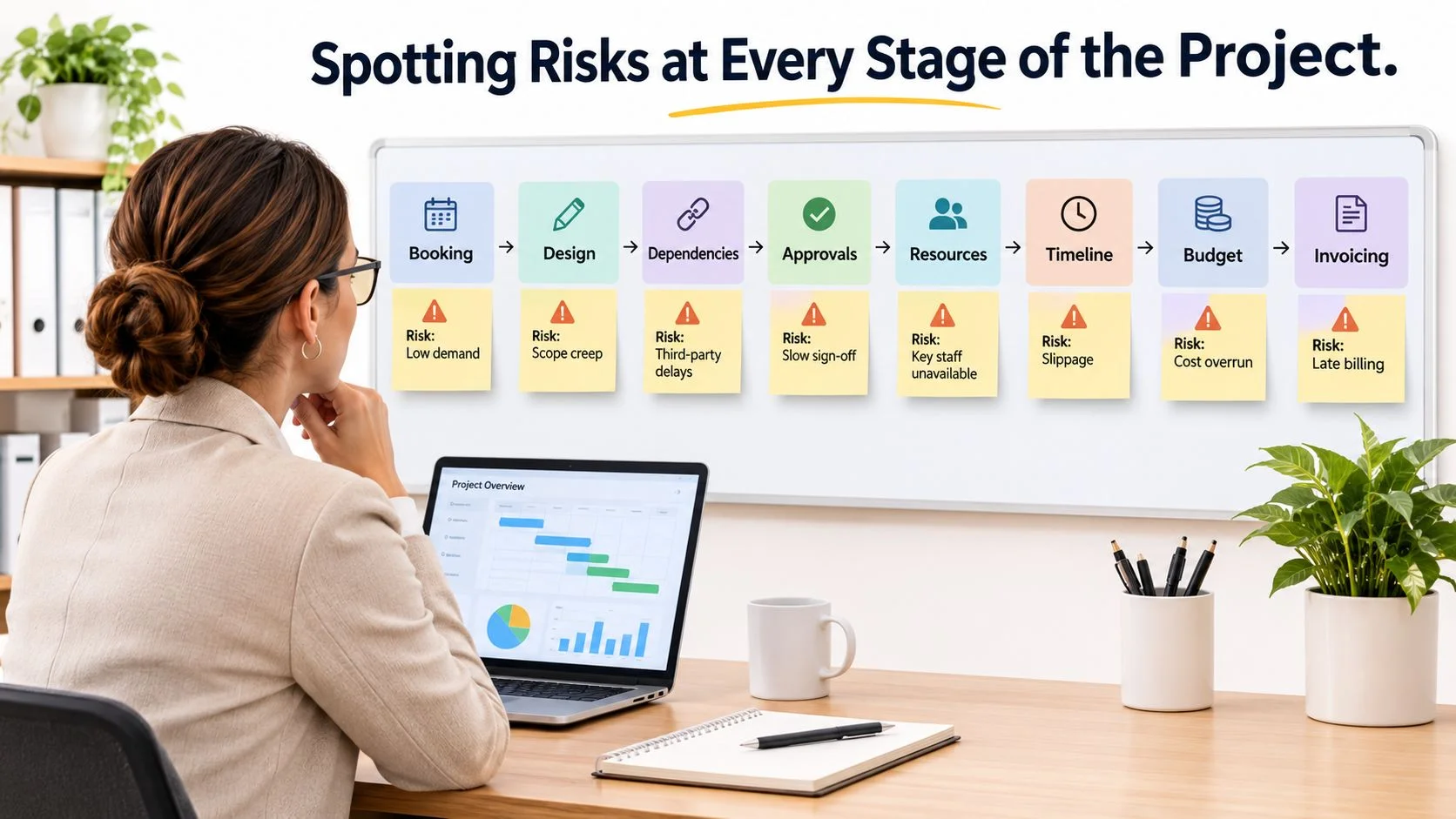
Look across the whole workflow
Use this category sequence to uncover gaps between departments:
- Scope: What deliverables, versions and revision allowances remain unconfirmed?
- Design: Has someone validated the finishing workflow and technical approach?
- Dependencies: Which task needs an approved output, rather than merely a completed task?
- Suppliers: Are external slots confirmed, including access to the people doing the work?
- Contracts: Who pays for changes, cancellations and additional deliverables?
- Technology: Have storage, codecs, plug-ins and integrations been tested together?
- Environment: Could power, connectivity or site access interrupt the planned work?
- Stakeholders: Who can approve, and who can overturn that approval?
Be precise about what a project dependency means. A grade waiting for approved picture has a different constraint from a grade waiting for an available suite. Adding more suite time won't fix missing approval.
For a useful cross-discipline comparison, HireArchitects' guidance on building critical-path schedules for engineering projects offers another way to examine linked work. Apply that dependency logic to turnover, finishing and delivery rather than copying an engineering programme wholesale.
Match entries to the gate
| Gate | Risks worth testing |
|---|---|
| Booking | The freelance VFX house has no final-turnover slot; the client hasn't confirmed delivery specifications |
| Edit lock | New picture requests remain unresolved; the approver hasn't reviewed the current cut |
| Grade | The colourist is unavailable during the finishing window; approved picture is still outstanding |
| VFX turnover | Another job needs the same render capacity; the asset handoff lacks source files or metadata |
| Delivery | Storage fills during online; an updated AI-assisted transcription tool breaks the established workflow |
| Invoicing | The client accepts delivery, but the billing milestone or purchase order remains unagreed |
At every gate, ask what would have to be true for this stage to fail, then ask which previous project struggled at the same point. Check comparable estimates against actual hours, review duration and supplier performance, not the optimistic schedule issued at booking.
Speak to editors, coordinators and finance separately before merging their lists. Editors may identify unstable creative decisions; coordinators see booking conflicts; finance sees unbilled work. Record each cause and consequence explicitly so a vague entry such as delay doesn't conceal the dependency you need to manage.
Scoring Risks by Probability and Impact
- Agree the impact scale with the client-facing lead. Define minor rework and severe delivery failure in operational terms, so the editor and producer aren't scoring different consequences.
- Score independently before comparing judgements. Give probability and impact separate ratings, then discuss disagreements using booking confirmations, approval history and remaining work.
- Check the leading risks against comparable jobs. If familiar causes of expensive disruption sit near the bottom, challenge the assumptions rather than trusting the ranking.
- Set an explicit action threshold. In the illustrative model below, treat scores of 15 or more as red, requiring a named response during the current working week.
- Record the expected residual score. Estimate what remains after the response, so the producer can judge whether its cost buys a meaningful reduction in exposure.
Risk score matrix for probability and impact
This is a proposed internal scoring convention, not an industry benchmark. Multiply the probability rating by the impact rating; bold cells mark the example red threshold.
| Probability | Impact 1 (minor) | Impact 2 | Impact 3 (moderate) | Impact 4 | Impact 5 (severe) |
|---|---|---|---|---|---|
| Probability 1 (unlikely) | 1 | 2 | 3 | 4 | 5 |
| Probability 2 | 2 | 4 | 6 | 8 | 10 |
| Probability 3 (possible) | 3 | 6 | 9 | 12 | 15 |
| Probability 4 | 4 | 8 | 12 | 16 | 20 |
| Probability 5 (almost certain) | 5 | 10 | 15 | 20 | 25 |
For impact, distinguish rework absorbed within a booking from rework that displaces another project. Include effects on margin, accepted quality and contractual commitments, not only the delivery date. Use the most material credible consequence, with a note explaining the judgement.
The scoring sequence provides a consistent way to compare entries.
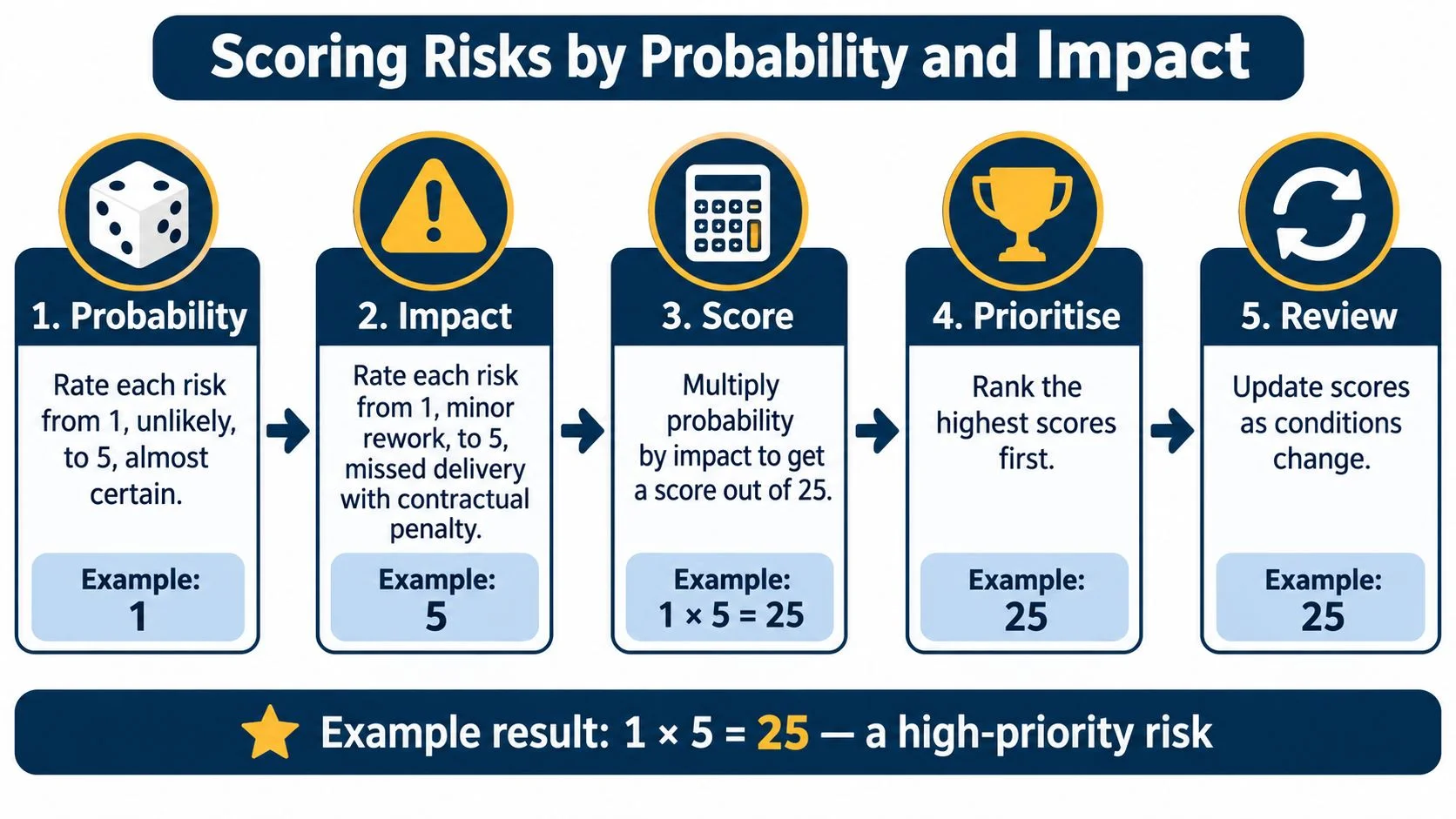
Don't mistake the score for a forecast
The common mistake is assigning the middle rating to everything because nobody wants to look alarmist or overconfident. That produces a tidy register with no useful distinction between an unconfirmed supplier and an unlikely archive failure. Ask owners what evidence would justify moving their estimate up or down.
Ordinal scores aren't percentages. A probability rating can rank concern, but it can't be used directly to calculate a cash reserve. For financial analysis, estimate an actual likelihood separately and document the basis for it.
Also inspect severe risks individually, even when their combined score sits below the action threshold. A low-likelihood storage incident may still justify a tested recovery procedure because the potential loss is unacceptable.
Re-score when scope, crew, dependencies or dates change. A monthly reminder is administrative housekeeping, not a reason to leave an obsolete assessment untouched. Keep the previous judgement and explanation so the team can distinguish genuine improvement from a more optimistic description.
Choosing a Response for Each Risk
| Response | Use when | Post-production example | Trade-off |
|---|---|---|---|
| Avoid | The risk would be expensive and the plan can change | Hold VFX until picture lock and delivery specs are signed off | Slower start, less overlap between teams |
| Reduce | The risk is likely but its impact can be cut | Book a standby colourist for the final grade week | Standby fee paid whether or not it is used |
| Transfer | Someone else can carry the cost more efficiently | Supplier contract with delay and rework clauses | Higher supplier rates and longer negotiation |
| Accept | The response costs more than the exposure | A few days of client approval delay absorbed by float | Needs written acceptance and a named owner |
A response is a decision about exposure, not a reassuring verb in a spreadsheet. Monitor isn't sufficient unless the entry also says what happens when the trigger is reached. Give the chosen response an accountable owner, an authorisation route and a budget line.
Use readiness checks before committing expensive work
A Building commentary on a National Audit Office review reports that £647 million of a combined £1.35 billion cost overrun across major programmes resulted from construction starting before requirements were fully understood or designs sufficiently mature. The relevant planning choice is whether an early start creates valuable progress or expensive work that may need replacing.
Before authorising substantial editorial, VFX, sound or finishing expenditure, require:
- Confirmed requirements: Deliverables, technical specifications and approval responsibilities are documented.
- Available resources: The required people, facilities and external services can support the intended sequence.
- A validated schedule: Review, render, handoff and recovery time have identifiable places in the plan.
- Visible assumptions: Outstanding decisions have owners, deadlines and consequences if they change.
Avoidance doesn't always mean stopping everything. You can authorise reversible preparation while withholding work that depends on unstable picture. For example, asset organisation and workflow testing may proceed while shot-specific finishing waits.
The trade-off is reduced overlap. If the client needs parallel execution, show the price of that decision through an explicitly funded rework allowance rather than pretending the exposure has disappeared.
Choose who can actually carry the consequence
Reduction works when the intervention changes a real constraint. A standby colourist is useful only if they can access the project, understand the look and use the required suite. A name on a contact list isn't replacement capacity.
Transfer needs equal care. Supplier clauses can allocate agreed costs, but they don't automatically recover a missed delivery window or preserve the client relationship. Check whether the supplier can meet the obligation and whether the commercial terms cover the relevant event.
Acceptance is appropriate when a proportionate response would cost more than the likely consequence and the studio can withstand that consequence. The decision should identify the exposure being retained, who authorised it and what would force reconsideration.
Record response expenditure separately from the remaining exposure. Otherwise, the producer may believe that paying a standby fee has eliminated every consequence of absence, even when a replacement would still need handover time.
Accepting a risk means authorising a defined exposure. Leaving the response cell blank means nobody has made the decision.
Building Contingency and Protecting Scarce Skills
A flat contingency percentage is easy to quote and difficult to defend. It doesn't show whether the reserve covers creative revisions, specialist absence or a technical recovery. Build an identified-risk reserve from specific exposures, then hold a separate allowance for residual uncertainty.
For each identified risk, estimate likelihood and the cost if it occurs, then calculate expected monetary value. Add the resulting exposures with care: linked consequences may belong to the same scenario, not separate independent events. Keep schedule exposure visible as well, because available cash can't purchase an unavailable specialist at short notice.
Follow an unavailable editor through the plan
Say the lead editor becomes unavailable while the cut still needs client approval. Trace the consequences in sequence:
- Establish recoverable work. Can an assistant prepare media, organise notes and maintain project structure without making unauthorised creative decisions?
- Test the replacement. Confirm project access, software compatibility, handover needs and authority to make editorial choices.
- Recalculate downstream bookings. Check sound's start condition and the online slot against the revised lock forecast.
- Compare intervention costs. Weigh replacement and handover costs against displaced bookings, waiting time and the client's delivery priorities.
The Creative Industries Policy and Evidence Centre's skills-mismatch analysis finds that 65% of hard-to-fill creative-industry vacancies are caused by skills shortages, compared with 41% across the wider economy. Treat a scarce specialist as a dependency to protect, not an interchangeable allocation.
Reserve specialist time for work that needs that person's judgement. Maintain internal cover and a credible freelance alternative, checking availability, permissions and handover requirements before pressure arrives. Repeatedly solving gaps through the same people's overtime can turn a booking problem into a retention problem.
When considering remote support for suitable tasks, Virtustant's nearshore hiring rate data can inform a cost comparison. Validate post-production experience, security arrangements, working-hour overlap and supervision costs rather than choosing on headline rates alone.
Separate profitability from cash availability
The University of Reading's analysis of the UK screen-sector downturn reports a 22% fall in domestic high-end television commissions in 2024. A studio therefore needs to test both delivery exposure and its ability to fund work while payments remain outstanding.
Alongside budgeting a film, forecast payment receipts against payroll, freelance commitments and supplier due dates. An invoice milestone isn't cash received. Flag any forecast shortfall that would consume the studio's approved liquidity buffer.
Keep the operational records connected. A booking holds the suite, operator and kit, collects hours worked, draws down the project budget, and becomes a line on the quote and then the invoice.
A low-margin job may protect continuity, but accept it only after checking its additional cash requirement and the capacity it prevents you selling elsewhere. Set the booking ceiling against sustainable specialist capacity, not the theoretical maximum hours available.
Monitoring Risks and Reporting Them Weekly
- Extract the current position. Each Monday, pull actual hours, planned and completed tasks, approval latency, change volume and budget burn from time records and the current plan.
- Compare evidence with triggers. Identify thresholds crossed and entries approaching them, including supplier or capacity changes that aren't visible in task completion.
- Update moved risks. Ask the owner to explain the change in probability or impact with evidence, not a general confidence statement.
- Authorise the response. Compare the expected cost and schedule effect of practical alternatives, including doing nothing.
- Check the previous decision. Record whether the response worked, what it cost and whether further exposure remains.
Example trigger thresholds for weekly risk review
The table is an illustrative starting policy, not a universal benchmark. Calibrate these signals against comparable completed jobs and agreed client turnaround times; a threshold should prompt investigation, not automatic spending.
| Indicator | Example trigger | Response |
|---|---|---|
| Task slippage | Work falls beyond the agreed schedule tolerance | Resequence tasks or add a freelance operator |
| Review cycles | Agreed review cycles are repeatedly missed | Escalate to the client and reset the approval date |
| Forecast utilisation | Committed work exceeds the approved capacity ceiling | Move low-priority work or agree an overtime limit |
| Approval latency | Approval remains outstanding beyond agreed turnaround | Chase the approver, then escalate |
| Change volume | Post-lock notes exceed the agreed revision allowance | Open a change control request before accepting new notes |
| Budget burn | Spend exceeds the value of accepted work beyond phase tolerance | Review scope and authorise any phase-budget revision |
Don't re-baseline just to make an adverse variance disappear. Retain the original baseline, identify the approved change, and show the current forecast alongside it. The producer needs to see both how the job is performing and what it now costs to finish.
Resource contention, rising rework, unresolved notes and compressed dates should be assessed together. Solving each symptom separately can leave the shared cause untouched.
The weekly dashboard should support that discussion rather than replace it.
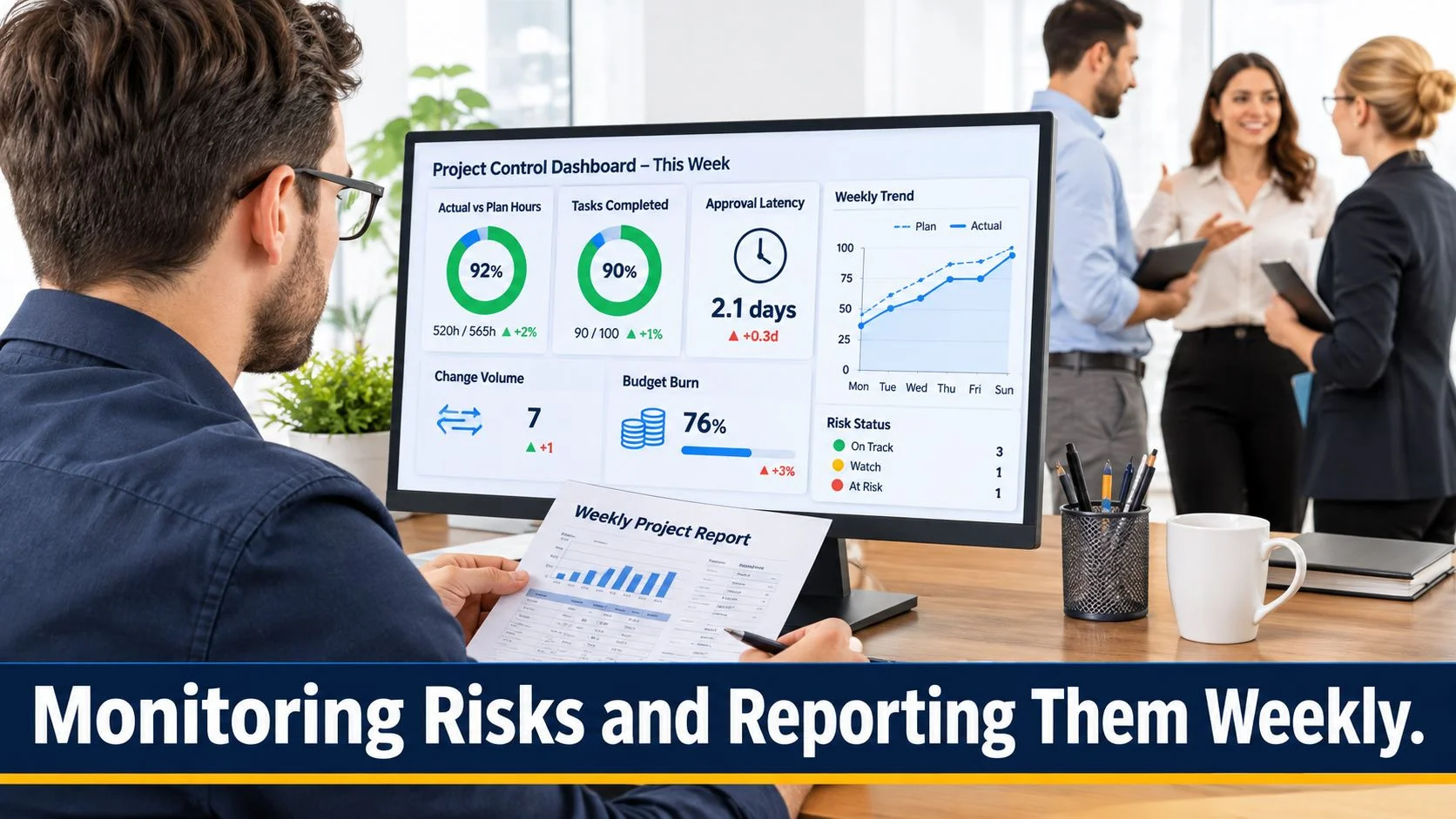
Look beyond the heat map
A 2025 study published in the Journal of Construction Engineering and Management, using 30,950 UK construction projects, identified a long right-tail distribution for large cost overruns. A probability-impact grid can organise attention, but it doesn't describe every plausible outcome or the relationships between events.
For a small studio, start with coherent scenarios: expected delivery, delayed approval, and combined capacity disruption. For a larger portfolio, Monte Carlo simulation can help explore ranges, provided the model represents shared resources and linked events. Detailed calculations won't rescue unsupported inputs.
Avoid double-counting correlated risks. If late picture approval causes both sound waiting time and a moved online slot, model those consequences within the same causal scenario. Don't independently assume every downstream exposure occurs at its full value.
Challenge stale estimates and distinguish work completed from deliverables accepted. An editor may have addressed every note while the client still hasn't approved the cut. Reporting that phase as complete hides the remaining approval exposure.
Use team workload management to inspect the person behind the allocation. A booking may fit the calendar while leaving no room for handovers, troubleshooting or supervision.
Finish the review with decisions, owners and the next evidence required. Report status against current facts, even when that means changing a previously green project to amber. A spreadsheet can preserve the record; it can't negotiate scope, authorise reserve spending or tell an overloaded specialist which commitment takes priority.
Set Your Risk Review Gates Before the Next Booking
Make the booking decision explicit: go only when the project is ready, its material risks have owners and its exposure is funded within approved limits. If a condition remains unresolved, the producer should either withhold the commitment or authorise a bounded exception. A tentative calendar hold mustn't slip, without anyone noticing, into permission to spend.
This isn't a demand for certainty. It's a demand that someone with authority understands what the studio is committing to, including the assumptions needed to deliver profitably.
Match the planning system to the decisions
Evaluate planning tools against the decisions your team needs to make, not the number of dashboard widgets they display.
| Risk-management need | Planning capability to test |
|---|---|
| Identify exposure at delivery gates | Gantt-style phases and milestones that make handoffs visible |
| Evaluate response feasibility | Resource scheduling showing the relevant people, suites and kit |
| Check whether interventions work | Time tracking and current plan-versus-actual budgets |
| Protect payment milestones | Billing and invoicing connected operationally to delivery gates |
| Keep environmental reporting consistent | Project carbon calculations derived from the same schedule |
Test the workflow with an awkward change, not a clean demonstration project. Move an approval date, make a specialist unavailable and inspect what the planner must update. Check whether the revised schedule, cost forecast and billing assumptions remain consistent without hidden manual reconciliation.
Our Focus plan includes resource scheduling, Gantt-style project planning, to-dos, time tracking, billing and invoicing, CRM, reporting and controlling, carbon emissions tracking, and storage server planning. Budgets show live plan-versus-actual on every project instead of a month-end spreadsheet, and automated project carbon emissions are calculated from the same schedule.
The approval discipline still belongs to your team. A connected system can make competing bookings and deteriorating budgets visible, but a producer must decide whether to change scope, fund cover or decline the job.
Use the booking checklist to make that authorisation visible.
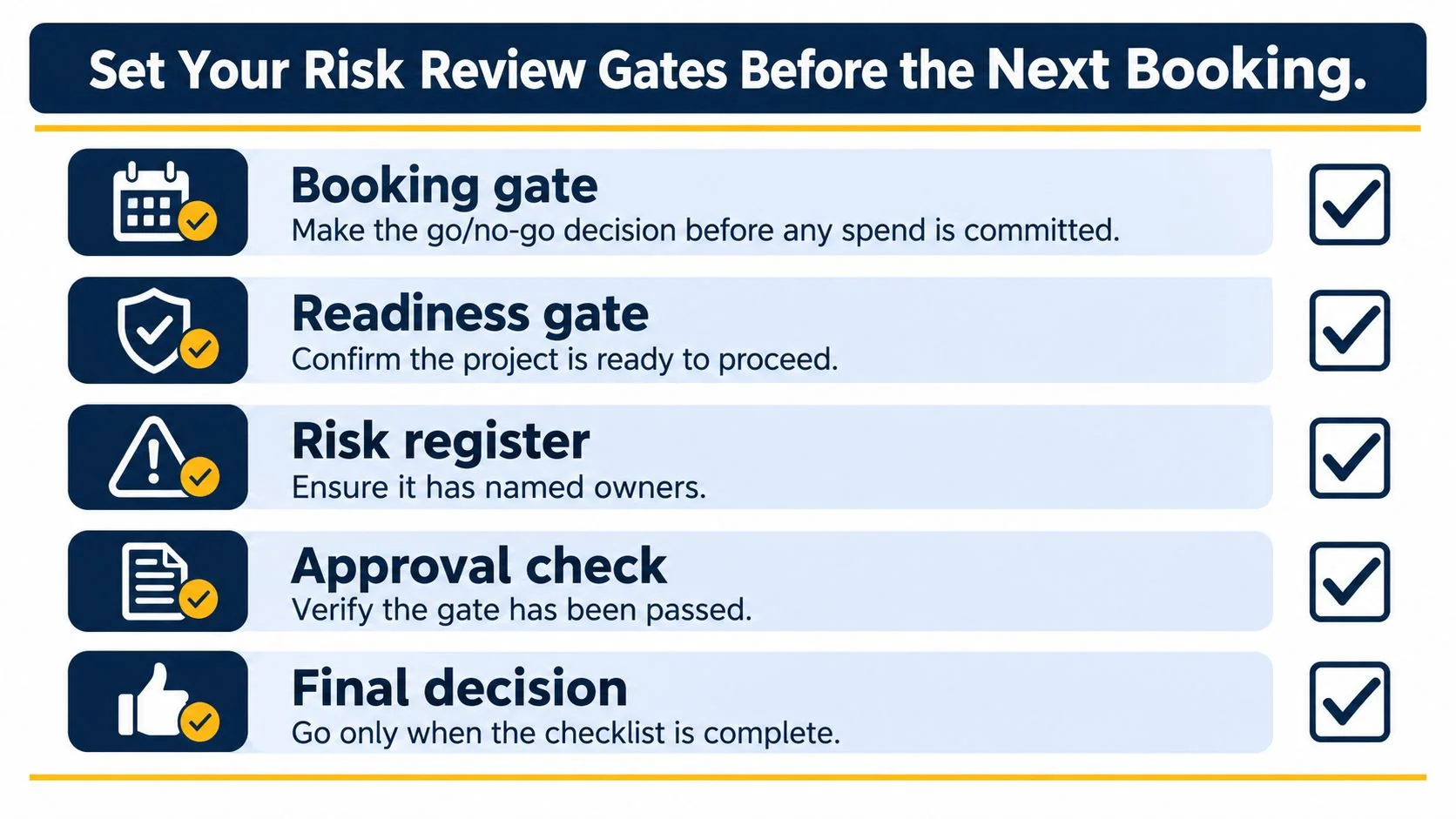
Before the next project is confirmed, book a short register review with your producer and coordinator. Bring the proposed schedule, supplier commitments and cash forecast, then resolve the highest-exposure unanswered decision. Leave with a clear booking outcome, not another request for everyone to keep an eye on things.
freispace connects post-production resource planning, time tracking, budgets and invoicing so your team can assess delivery and financial exposure together. Visit freispace to explore how your next booking, weekly risk review and project cost forecast could run from a connected plan.