
Successful financial management doesn't kick off when the first creative asset is made. It starts much, much earlier, with a meticulously planned financial foundation. This means getting way beyond a simple spreadsheet and building a comprehensive budget, estimating costs accurately, and creating a baseline forecast that acts as your roadmap for the entire production.
Building Your Project’s Financial Foundation
Every great media project is built on a solid financial framework. Without one, even the most brilliant creative vision can crumble under the weight of surprise costs and poor planning.
Think of this initial stage not as a restriction, but as building the strong container your project needs to thrive. A well-constructed budget and forecast give your team the confidence and clarity to focus on what they do best: creating exceptional work.
This isn't just about plugging numbers into a template. It's a deep dive into every potential expense, from the obvious to the easily overlooked. Getting this right from the start is critical, and a good first step is to understand how to create a robust business budget, as the core principles are exactly the same.
Moving Beyond Basic Budgeting
A common pitfall is treating the budget as a static, one-time document. But for a dynamic media project, your budget has to be a living blueprint that reflects the true scope of work. That means accounting for every single cost centre with precision.
In a post-production environment, you need to break down costs into clear, manageable categories:
- Labour Costs: This is almost always your biggest expense. You've got to account for salaries, freelance rates, and potential overtime for every artist, editor, supervisor, and coordinator.
- Vendor and Contractor Fees: This bucket holds all your external partners—think sound design studios, colour grading specialists, or freelance VFX artists.
- Software and Hardware Licences: Don't forget the recurring costs for essential tools like Adobe Creative Cloud, Nuke, or any specialised plugins your team relies on.
- Variable Overheads: These are the costs that scale up or down with production volume, like cloud rendering fees from services like AWS or Google Cloud, and raw GPU time.
The Art of Accurate Cost Estimation
Once you've got your categories sorted, it’s time to estimate. This is where experience and hard data really come into play. A vague guess is a recipe for disaster, almost guaranteeing scope creep and some pretty tough conversations with stakeholders down the line.
For example, estimating the cost of a single VFX shot isn't just about the artist's time. You have to factor in render farm usage, software seat allocation for the duration of the task, and even a sliver of the producer’s time for management. By breaking down huge deliverables into smaller, measurable tasks, you can build a far more accurate and defensible cost structure right from the beginning.
A project budget is about telling your money where to go instead of wondering where it went. Building this detailed map upfront is the single most important activity in the financial management of any project.
Creating Your Baseline Financial Forecast
While a budget lays out what you plan to spend, a forecast predicts when you’ll spend it. This financial roadmap is absolutely essential for managing cash flow and measuring your progress as you go.
Your baseline forecast should map out expected monthly or weekly spending against the project timeline. This forecast then becomes your primary tool for monitoring financial health. It lets you track your burn rate—the speed at which you’re spending the budget—and compare it against your planned progress.
If you’ve spent 50% of your budget but have only completed 25% of the work, your forecast will flag this variance immediately, giving you precious time to correct course. For a deeper dive into these strategies, check out our guide on effective budgeting and financial controlling techniques. This initial planning is what provides the oversight needed to ensure your creative vision is backed by a sustainable financial reality.
Creating a Dynamic Financial Control System
A project budget is a great starting point, but let’s be honest, it’s a static document. Creative projects are anything but static; they’re fluid, constantly evolving beasts. This is exactly where a dynamic financial control system stops being a nice-to-have and becomes absolutely essential. It’s the difference between a fixed plan and a responsive, real-time workflow.
This system isn't just about tallying up what you've spent. It’s about understanding precisely where every pound is going and, crucially, why. By building a system that breathes with your project, you gain the agility to make smart financial calls on the fly, instead of waiting for a month-end report to tell you you're already in trouble.
At its heart, a dynamic system pulls in live data—think time tracking, vendor invoices, render farm usage—directly into your financial overview. This completely transforms your budget from a historical document into a living tool, giving you an accurate, up-to-the-minute picture of your project's financial health.
This process is built on a clear sequence: a solid estimate informs a reliable budget, which then allows for an accurate forecast to keep things on track.
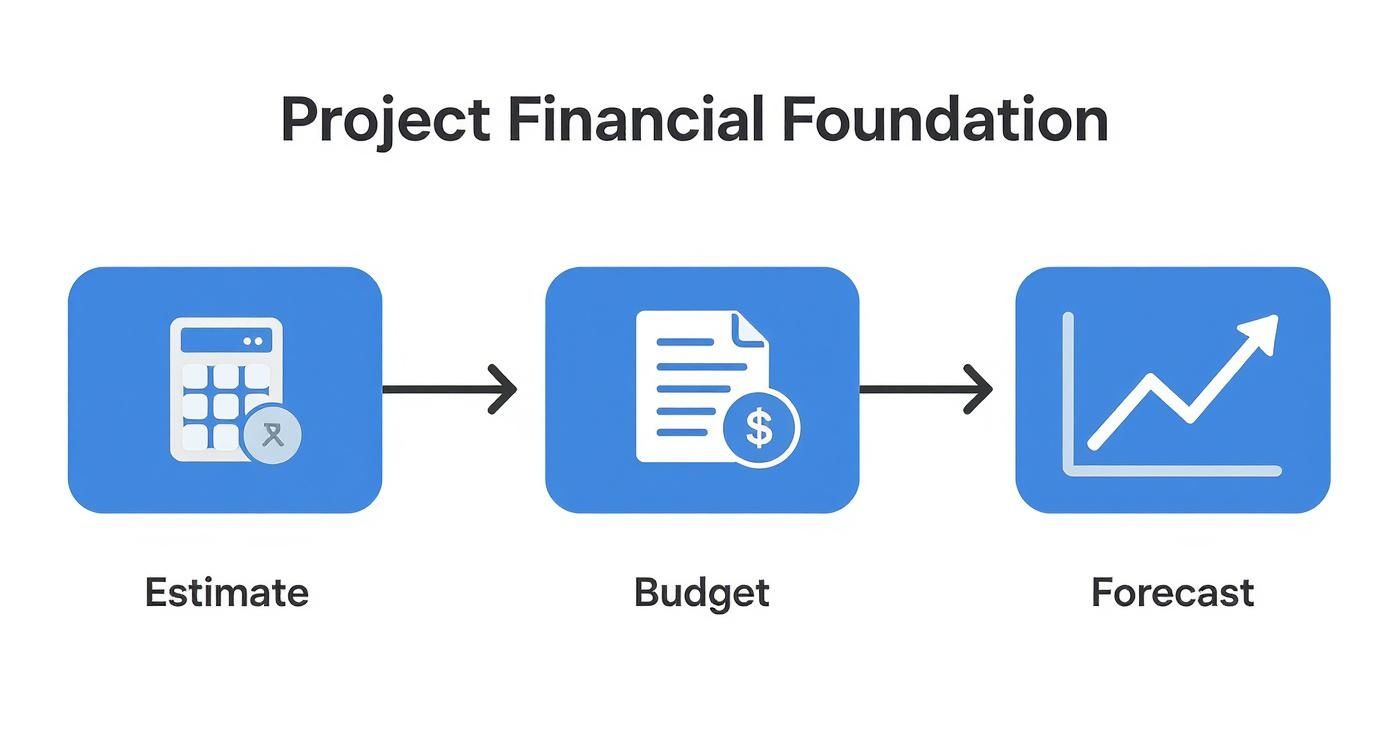
As the diagram shows, a solid estimate is the bedrock. Get that right, and your budget and forecasts have a fighting chance of reflecting reality.
Integrating Real-Time Data Streams
First things first: you need to connect the tools your team already uses every day directly to your financial tracking. Forget manual data entry. It’s slow, riddled with errors, and simply can’t keep pace with a modern post-production pipeline.
Automating this is the key. When an artist logs hours against a shot, that data needs to automatically update the labour cost for that specific task. When a vendor’s invoice lands, it should be captured and reflected in your project's total spend instantly. You're creating a seamless, effortless flow of information.
- Time-Tracking Tools: Platforms that let artists log hours against specific tasks or shots are invaluable. Integrating this gives you a real-time pulse on your labour costs, which are often the biggest and most unpredictable expense.
- Invoicing Software: Linking your invoicing and accounts payable software ensures every external cost, from freelance contracts to software licences, is immediately factored in.
This kind of integration provides instant visibility into your burn rate, helping you spot potential overages before they spiral out of control. The consequences of flying blind can be severe.
For instance, look at the challenges in the UK public sector. A well-known analysis revealed a staggering 81% of public sector IT projects run over schedule, a huge jump from the 52% seen in the private sector. Even more telling, these public projects have cost overruns that are, on average, three times higher. This really hammers home the need for robust, real-time financial controls. You can discover more insights on project overruns and what causes them.
Precision in Cost Allocation
Once real-time data is flowing in, you can achieve a level of granular cost allocation that’s simply impossible with old-school spreadsheets. Instead of just knowing your total labour cost for the month, you can see the exact cost of a specific task, a single shot, or a key project phase.
This precision is a complete game-changer. It lets you:
- Analyse Profitability: Finally figure out which types of shots or tasks are your most (and least) profitable.
- Refine Future Bids: Use detailed historical data from similar shots to build incredibly accurate quotes for new projects. Less guesswork means a better win rate.
- Identify Inefficiencies: Spot tasks that consistently blow the budget. This allows you to dig into the root cause—is it a workflow bottleneck, a training gap, or just an unrealistic initial estimate?
The goal is to shift from asking "How much have we spent?" to answering "What is the exact cost of this deliverable?" That change in perspective is fundamental to proactive financial management.
Real-World Scenario: A Complex VFX Shot
Let’s break this down with a practical example: a single, complex VFX shot involving fluid simulation—a notoriously resource-heavy task. Your dynamic system would track multiple cost streams against this one shot.
An artist logs 35 hours working on the simulation. Your system instantly calculates the labour cost based on their rate. At the same time, the shot chews through render time. The system tracks the exact GPU hours used, whether on your local farm or a cloud service like AWS, allocating that variable cost directly to the shot.
This allows for a detailed and brutally honest breakdown of where the money is going.
Below is a simplified example of how this might look for a single VFX shot. A producer can glance at this and see immediately if things are on track.
Cost Allocation Example for a VFX Shot
| Cost Category | Description | Estimated Cost (£) | Actual Cost (£) | Variance |
|---|---|---|---|---|
| Senior Artist Labour | 30 hours @ £65/hr | 1,950 | 2,275 | -325 |
| Junior Artist Labour | 20 hours @ £40/hr | 800 | 800 | 0 |
| Cloud Rendering | GPU time for fluid sims | 500 | 620 | -120 |
| Software Licence | Pro-rated cost of simulation plugin | 75 | 75 | 0 |
| Storage | Cloud storage for caches/renders | 40 | 55 | -15 |
| Total Shot Cost | Combined expenses for the shot | £3,365 | £3,825 | -£460 |
This granular view makes it clear that both senior artist time and rendering went over the initial estimate. With this data, a producer can immediately investigate why and make informed decisions—perhaps by adjusting the workflow on similar upcoming shots—instead of discovering a major budget issue weeks later. This is what effective financial management of the project looks like in practice.
Actively Monitoring Your Project's Financial Health
Proper financial management isn't a "set it and forget it" discipline. It's an active, ongoing process. Think of your budget as the starting map for your project's journey; actively monitoring its financial health is how you navigate the terrain without getting lost. It means keeping a constant finger on the financial pulse so you can spot potential issues and make smart adjustments before they snowball into full-blown crises.
This goes way beyond just ticking off expenses as they land in your inbox. Real financial control is about using specific metrics to measure how you’re doing, figure out why you’re deviating from the plan, and maintain a clear view of your trajectory from start to finish. Without this active oversight, you're essentially flying blind and just hoping you land on budget by some miracle.

Key Performance Indicators That Matter
To get a true picture of your project’s health, you need to track the right key performance indicators (KPIs). These aren't just abstract numbers; they are the vital signs that tell you how efficiently you're using your two most valuable resources: time and money.
Two of the most powerful KPIs you'll ever use are the Cost Performance Index (CPI) and the Schedule Performance Index (SPI).
- Cost Performance Index (CPI): This metric tells you if you're getting good value for the money spent so far. A CPI greater than 1.0 means you're under budget (great!), while a CPI less than 1.0 shows you're over budget. It’s a brilliant early warning system.
- Schedule Performance Index (SPI): This measures your progress against the project plan. An SPI greater than 1.0 means you're ahead of schedule, whereas less than 1.0 means you’re falling behind.
Calculating these regularly gives you an objective, data-driven view of where you stand, taking all the guesswork out of your progress reports. For a deeper dive, it's also worth getting familiar with some of the 5 key financial ratios that offer a broader perspective on performance.
Tracking Your Burn Rate and Variance
Beyond CPI and SPI, tracking your burn rate is absolutely fundamental. This is simply the rate at which you’re spending your project's budget. By comparing your actual burn rate against your forecast, you can see in an instant if you’re chewing through cash faster than you planned.
This leads you straight into variance analysis – the simple act of comparing what you've actually spent against what you budgeted. The real goal here isn't just to spot a difference, but to understand why it happened.
Was a particular task more complex than you first thought? Did a vendor invoice come in higher than quoted? This kind of analysis turns raw numbers into actionable intelligence, helping you make sharper, more accurate estimates on future projects.
Variance analysis isn't about placing blame; it's about learning. Every deviation from the budget is an opportunity to refine your processes and improve future financial accuracy.
Making Smarter Decisions with Data
Consistent monitoring gives you the hard data you need to make informed, strategic decisions. When you see your CPI dipping below 1.0, you know you need to investigate your costs immediately. If your SPI is lagging, it’s a clear signal to tackle workflow bottlenecks before they cause a major delay.
This data-driven approach transforms financial management from a stressful, reactive headache into a powerful strategic tool. It lets you have transparent, evidence-based conversations with stakeholders and clients, which builds trust and keeps everyone on the same page.
Ultimately, you want to create a feedback loop where real-time data informs your decisions, your decisions impact performance, and that performance is then measured with the same data. This continuous cycle is the engine of successful project financial management. You can explore more strategies in our detailed guide on https://freispace.com/blog/project-finance-management. By embracing these monitoring practices, you give your project the best possible chance of succeeding both creatively and financially.
Managing Financial Changes and Stakeholder Reporting
Let’s be honest: no creative project ever follows a perfectly straight line. Client feedback, technical hiccups, or unexpected pipeline hurdles aren’t just possibilities; they are certainties. The mark of a well-run project isn’t avoiding these bumps in the road, but having a solid financial plan to navigate them professionally and communicate their impact clearly.
This isn’t about stopping change—it’s about mastering it. A structured way of handling scope adjustments and transparent reporting keeps your project on stable financial ground. It ensures you’re compensated for all the work you do while maintaining trust with everyone involved.

A Structured Process for Change Orders
When a client asks for a change that’s outside the original scope, the temptation is to just get it done. But that’s a fast track to an unravelled budget. A formal change order process is your single best defence for protecting your project’s financial health.
It doesn't need to be overly complicated, but it absolutely must be consistent. This process turns a casual "what if we tried this?" conversation into a properly documented, approved, and budgeted task.
Here’s a simple workflow that just works:
- Acknowledge and Scope the Request: The second a change is requested, acknowledge it formally. Then, huddle with your team to figure out exactly what’s involved—the extra hours, resources, and any vendor costs.
- Create the Change Order Document: Draft a clear, simple document. It should outline the change, how it will affect the timeline, and the total additional cost. Be specific and transparent; no fuzzy numbers.
- Secure Written Approval: This is non-negotiable. Before a single artist starts work, the client or stakeholder must sign off on the change order. This written approval is your official green light to amend the budget and schedule.
This structure protects everyone. The client understands the financial knock-on effect of their request, and your team is guaranteed to be paid for every hour of their creative effort. Handling these adjustments smoothly is a core part of our approach to billing and invoicing best practices.
Building a Safety Net with Contingency Funds
Even with the best planning in the world, stuff happens. A critical render might fail overnight, a key artist could get sick, or a software bug could throw a spanner in the works for a day. That’s what a contingency fund is for. It's your project's financial safety net, designed to absorb these unexpected costs without derailing the entire budget.
As a rule of thumb, a contingency fund is a percentage of the total project budget, usually somewhere between 5% and 15%. The exact figure depends on how complex or risky the project is.
A contingency fund isn’t a slush fund for random spending. Think of it as a managed reserve, earmarked for legitimate, unforeseen problems that are documented and approved by the project manager.
Tapping into these funds should always require a clear justification. For example, if a power cut corrupts a file and it takes an extra day of work to fix, you’d document the issue and approve the use of contingency funds to cover that extra labour. This disciplined approach keeps the budget under control while giving you the flexibility you need.
Tailoring Reports for Your Audience
When it comes to financial reporting, one size definitely does not fit all. Different stakeholders have very different needs. Your reports have to be tailored to give the right information to the right people, without burying them in details they don’t care about.
Clear, concise communication builds trust and keeps everyone on the same page about the project’s financial status. You should be thinking about at least two key audiences:
- Internal Stakeholders (Producers, Studio Heads): These people need the big picture. They want to know about overall budget health, burn rate, CPI, and forecasted completion costs. A simple dashboard with key KPIs is usually the most effective tool here.
- External Stakeholders (Clients): Clients need to see how their money is being spent against the project's progress. They need more detailed breakdowns, especially when change orders come into play. Clear, itemised reports prevent misunderstandings and help build a true partnership.
Getting this level of reporting and control right is a sign of mature financial management. For instance, UK Research and Innovation (UKRI) managed its huge project portfolio so precisely that it had an underspend of only £22 million against its Core Capital allocation—a tiny variance of just 0.3%. For massive organisations where small percentages can mean millions, that level of control is everything.
By mastering change orders, managing a contingency fund wisely, and delivering tailored reports, you shift from simply tracking costs to strategically managing the financial journey of your project. This proactive approach ensures that no matter what creative challenges pop up, your project stays financially sound and on track for a successful delivery.
Looking Beyond the Finish Line: Future-Proofing Your Project Financials
Great financial management doesn't stop when you ship the final master. If you really want to build a resilient, forward-thinking studio, you need to look beyond the immediate deadline. It’s about building smarter practices that learn from the past and anticipate the future.
This really boils down to two things. First, adapting to new expectations from clients and the industry, like sustainability. Second, creating a disciplined feedback loop where the financial story of a completed project makes your next one even better.
Integrating Carbon-Cost Tracking
Let's be honest: sustainability isn't just a buzzword anymore. For many clients, especially major brands, it’s a non-negotiable part of the deal. This has brought carbon-cost tracking from the fringes right into the centre of our work, measuring the environmental impact of what we do. In post-production, that means looking squarely at energy-hungry tasks like rendering.
Tracking this data isn't just about being a good corporate citizen; it’s a new layer of financial intelligence. When you calculate the energy your render farm or cloud instances are chewing through, you can put a carbon cost (and a very real financial cost) on specific shots or sequences.
This simple act achieves a few goals at once:
- It wins you work. Providing detailed sustainability reports can be a massive competitive advantage when you're bidding on projects for environmentally-conscious clients.
- It reveals hidden waste. High carbon costs almost always point to inefficient workflows. Pinpointing these tasks can show you where to optimise render settings or hardware, which translates directly into lower energy bills.
- It builds your brand. A genuine commitment to sustainability makes your studio a more attractive place to work, helping you land top-tier talent who care about where they work.
You can get started pretty easily with energy monitoring tools for your on-premise gear or by digging into the carbon footprint reports that vendors like AWS and Google Cloud now provide. The trick is to just start gathering the data. Once you have it, you can start managing it.
The Financial Post-Mortem: Learning from Every Project
Once the adrenaline of a project wears off, the most valuable thing you’re left with is the data. A thorough post-project financial review—what some call a "post-mortem"—is your chance to turn that raw data into genuine wisdom. This isn't about pointing fingers for budget overruns; it's about learning as a team.
This review is where you get brutally honest about the project's financial journey. Get your key people in a room—producers, supervisors, coordinators—and lay the budget out next to the actuals.
The whole point of a financial post-mortem is to lock in the lessons from your last battle. Analysing what went right and what went sideways is the only way to systematically make your bidding sharper and your projects more profitable.
In this meeting, you need to zero in on a few crucial questions:
- Where did we bleed the most? Find the top three spots where your actual spending was way off the budget.
- Why did it happen? Was it a bad guess at the start? An unexpected technical nightmare? Or was it scope creep that someone forgot to capture in a change order?
- Where were we dead-on? Don't forget to celebrate the wins. Knowing what you estimated perfectly is just as valuable as knowing where you missed.
- How do we fix it for next time? This is the most important part. Turn what you've learned into concrete actions. Maybe you need to update your bidding templates, tweak your standard contingency, or invest in training for a tricky workflow.
By making this review a mandatory final step on every single project, you create a powerful cycle of continuous improvement. Every job makes the next one smarter. Every budget becomes more accurate. This is how you stop just reacting to financial surprises and start building a more profitable, predictable future for your studio.
Your Questions, Answered
Managing the money side of a project can feel like a minefield, especially with the pressures and pace of post-production. Let's tackle some of the most common financial questions that pop up.
How Much Contingency Is Enough?
There isn't a single magic number, but a solid rule of thumb is to set aside between 5% and 15% of your total project budget.
For a straightforward, well-defined job, 5% might be all you need. But if you're diving into something more complex or experimental—think projects heavy on new software or intricate VFX—then aiming for 10-15% is a much safer bet. It gives you the breathing room to handle unexpected tech hitches or client curveballs without blowing up the whole budget.
What’s the Best Way to Track Costs in Real Time?
Ditch the manual spreadsheets. The best approach is to connect the tools your team already uses into a single financial overview. Manual data entry is just too slow and asking for trouble.
The goal is to build an automated workflow:
- Time Tracking Software: Make sure every artist logs their hours against specific shots or tasks. This data should feed directly into your project’s labour costs.
- Accounting and Invoicing Platforms: Link your invoicing system so that every payment to a vendor or software subscription gets captured and allocated to the right project, instantly.
This kind of integration gives you a live, accurate picture of your burn rate. It helps you spot problems the moment they happen, not weeks down the line when it’s too late.
Real-time tracking is all about eliminating surprises. When you connect your day-to-day operational tools to your financial dashboard, you get the clarity you need to make smart decisions on the fly. That’s the core of good financial management.
Should I Bill for Project Management Time?
Yes. Absolutely. Project management, coordination, and producer time are vital services that are directly responsible for a project's success. This is a real labour cost and it needs to be its own line item in your budget and on your invoices.
When you don't bill for this time, you're devaluing the critical work that keeps a project on track and on budget. Be upfront with your clients from day one: management and coordination are billable hours, just like an artist’s time on the box.
How Can We Get Better at Estimating Costs for Future Projects?
The secret to better estimates is simple: data. After every project wraps, you need to hold a financial post-mortem. This isn’t about pointing fingers; it's about learning.
In the review, pull up your initial estimates and compare them to the final actual costs. Zero in on the biggest differences and ask why they happened. Was a certain kind of VFX shot way more complicated than you thought? Did a particular workflow create a bottleneck?
Use what you learn to tweak your bidding templates and estimation models. Every project you finish should make your next bid that much sharper and more competitive.
Ready to take real control of your studio's finances and scheduling? With freispace, you can integrate budgeting, time tracking, and project planning into one seamless platform. It gives you the real-time data you need to deliver projects on time and on budget. Learn more about freispace.