Think of the last time you were part of a truly massive project—the kind that feels like trying to steer an oil tanker. A new product launch, a company-wide software migration, a complete rebranding. How do you even begin to organise something that complex without it descending into chaos?
The answer is to stop thinking of it as one giant project. Instead, break it down into workstreams.
A workstream is a high-level way of grouping related projects and activities that all point towards a single, major business goal. Imagine that new product launch is a military operation. Your workstreams are the specialised divisions: infantry, air support, logistics. Each has its own mission, its own leader, and its own resources, but they're all working in parallel to win the same war.
What Exactly Is a Workstream?
At its core, a workstream is a strategic container. It bundles together a collection of related projects and tasks under one roof to achieve a specific, high-level business outcome. It’s a way to make huge, complicated initiatives manageable.
Let’s stick with the product launch example. Instead of a single, sprawling project plan with thousands of lines, you’d create distinct workstreams:
- Product Development: Everything related to building the actual product.
- Marketing & Comms: Focused on creating the launch campaign, PR, and social media buzz.
- Sales Enablement: Responsible for training the sales team and creating sales materials.
Each of these is a major undertaking in its own right, with its own budget, team, and timeline. But they are all fundamentally linked, and the overall launch can only succeed if they all deliver.
From Big Picture to Daily Details
It's crucial to understand where workstreams fit in the hierarchy. They’re not just glorified to-do lists. A workstream sits at a strategic level, hovering above the individual projects and the day-to-day tasks they contain. This structure brings immediate clarity, letting specialised teams zero in on their area of expertise without getting bogged down by the noise of the bigger programme.
A workstream helps you break down complex projects into manageable sections to ensure clarity and focus for each aspect of a large project. It organises the 'who does what' at a strategic level, preventing overlap and ensuring all critical components are covered.
This approach brings order to chaos. It simplifies things for project managers, who can oversee progress more effectively because each team is accountable for its distinct piece of the puzzle. This is what makes efficient resource allocation and clear accountability possible.
To make this distinction crystal clear, here’s a quick breakdown of how these concepts relate to one another.
Workstream vs Project vs Task At a Glance
The table below offers a simple way to see the difference in scope and purpose between these three core concepts.
| Concept | Scope | Objective | Example |
|---|---|---|---|
| Workstream | High-level, strategic grouping of projects | Achieve a major business outcome | "Customer Experience Improvement" |
| Project | A defined initiative with a start and end | Deliver a specific output or result | "Launch New Help Centre Website" |
| Task | A single, actionable work item | Complete a specific step | "Write FAQ page content" |
As you can see, a single workstream can hold multiple projects, and each of those projects is built from countless individual tasks. It's this layered structure that makes managing complexity possible.
Clearing Up The Confusion Between Workstreams and Workflows
It’s easy to get ‘workstream’ and ‘workflow’ mixed up. People often use them interchangeably, but they represent two completely different levels of organisation. Getting this wrong can lead to mismanaged projects and seriously frustrated teams. The real difference boils down to scope and purpose.
A workflow is a specific, repeatable sequence of tasks designed to get one defined thing done. Think of it like a detailed recipe for a single dish. To approve a new marketing graphic, the workflow might be: Designer submits to Manager > Manager requests revisions > Designer makes edits > Manager gives final approval. It’s linear, it’s procedural, and it’s all about the how.
A workstream, on the other hand, is the entire kitchen where that recipe is made—along with many others. It’s a bigger, more strategic grouping of related projects and all their associated workflows. The “Marketing Campaign Launch” is the workstream; creating that one graphic is just a tiny part of the bigger picture.
Hierarchy and Scale
The relationship here is all about hierarchy. Workstreams are the high-level containers. They hold projects, which are then carried out through various individual workflows. A film’s “Post-Production” phase is a perfect example of a workstream. Inside that, you’ve got distinct projects like “Visual Effects,” “Sound Design,” and “Colour Grading.”
Each of those projects has its own unique set of workflows. The Sound Design project, for instance, includes workflows for dialogue editing, Foley recording, and the final mix approval. They are all separate, step-by-step processes, but they all fall under the Sound Design project, which itself is part of the larger Post-Production workstream.
This diagram shows how everything fits together, from the broadest strategic level right down to the individual task.
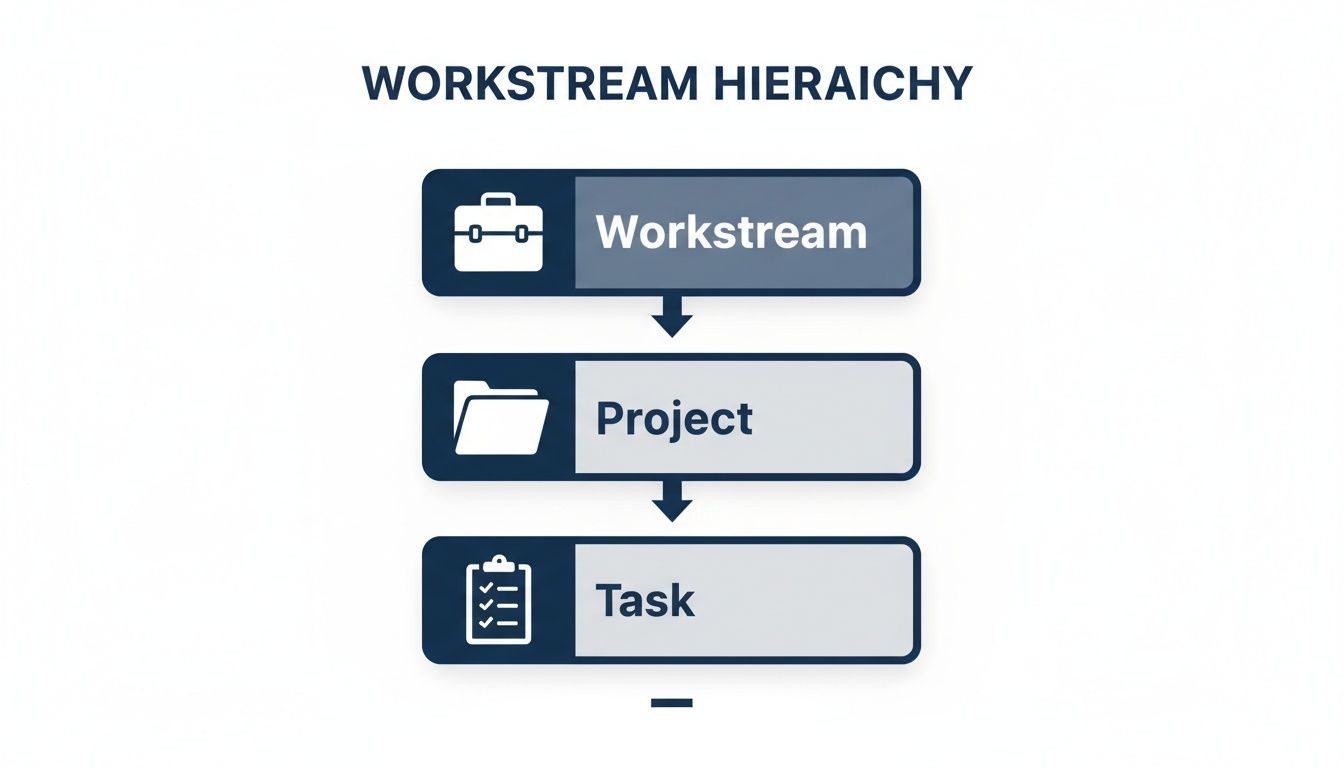
As you can see, the workstream is the strategic umbrella. It covers multiple projects, and each project is made up of those granular workflows and tasks.
At its core, a workstream organises the what and why (the strategic goals), while a workflow defines the how (the step-by-step execution). Mistaking one for the other is like trying to navigate a city with a single building's floor plan.
Documenting Your Processes
Clarity is everything when it comes to efficiency. To stop people from mixing up these levels, it’s vital to document your repeatable processes. Taking the time to learn how to create standard operating procedures is a game-changer. These SOPs become the backbone of your workflows, making sure everyone follows the same steps, every single time.
When you have well-defined procedures within a workstream, teams can operate with autonomy and precision. By clearly separating the strategic workstream from the tactical workflow, leaders can delegate with confidence, track progress accurately, and avoid getting bogged down in operational details. Understanding this distinction is the first step to improving your team's workflow efficiency and delivering complex projects on time.
How Workstreams Drive Real-World Business Results
Knowing what a workstream is in theory is one thing, but seeing it deliver actual, measurable results is where things get interesting. In the real world, a well-thought-out workstream is an engine for solving complex business problems, boosting performance for companies and public sector bodies across the UK. It’s how organisations move from a scattergun approach to focused, deliberate execution.
A perfect example comes from Human Resources, specifically the challenge of employee retention. Instead of seeing onboarding as just another checklist, smart companies are framing it as a dedicated onboarding workstream. This simple shift turns a string of disconnected tasks into a coordinated, strategic priority.
This matters more than you might think. In 2023, a worrying 9.09% of the UK’s 34.2 million workers left their jobs within the first 90 days. By creating a specific workstream for onboarding, a business can pull together HR, IT, and department managers to build a seamless, supportive welcome for new hires—directly tackling that costly early turnover.
Public Sector Efficiency and Private Sector Growth
The impact of workstreams isn't just a corporate phenomenon. Public sector organisations like the NHS deal with colossal operational hurdles where this kind of focused approach is essential. With around 2 million employees, the NHS faces huge challenges like staff absenteeism.
A dedicated "Staff Wellbeing and Attendance" workstream could be set up to tackle this head-on. This allows different initiatives—mental health support, flexible working schemes, better management training—to run in parallel, all driving toward the single, clear goal of reducing absenteeism and improving patient care.
Back in the private sector, workstreams are often the key to connecting performance with growth. Many companies now create a "Performance-Based Compensation" workstream. This initiative gets sales, operations, and finance teams all pulling in the same direction to design, roll out, and manage bonus structures that actually reward productivity.
By isolating performance pay as its own workstream, companies can build systems that are fair, transparent, and directly tied to what the business needs to achieve. It’s a move away from vague annual reviews to a model that actively drives results.
Optimising Complex Initiatives
Whether you’re trying to improve public services or boost company profits, the core benefit is the same. Workstreams give you the structure needed to manage complexity and keep everyone’s eyes on the prize.
This structured thinking is vital for any modern operation. As businesses scale, figuring out how to streamline business processes with AI automation often becomes the next logical step, highlighting how individual workstreams can be made even slicker. By carving out clear lanes of responsibility, organisations sidestep common traps like fighting over resources or communication breakdowns. This clarity gives teams the confidence to nail their specific mission, knowing they’re a vital piece of a bigger, coordinated strategy for success.
Using Workstreams to Manage Data and Compliance
Workstreams aren't just for getting projects over the finish line. They also play a huge role in the less glamorous—but critically important—areas of operational risk and governance. In a world tangled with complex regulations, a well-defined workstream can turn a potential minefield of legal obligations into a clear, manageable process.
Many modern organisations now build dedicated compliance workstreams to get a handle on regulations like GDPR. Instead of lumping compliance in with the IT or legal department’s to-do list, this approach elevates it. It becomes a strategic priority with its own leader, its own budget, and its own goals. This simple shift creates real accountability and focus.
Building a Framework for Regulatory Adherence
A compliance workstream is much more than a box-ticking exercise; it’s about creating a solid operational framework from the ground up. It means dedicating specific people and resources to make sure data protection laws are followed day in, day out. Getting this right helps you sidestep crippling fines and the kind of reputational damage that’s hard to come back from.
The proof is in the numbers. The UK Business Data Survey 2024 gives a great real-world example of this in action, showing how companies are carving out specialised streams for data handling. One major workstream involved dedicated staffing, where 42% of businesses handling personal data assigned at least one full-time equivalent (FTE) staff member to UK data protection. That adds up to over 50,000 FTEs across the country. You can dig deeper into UK employment figures on Statista.com.
And this focused effort clearly pays off. Since GDPR came into force in 2018, using compliance workstreams has been a key factor in helping businesses reduce potential breach fines. That’s a pretty compelling argument for their value.
Visualising Compliance Workstreams in Action
Data from government surveys really brings this trend to life. The chart below, pulled from the UK Business Data Survey, shows just how many businesses have assigned specific roles for data protection.
It’s clear from this data that a huge number of organisations are formalising their compliance efforts. They're moving away from ad-hoc processes and towards dedicated roles and clear lines of responsibility.
By creating a specific workstream for something as crucial as data safety, a company ensures that compliance is not an afterthought but a core part of its operational strategy. This proactive stance is fundamental to building trust with customers and regulators alike.
If your business is looking to build a similar structure, the first step is understanding the principles behind it. To get started, check out our detailed guide on data safety and GDPR compliance. It breaks down the practical steps for setting up your own protective frameworks and shows how workstreams are an essential tool for maintaining business integrity, not just delivering projects.
How to Design and Launch Your First Workstream
Alright, you get the theory. But how do you go from knowing what a workstream is to actually building one? Launching your first workstream doesn’t need to be this huge, complicated thing. If you follow a clear blueprint, you can break down a massive initiative into a series of focused, manageable efforts that actually get things done.

It all starts with getting crystal clear on what you're doing. Before you assign a single person or spend a single penny, you have to nail down the core purpose and boundaries. This first step is non-negotiable; it’s what keeps everyone aligned and pointing in the same direction.
Define Scope and Objectives
First things first: what is this workstream actually supposed to achieve? Spell it out. What specific business outcome are you chasing? This needs to be a number you can track, not just a fuzzy goal. So, instead of "Improve Customer Onboarding," you'd aim for something like, "Reduce New Customer Churn by 15% Within Six Months." See the difference? One is a wish, the other is a target.
With that sorted, define the scope. What’s in, and just as critically, what’s out? Setting these guardrails from the start is your best defence against "scope creep"—that slow, silent killer of focus where a workstream just keeps absorbing more and more responsibilities. A tight scope is your North Star for every decision that follows.
A workstream without a clear, measurable objective is just a collection of busy people. Defining success from the outset provides the team with a clear finish line to aim for.
Once you know where you're going, it’s time to get the right people and gear in place to make the journey.
Assign Leadership and Resources
Every single workstream needs a leader. This is the person who keeps an eye on progress, juggles the resources, and serves as the go-to contact. This leader doesn't have to be a top-level executive, but they absolutely must be organised and have the authority to make calls when needed.
With a leader in place, you can start building out the team and its toolkit. This means covering:
- Team Members: Hand-pick people with the skills you need for the job. And be honest about their capacity—you don't want to burn them out before you've even started.
- Budget: Ring-fence a specific budget for the workstream. This gives the team the financial freedom to get on with it without having to ask for permission for every little thing.
- Tools and Technology: Make sure they have the software they need for collaboration, tracking progress, and reporting back.
Establish Communication and Tracking
Finally, set up a solid rhythm for communication and monitoring. Silos are the natural enemy of a successful workstream. To stop them from forming, you need regular check-ins—both within the team and with any other workstreams you depend on.
You’ll also want to establish Key Performance Indicators (KPIs) that tie directly back to that main objective you set earlier. These are your mile markers. Modern tools are a huge help here, pulling all your reporting into one place and making dependencies obvious. Effective project planning software like freispace can automate a lot of this, creating a single source of truth for everyone involved and making sure your workstream stays on track from day one to done.
Applying Workstreams in National Governance
Workstreams aren't just for corporate projects. They're powerful frameworks for managing immense complexity at the highest levels, including national governance. A perfect example is how UK government bodies use them to drive massive, meaningful reforms, showing just how the definition of workstream can scale up to huge public initiatives.
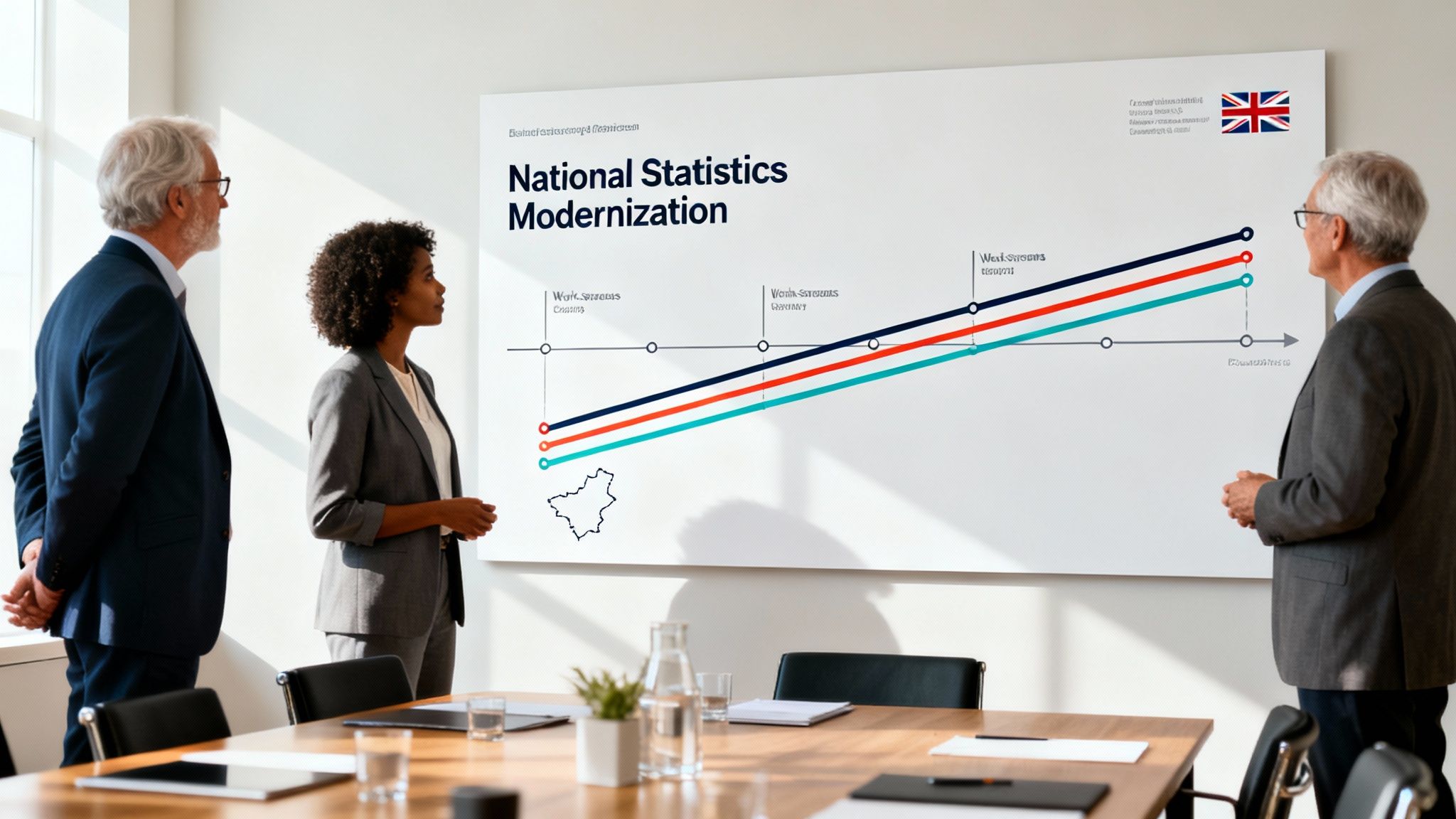
When an organisation has to modernise something fundamental, a single, monolithic project can quickly spiral out of control. By breaking the whole thing down into focused workstreams, leaders can assign clear ownership, get resources to the right places, and track several lines of progress at once without ever losing sight of the big picture.
A Case Study in Public Sector Reform
The UK’s Office for Statistics Regulation (OSR) gives us a compelling real-world case. In 2022, the OSR kicked off a major review to refresh the highly respected National Statistics designation. This wasn't a simple task. It was a complex undertaking structured into three distinct but interconnected workstreams, each tackling a specific piece of the puzzle. This strategic split allowed them to push forward on several fronts at the same time.
As the OSR moved to modernise its processes, the initiative gained formal ground by splitting the review into these targeted areas. This methodical approach paid off big time. Internal audits revealed that producers’ understanding of the designation's nuances jumped from 60% before the review to a staggering 92% by 2024. You can dig into the full details of the National Statistics designation review to see the structure for yourself.
The three core workstreams were:
- Workstream 1: Clarifying Meaning This team was entirely focused on sharpening the definition and purpose of the National Statistics designation. Their job was to make sure it was clear, relevant, and understood by everyone involved.
- Workstream 2: Targeting Producer Culture A separate group was tasked with improving the culture and practices of the data producers themselves, aiming to build a greater sense of ownership and pride in the quality of their stats.
- Workstream 3: Refining Assessments The third workstream concentrated on overhauling the assessment process, redesigning it to be more tailored and effective for different kinds of data.
By dividing a monumental reform into logical workstreams, the OSR could tackle conceptual, cultural, and procedural challenges all at once. This structure prevented bottlenecks and made sure each critical area got the specialised attention it needed to succeed.
This high-level example proves that the workstream model isn’t just for business. It's an essential tool for any organisation—public or private—that needs to manage complexity, improve transparency, and drive successful, lasting change on a grand scale.
Still Got Questions About Workstreams?
We hear a few common ones, so let's tackle them head-on.
How Many Workstreams Should a Project Have?
Honestly, there’s no magic number here. A straightforward project might only need two or three distinct streams. But if you’re looking at a huge business transformation, you could easily have a dozen or more.
The real key is to group your tasks logically. You want enough structure to keep things organised, but not so much that you create unnecessary layers of bureaucracy.
Can Someone Be on Multiple Workstream Teams?
Absolutely, and it happens all the time, especially in smaller companies where everyone wears a few different hats.
The trick is to be incredibly deliberate with your resource planning. Spreading someone too thin is a recipe for burnout and context-switching fatigue. When a team member’s time is split, everyone needs to be crystal clear on what the priorities are.
What Is the Biggest Challenge of Using Workstreams?
The most common pitfall we see is teams accidentally creating silos. When workstream teams don't talk to each other, everything grinds to a halt. You end up with dependency issues, resource conflicts, and a lot of frustration.
The best way to avoid this is with regular cross-team check-ins and using shared project management tools where everyone can see the bigger picture.
Ready to build smarter, more organised post-production plans? freispace gives you the tools to design, manage, and track your workstreams with total clarity. See how it all comes together at https://freispace.com.