Let’s be honest, a solid communication management project is the central nervous system of your entire post-production workflow. It's the thoughtful process of planning, executing, and monitoring how information moves from one person to the next throughout the project. Get it right, and it’s like a well-oiled machine. Get it wrong, and you’re headed for chaos.
Why Your Project Hinges on a Strong Communication Plan

We've all been there. Facing down a mountain of edits with a team that feels completely disconnected is a recipe for disaster. The knee-jerk reaction is to send more emails or create yet another group chat, but that just adds to the noise. The real solution is a strategic, well-structured plan that anticipates who needs to know what, long before it becomes an emergency.
Think of your communication management project as the director’s blueprint for the entire film. Without it, you're just shooting scenes in the dark, hoping they’ll magically string together into a coherent story in the final cut. A structured approach stops costly misunderstandings before they start, keeps deliverables on track, and makes sure everyone—from the client to the junior editor—is moving in perfect sync.
The Real Cost of Poor Communication
The damage from disorganised communication isn't just a minor headache; it has a real financial impact. In the UK, poor communication is consistently cited as a top reason projects go off the rails. In fact, some studies show communication issues are to blame for roughly 30% of all project failures. Simple misunderstandings can derail progress more effectively than almost any other single factor.
This brings us to a crucial point: a communication plan isn't just administrative busywork. It's a fundamental pillar of success, and its benefits go straight to your bottom line.
A well-crafted communication plan doesn't just manage information—it manages expectations, mitigates risk, and builds the trust necessary to navigate the inevitable challenges of any project.
Connecting Communication to Project Success
To see just how tightly your project’s fate is tied to communication, it’s worth looking at what makes for effective team interaction. When information flows smoothly, teams can make smarter decisions, faster. Digging into actionable internal communication best practices shows how structured methods consistently lead to better outcomes.
A clear plan delivers several key wins that are central to the benefits of effective project management:
- Aligns Stakeholder Expectations: It spells out who gets what information, how often, and in what format. No more guesswork or frustration.
- Boosts Team Morale: When your team feels informed and heard, you'll see engagement and accountability shoot up.
- Reduces Rework: Clear briefs, defined feedback loops, and timely updates prevent the kind of misinterpretations that lead to wasted hours and blown budgets.
At the end of the day, a strong communication management project is your best defence against the friction that grinds projects to a halt.
The Building Blocks of a Powerful Communication Plan
Let's move past the theory. A truly effective communication management project isn't some abstract document; it's a practical framework built from a few distinct, interconnected parts. Think of it like building a house: you need solid foundations, strong support beams, clear blueprints, and an emergency plan. If you skip one, the whole structure gets wobbly.
A solid communication plan works the same way. It relies on a handful of key pillars that work together, making sure information flows smoothly, everyone knows their role, and problems get nipped in the bud before they blow up. Let's break down what those pillars look like in practice.
Identifying Your Stakeholders
Before you can figure out what to say, you have to know who you're talking to. This is where a stakeholder analysis comes in. It’s the process of mapping out every single person, group, or company involved in or affected by your project. This isn't just about making a list of names; it's about creating a strategic map of who holds influence and what they care about.
For any given post-production project, your stakeholder map might include:
- The Client: The one footing the bill and making the final calls. They care about the end product and the budget.
- The Director: The creative visionary. Their world revolves around the story and artistic integrity.
- The VFX Supervisor: The person in charge of all visual effects, leading a team of artists.
- The Sound Designer: The expert focused on everything you hear.
- The Finance Department: The team keeping a close eye on budget tracking and invoices.
Getting a handle on each stakeholder’s specific needs, expectations, and level of influence is the critical first step. The director doesn't need a weekly cost report, and the finance team has no use for dailies on colour grading. Tailoring your communication starts here.
Choosing the Right Communication Channels
Once you know your audience, you need to decide how you’ll reach them. It's a classic rookie mistake to use the wrong tool for the job. A quick message on Slack is great for an informal team question, but it’s a terrible way to send a formal progress report to a client.
Every message has an ideal home. The trick is to match the channel to the message's urgency, formality, and audience. A well-defined communication management project spells out which platforms to use for different types of information. This cuts through the digital noise and stops important updates from getting lost.
A good way to think about it is to map out the pros and cons for your team.
Choosing the Right Communication Channel
| Channel | Best For | Pros | Cons |
|---|---|---|---|
| Formal updates, client reports, official sign-offs | Creates a documented paper trail, universally accessible. | Can be slow; messages get easily buried in a cluttered inbox. | |
| Slack/Teams | Quick internal questions, informal team updates, sharing GIFs. | Fast, conversational, and brilliant for team spirit. | Can become a major distraction, not the place for formal decisions. |
| Project Management Tool | Task updates, feedback on specific assets, progress tracking. | Keeps everything in one place, linking communication directly to tasks. | Only works if the whole team buys in and uses it consistently. |
| Video Calls | Weekly syncs, complex problem-solving, client demos. | Perfect for real-time discussion and picking up on nuance. | Needs scheduling, and can quickly lead to "Zoom fatigue." |
By defining these channels from the get-go, you build a system that everyone on the team understands and can rely on. It makes the whole process predictable.
Clarifying Roles with a RACI Matrix
Ambiguity is the enemy of a smooth-running project. When people aren't sure who's meant to do what, tasks get dropped and decisions grind to a halt. This is exactly where a RACI matrix comes to the rescue. RACI is a simple acronym that stands for Responsible, Accountable, Consulted, and Informed.
It’s just a straightforward chart that lays out who does what for every major task or deliverable.
- Responsible: The person actually doing the work.
- Accountable: The person who owns the work and has the final say. There should only ever be one 'A' per task.
- Consulted: The experts you bring in for their input.
- Informed: The people who just need to be kept in the loop on progress.
Picture this: you're dealing with client feedback on a key scene. The editor is Responsible for making the physical changes. The post-production supervisor is Accountable for signing off on the final cut. The director is Consulted for creative input, and the client is Informed when the new version is ready for them to review.
This simple framework eliminates the guesswork and empowers your team by making their roles perfectly clear.
Establishing Clear Escalation Paths
Let's be realistic—no project goes off without a hitch. That’s why a pre-defined escalation path is a non-negotiable part of any communication plan. It's a clear, step-by-step process for what to do when a problem can't be solved by the people currently dealing with it. It outlines who to talk to, and in what order, when something pops up that could threaten the budget, timeline, or scope.
Without a clear escalation path, small issues have a nasty habit of festering and turning into full-blown crises because nobody knows who has the authority to make a tough call. A clear path ensures problems get tackled quickly by the right people, keeping the project on track and under control.
How to Build Your Communication Plan Step by Step
Building a solid communication plan might seem like a heavy lift, but it’s actually a pretty logical process when you break it down. It’s all about moving from the big-picture project goals to the nitty-gritty of who says what to whom, and when. This isn't just about creating documents; it's about building a shared brain that stops confusion before it even starts.
Think of it like setting up the lighting for a shoot. You don't just blast lights everywhere and hope it looks good. You start with your key light (the main objectives), bring in fill lights (what stakeholders need to see), and add backlights (your channels and methods) to shape the final scene. Each step builds on the last, turning a vague idea into a precise and effective strategy.
Step 1: Define Your Communication Objectives
Before you type a single word, you need to know what you’re trying to accomplish. Your communication objectives should be bolted directly to your overall project goals. Are you trying to get client sign-offs faster? Cut down on rework caused by crossed wires? Or maybe just keep a remote team perfectly in sync?
Get specific. A vague goal like “improve communication” is useless. Instead, aim for something you can actually measure, like, “Reduce the number of revision rounds on final edits by 25% through clearer, consolidated feedback.” These clear objectives become your North Star, guiding every other decision you make. You can find more detailed strategies in our complete guide to effective project planning.
Step 2: Conduct a Thorough Stakeholder Analysis
Once your objectives are crystal clear, it’s time to figure out who’s who in the zoo. A stakeholder analysis is much more than a simple list of names. It’s a deep dive into who needs to be kept in the loop, who needs to be consulted, and who has the final say. You’ve got to map out their influence, their level of interest, and exactly what information they need.
For a post-production project, this usually breaks down like this:
- Primary Stakeholders: The client, the director, and the post-production supervisor. These are the people with direct influence.
- Secondary Stakeholders: The VFX team, sound designers, and colourists—the artists and technicians actually doing the work.
- Tertiary Stakeholders: Folks in the finance department or marketing teams who just need high-level progress updates to do their jobs.
When you understand what each person actually cares about, you can tailor your updates to be genuinely useful, cutting through the noise of one-size-fits-all emails.
This step-by-step approach untangles the complex web of interactions that exists in every single project.
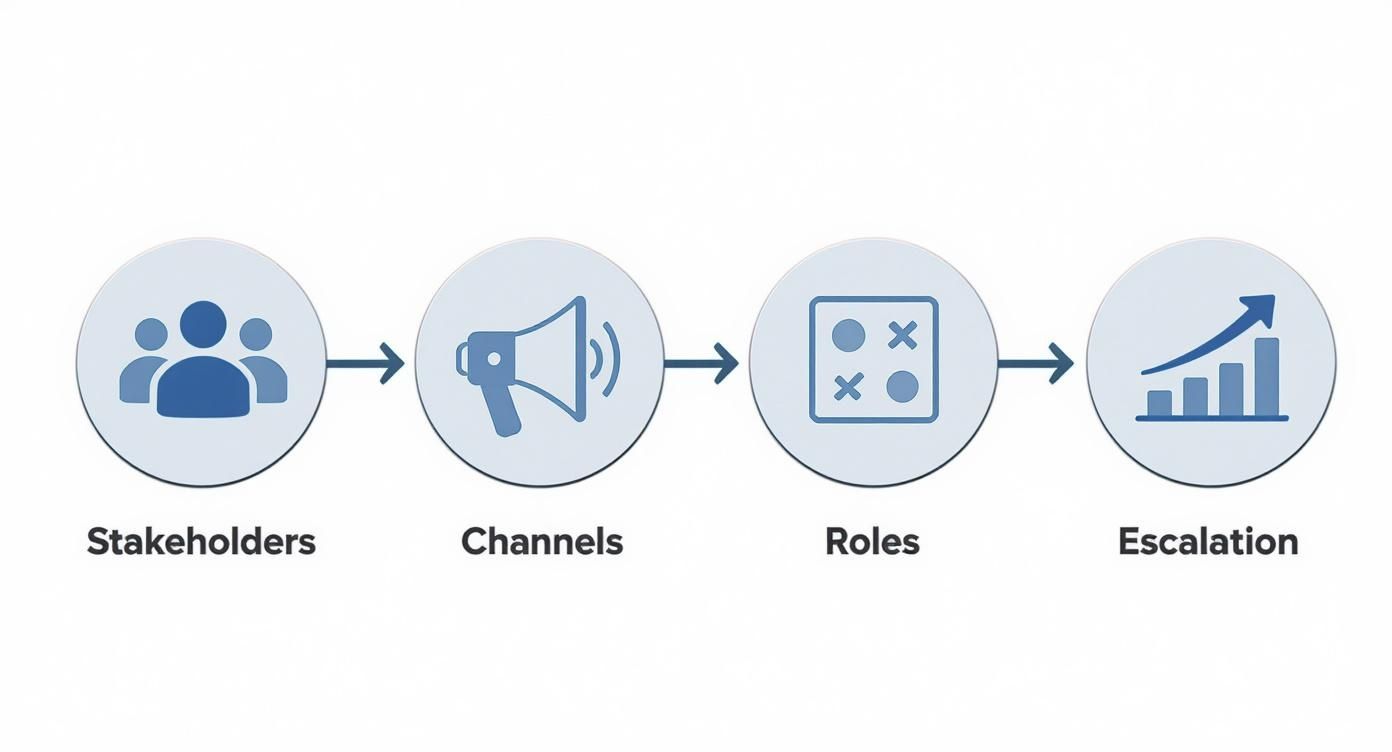
Seeing the flow—from identifying stakeholders right through to defining escalation paths—really shows how each piece connects to create one cohesive communication machine.
Step 3: Select Channels and Define Cadence
You’ve got your "who" and "why" sorted. Now it’s time for the "how" and "when." This is all about picking the right tools for the job and setting a predictable rhythm, or cadence, for your communication. A formal weekly progress report for the client demands a professional email, while a quick question for the editing team is a perfect fit for Slack.
Write these choices down so there’s no guesswork. For example:
- Daily Stand-ups: Internal team only, via video call (15 mins max).
- Weekly Client Updates: Formal email with a dashboard link (every Friday at 4 PM).
- Urgent Blockers: Direct message in the dedicated project channel for immediate attention.
This kind of structure kills ambiguity. It ensures information gets delivered in the right format, preventing critical details from getting buried in an avalanche of notifications. This stuff matters. A staggering 86% of employees and executives in the UK say workplace failures are a direct result of poor communication and collaboration.
Step 4: Document the Plan and Secure Buy-In
The final move is to pull everything together into a single, easy-to-find document. This becomes your project's single source of truth for all things communication. It needs to be clear, concise, and simple enough for anyone to understand at a glance.
Your documented plan should include these five key parts:
- Project Communication Objectives: What success actually looks like.
- Stakeholder Register: Who’s involved and what they need from you.
- Communication Matrix: A clear grid showing what’s being communicated, by whom, to whom, on which channel, and how often.
- RACI Chart: To spell out roles (who is Responsible, Accountable, Consulted, and Informed).
- Escalation Path: A simple guide on who to call when things go sideways.
Once it's written down, don't just shove it in a folder and forget about it. Share the plan with your entire project team and the key stakeholders. Walk them through it, answer their questions, and get their agreement. This is the crucial step that turns your document into a genuine, shared commitment.
Measuring the Success of Your Communication Strategy
A detailed communication management project is a powerful tool, but how do you actually know if it’s working? To get beyond just a gut feeling, you need real metrics that show you the health of your project's information flow. Measuring success isn’t about creating more admin work; it's about making smart, data-driven tweaks to keep your strategy sharp.
Without clear Key Performance Indicators (KPIs), you’re essentially flying blind. You can't prove the value of your efforts or spot the areas that are crying out for improvement. By tracking the right things, you turn your communication plan from a dusty document into a living, breathing tool that adapts as your project evolves.
Defining Your Key Performance Indicators
To get this right, you need a healthy mix of quantitative (the numbers) and qualitative (the feelings and observations) KPIs. One tells you what’s happening, and the other tells you why. Bring them together, and you get the full picture of how your communication is really affecting the project.
Think of it like an editor reviewing the dailies. The quantitative data is the shot list—how many takes, the length of each shot. The qualitative feedback is the director's notes on an actor's performance or the emotional tone. You absolutely need both to tell the final story.
Here are a few essential KPIs to get you started:
Quantitative Metrics: These are the hard numbers that give you a clean, objective view.
- On-Time Reporting: What percentage of your status reports and updates are actually hitting their deadlines?
- Reduced Escalations: Are you seeing a drop in the number of fires you have to put out? Fewer last-minute emergencies is a great sign.
- Meeting Efficiency: Are meetings starting on time? Ending on time? Crucially, are people leaving with clear action items?
Qualitative Metrics: These metrics get to the heart of the human experience and stakeholder sentiment.
- Stakeholder Satisfaction: How do clients and your own team feel about the communication? Is it clear? Is it frequent enough?
- Clarity of Feedback: Is the feedback you’re getting becoming more specific and actionable? Or is it still vague and hard to work with?
- Team Alignment: Does everyone on the team seem to be on the same page about the project's goals and what their role is in getting there?
Gathering Data Without Overwhelming Your Team
Collecting this data shouldn't feel like a second job. The secret is to weave it right into the workflows you already have. You could use quick pulse surveys, add a short feedback section to your meeting agendas, or just pull the data your project management tools are already generating.
The goal isn’t to create more reports. It’s to gather actionable insights that help you sharpen your process on the fly. A simple, consistent feedback loop is worth far more than a complex, infrequent one.
One of the biggest hurdles is that so many teams are stuck with outdated tools. In the UK, a surprising 23% of organisations are still not using any project management software, relying instead on things like spreadsheets. This makes tracking anything a real nightmare. But the data speaks for itself: 77% of high-performing projects use these tools, and nearly 80% of organisations say their internal communication improved after adopting them. You can find more stats on how tools drive project success over at pm360consulting.ie.
Turning Insights into Action
Once you've got the data, the most important step is to actually use it. Review your KPIs with the team on a regular basis.
If stakeholder satisfaction scores are dipping, maybe it’s time to adjust the frequency of your client updates. If escalations are creeping up again, perhaps that RACI chart needs another look. Measuring success is only half the battle; the real win comes from making tangible improvements to your communication management project.
This cycle of continuous improvement also feeds directly into the financial health of your projects. Better communication means less rework and fewer delays, which has a direct, positive impact on the budget. For a deeper dive, check out our guide on how effective communication supports project finance management.
At the end of the day, these metrics prove that a well-run communication strategy isn't just an expense—it's one of the most critical investments you can make in your project’s success.
Navigating Common Communication Pitfalls
Even the most carefully built communication management project can hit a snag. Let’s be honest, projects are messy, human-led adventures, and knowing what could go wrong is half the battle in keeping things running smoothly. Thinking about these potential issues beforehand is like knowing the common editing mistakes to avoid—it’s what separates the good projects from the truly great ones.
The best communication plans aren't rigid rulebooks; they’re adaptable guides for the road ahead. They anticipate the tricky spots and lay out a clear path for getting through them. By spotting these traps early, you can turn a potential disaster into a minor bump in the road, ensuring your communication stays clear and effective from the first slate to the final delivery.
Breaking Down Information Silos
One of the most common—and most destructive—problems is the dreaded information silo. This is what happens when teams or departments close themselves off, hoarding information and failing to share crucial updates with the rest of the crew. In post-production, this can be absolutely catastrophic.
Picture this: the VFX team is falling behind on a particularly tricky render. They keep it to themselves, hoping they can just power through and catch up. Meanwhile, the sound design and colour grading teams are blissfully unaware, working away based on an old timeline. When the VFX delay finally comes to light, it sets off a domino effect of rushed work, blown deadlines, and frantic last-minute fixes that tank the quality of the final product.
To stop this from happening, your plan needs to be all about cross-team transparency.
- Centralised Updates: Use a shared project management dashboard where every department’s progress is visible to everyone. No more secrets.
- Inter-team Syncs: Set up quick, regular check-ins between teams that depend on each other (like VFX and colour) to make sure they’re still on the same page.
- Shared Goals: Don’t frame milestones as separate department tasks. Make them collective achievements that everyone is working towards together.
A project's strength is measured by its weakest communication link. Breaking down silos ensures that every link is fortified by shared knowledge and collective responsibility, preventing small issues from escalating into major crises.
The Danger of Silence as Agreement
Here’s another classic mistake: assuming that no news is good news. A project manager pings out an email with a new delivery schedule and, hearing nothing back, figures everyone’s happy with it. This is a massive gamble that often just hides confusion, disagreement, or an inbox that’s simply too full.
Silence means nothing. It could be "Yep, I agree," but it’s just as likely to be "I haven't even seen this," "What on earth does this mean?" or "I hate this, but I don't want to rock the boat." When you take silence as a green light, you’re setting yourself up for misaligned expectations and eleventh-hour objections when it's way too late to change course.
Instead, you need to build a culture where people actively confirm things.
- Explicit Sign-offs: For any big decision, require a clear "approved" or "confirmed" from the key players.
- Follow-up Questions: If you’re met with silence, don’t let it slide. Ask direct questions like, "Does anyone have any concerns with this new timeline?"
- Use Interactive Tools: Take advantage of tools with polls or simple reaction buttons for a quick and visible way to check for consensus.
Failing to Adapt the Communication Plan
Lastly, a huge error is treating the communication plan like it was carved into stone on day one. Projects change. New stakeholders come on board, priorities get shuffled, and unexpected problems always pop up. The plan that was perfect at kickoff could be completely useless by week eight.
Imagine the project suddenly expands to include a massive new VFX sequence. Your original communication schedule and stakeholder list are probably no longer fit for purpose. If you just stick to the old plan, crucial new people will be left out of the loop, which only leads to friction and rework. A truly successful communication management project is a living document, one that you regularly revisit and tweak to match the reality of the project right now.
Streamlining Workflows with Modern Communication Tools
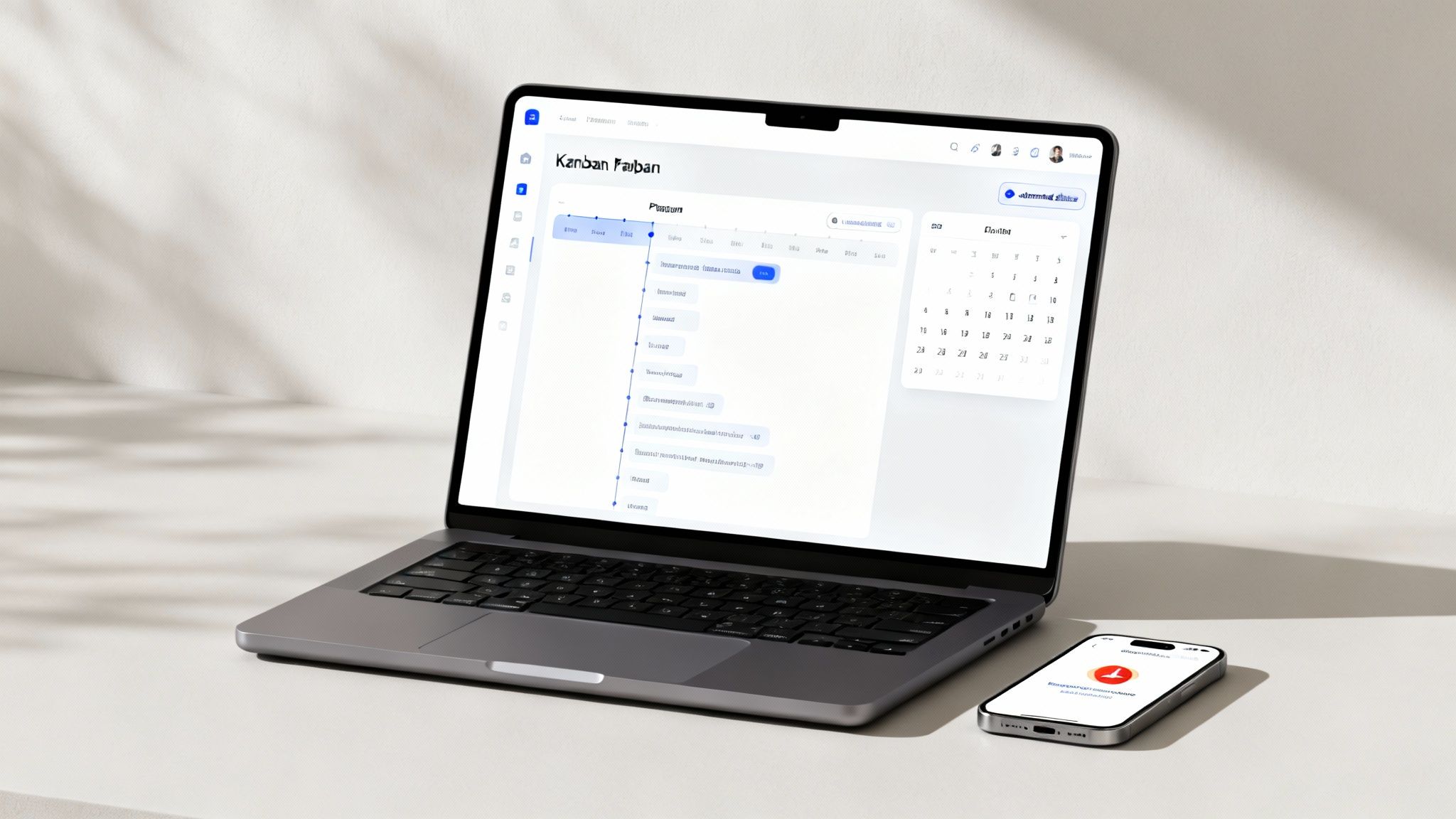
A well-structured plan is your blueprint, but technology is the power tool that brings it to life. Modern platforms can turn that static document into a dynamic engine, automating the tedious tasks that so often cause communication to fall apart. This is the point where your communication management project evolves from a plan into a living, breathing workflow.
Instead of manually chasing updates or piecing together reports, you can let the software handle the heavy lifting. The whole point is to free up your team’s creative energy. Let them focus on what they do best—delivering outstanding post-production work—rather than getting bogged down in administrative follow-ups.
Automating for Consistency and Clarity
Automation is the secret to making your communication plan stick. When you set up automated workflows, you guarantee that the right information reaches the right people consistently, without ever relying on someone remembering to hit "send."
Here are a few high-impact automations you can put in place:
- Automated Status Reminders: Set up daily or weekly pings that automatically ask team members for updates on their tasks. This info can then feed directly into a real-time progress dashboard for everyone to see.
- Templated Client Updates: Create standard templates for recurring messages, like weekly progress reports or milestone summaries. The system can pull in the latest data, leaving you with just a quick review before it goes out.
- Centralised Dashboards: Give every stakeholder a single source of truth. A live dashboard can display project timelines, budget status, and key milestones, dramatically cutting down on the need for constant status meetings.
Platforms like freispace are built for exactly this, integrating resource management and project planning right into your communication flows. This creates a unified view where updates are tied directly to specific tasks and deliverables, not lost in an email chain.
The true power of modern tools isn't just about sending messages faster. It’s about building a predictable, reliable system of information flow that runs quietly in the background, keeping everyone aligned without constant manual effort.
Beyond just the tools, broader strategies for improving workflow efficiency and boosting productivity are essential. When you combine these principles with the right tech, you create a powerful framework for getting things done right.
A Case Study in Action
Picture a post-production studio drowning in client feedback and asset approvals. Their old process was a chaotic mess of email threads where vital feedback got lost and version control was a nightmare. By bringing in a modern communication tool, they completely transformed their workflow.
They set up an automated system where clients could leave time-stamped comments directly on video files. These comments automatically created tasks for the relevant artists, who got notified instantly. Once an artist marked a task as complete, the system pinged the supervisor for review. Upon approval, the client automatically received a link to the updated version. Simple.
This isn't an isolated story; it's part of a much larger trend. In the UK, the Customer Communication Management (CCM) software market was valued at around £118 million and is growing fast. Integrated solutions now make up a whopping 62% of all CCM spending, showing a massive shift towards unified platforms that handle communication workflows seamlessly.
So, what was the result for that studio? Approval times were cut in half. The number of revision rounds dropped significantly. Best of all, client satisfaction soared. That’s the tangible impact of a well-executed communication management project powered by the right tools.
Frequently Asked Questions
Even the best-laid plans run into real-world questions. You've got the theory down, but what happens when you actually try to put a communication management project into practice? Let's tackle some of the most common hurdles you're likely to face.
How Detailed Should a Communication Plan Be for a Small Project?
Less is more. For smaller projects, your goal isn't to create a massive, fifty-page document nobody will read. You need a lean, one-page guide that hits the absolute essentials.
Think of it like this: a blockbuster film needs a meticulously detailed script and call sheet for hundreds of people. A quick social media video? A few bullet points on a napkin might do the trick. Your small project plan should be just as focused:
- Key Stakeholders: Who really needs to be in the loop? Think client, lead editor, maybe one other person.
- Primary Channels: Where will the most important conversations happen? Let's say project updates go via email, and quick fire questions live on Slack.
- Basic Cadence: How often will people hear from you? A simple "update email every Friday" is often enough.
The idea is to provide just enough structure to keep everyone on the same page without bogging the team down in admin.
How to Handle a Stakeholder Who Isn't Following the Plan
It's a classic scenario: you've set up a perfect feedback system, and a key stakeholder starts sending urgent notes via late-night text messages. The key here is to be diplomatic but firm. You need to reinforce the process without making it a confrontation.
The best move is to gently guide them back to the right path. Acknowledge their message where they sent it, but immediately pivot the conversation to the correct platform. For example, a quick reply like, "Thanks for this—I'm adding it to our feedback board now so the whole team can see it. Can you pop any future notes there directly?" works wonders.
This approach does two things: it validates their input (making them feel heard) while clearly reinforcing the agreed-upon process. You're subtly reminding them that the plan helps them by ensuring their feedback is actually seen and actioned by the right people. Stay consistent, and they'll get the message.
How Often Should I Review and Update the Communication Plan?
Your communication plan should be a living document, not something you write once and then file away to gather dust. It needs regular check-ins to make sure it's still working as your project changes.
For most post-production jobs, a good rhythm is to review the plan at key milestones. Think of them as pit stops in a race.
Consider these natural checkpoints:
- After the initial kickoff: Make sure everyone is aligned and understands the rules of engagement from day one.
- At the end of a major phase: For instance, once the rough cut is signed off.
- If a new stakeholder joins the team: You'll need to get them up to speed and integrated into the workflow.
- When a big problem crops up: It's a perfect time to ask, "Did a communication breakdown play a role here?"
These brief, regular reviews ensure your communication management project stays relevant and continues to be a genuinely useful tool, not just another piece of paper.
Ready to stop wrestling with static documents and start building a dynamic, automated workflow? See how freispace can centralise your project updates, simplify stakeholder feedback, and give your team the breathing room they need to create. Explore how freispace simplifies post-production scheduling.