
In 2025, UK film production spend reached a record £2.77 billion across 193 films, yet inward investment contributed £2.51 billion, while domestic UK films accounted for only £193 million and co-productions £68 million, according to the BFI's official 2025 statistics. That split changes everything about budgeting a film in the UK. A budget built from large inward investment assumptions can mislead a domestic producer on crew availability, facility rates, insurance buying power and how long finance takes to arrive.
I treat a UK film budget as two documents at once. It's a cost plan, department by department, and it's a cash timing plan that shows when money becomes drawable, when payroll falls due and when post-production invoices land. If you separate those two jobs, you'll catch problems while they're still cheap to fix.
Film Budget Categories at a Glance
In the 12 months ending June 2025, inward investment films represented 86% of UK film production spend at £1.8 billion, compared with 9% for domestic UK features at £191 million and 5% for co-productions at £107 million, as reported by Screen Global Production's UK production spend report. So your budget isn't shaped only by the script. It's also shaped by who's paying, how much influence they have with suppliers, and how much slippage they can absorb when a week goes wrong.
That matters most when you're sorting costs into categories. A large production can spread fixed costs, negotiate facility deals and hold specialist post resources for longer. A smaller UK feature can't, and costs that look proportional on paper often aren't. Insurance, legal work, delivery compliance and a minimum viable post schedule don't shrink neatly just because the shoot budget does.
The Six Rows Every Budget Needs
Use this table as your sorting test before you request a single quote. Every line in your estimate belongs in one row, and finance sits below costs rather than being netted off inside them.
| Category | What It Covers | Phase | Typical Line Items |
|---|---|---|---|
| Above-the-line | Creative rights and key creative roles | Development and pre-production | Story rights, writer, director, producers, principal cast |
| Below-the-line | Crew, facilities and kit for shooting | Production | Crew wages, equipment hire, locations, transport, catering, art department |
| Post-production | Edit, sound, grade, effects and delivery | Post-production | Editorial, sound mix, colour grade, VFX, mastering, deliverables |
| Production services and insurance | Costs that cover the whole project | Throughout | Production office, insurance, legal, accounting |
| Financing and tax relief | Money coming in, not a cost | Finance plan | Equity, distributor advances, grants, tax relief receivable |
| Contingency | Reserve for unforeseen cost | Throughout | Commonly around 10 per cent of total, held separately |
Above-the-line costs are usually negotiated as deals rather than bought by the day. They're agreed early, they're hard to reduce once contracts are signed, and they can trigger other costs, such as cast availability windows that force the schedule into a particular shape.
Below-the-line costs behave differently. They're driven by time, headcount and distance. Add a shooting day and you don't just pay crew again, you pay for locations, catering, transport, equipment and art department resets again too. That's why day count is the most powerful variable in the whole document.
Why Post and Services Get Their Own Rows
Post-production gets its own row because it's billed later, often by different companies, on a different approval rhythm. Editorial might run alongside the shoot, but sound, colour, VFX, mastering and deliverables cluster towards the end, when there's the least money and the least patience left. Burying them inside a general production total hides that timing risk.
Production services, insurance, legal and accounting run across the whole project. They rarely excite anyone in a creative meeting, but they protect the production's ability to hire, insure, contract and deliver. Underprice them and you'll usually pay twice, once in fees and once in delay.
Sort every line of your last estimate into one of these six rows. Treat anything you cannot place as a gap to fix before you go further. If a cost could sit in two rows, decide who owns it and record why.
Financing and tax relief are sources, not negative costs. Showing them as money in keeps the gross budget honest and lets you ask a better question. Not "does the total look affordable," but "does drawable cash arrive before each block of spend falls due?"
Contingency stays separate for the same reason. If it's scattered invisibly inside department allowances, nobody knows how much protection is left, and every department will assume the buffer belongs to them.
Sample Film Budget Template to Fill In
Build the skeleton before you chase perfection. A usable template has one row per account, one column per scenario, and a sources section underneath the costs so the funding gap is always visible.
| Account | Line Item | Base | Compressed Schedule | Downside |
|---|---|---|---|---|
| Above-the-line | Story rights, writer, director, producers, principal cast | Fill from signed deal or written quote | Copy base, then adjust affected deals | Copy base, then add replacement allowance |
| Below-the-line | Crew wages, equipment hire, locations, transport, catering, art department | Fill from department estimate | Increase day rates and overtime lines | Add lost day, location failure and reshoot lines |
| Post-production | Editorial, sound mix, colour grade, VFX, mastering, deliverables | Fill from post house quote by milestone | Add overtime and priority booking costs | Add rework and redelivery allowance |
| Production services and insurance | Production office, insurance, legal, accounting | Fill from broker and adviser quotes | Keep base unless duration changes cover | Extend cover for added days |
| Contingency | Reserve, commonly around 10% of total, held separately | Calculate as percentage of cost total | Recalculate after compressed costs | Recalculate after downside costs |
| Sources (not costs) | Equity, distributor advances, grants, tax relief receivable | Enter only drawable amounts with dates | Enter only drawable amounts with dates | Enter only drawable amounts with dates |
Filling It In the Right Order
- Create the rows first. Use the category table so you don't invent a new structure for every project. Consistency lets you compare estimates across productions.
- Fill the base column from current quotes. Use department estimates and supplier responses, not last year's rates from memory. Leave an unknown cell clearly blank until a quote arrives, rather than inserting a comforting guess.
- Copy base into the other scenarios. Then change only the lines each scenario affects. A compressed schedule mainly moves day rates, overtime and parallel working. A downside case moves lost days, location cover, replacement cast and reshoots.
- Add contingency as its own percentage row. Raise it for unfamiliar locations, water, animals, complex stunts or a tight schedule, because those risks don't price themselves.
- Put sources below costs. The funding gap is total costs minus drawable sources. A signed commitment that can't be drawn until delivery doesn't fund week one's payroll.
- Attach an assumption to every line. Flag each cost as fixed, variable or schedule-triggered. That flag tells you instantly what changes when the schedule moves.
Keep this template in the same workbook as your weekly reforecast. The base column then becomes your plan versus actual baseline, instead of becoming an early draft nobody trusts by week three.
How to Build the Budget From the Bottom Up
A top-line estimate feels efficient, but it can't be checked. A bottom-up budget can, because each department figure can be traced to an assumption, a quote and a person who owns it.
The need for that discipline is clear for independent productions. The BFI's economic review of UK independent film found that COVID protocols alone added an estimated 10 to 20% to production budgets, while rising crew, cast and studio costs created further pressure. You can't model pressure like that with a single total. You need visible allowances, named assumptions and a schedule you can stress test, and a practical production schedule example helps you see how those shooting days translate into costed resources.
The Seven Build Steps
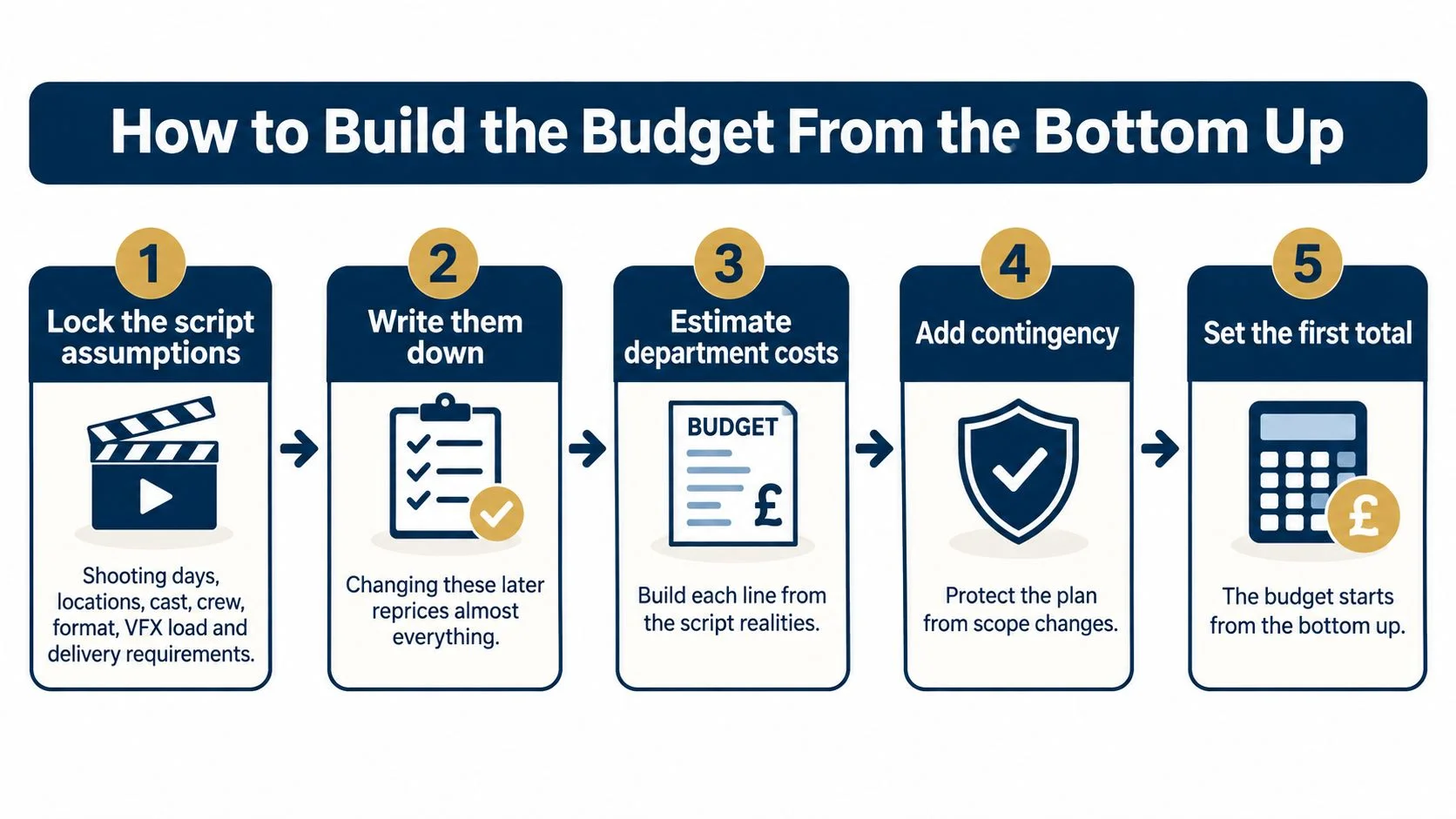
- Lock the script assumptions first. Write down shooting days, locations, cast, crew size, format, VFX load and delivery requirements before requesting quotes. Change any one of these later and you'll reprice almost everything, often without realizing how many departments were relying on the original version.
- Cost each department separately. Ask the production designer, location manager, post supervisor and other heads of department for their own figures against the same locked assumptions. A department estimate can be challenged line by line. A lump sum can only be argued about.
- Separate above-the-line from below-the-line. Creative deals and crew costs follow different negotiation logic. Cast and director agreements may be fixed but schedule sensitive, while crew, kit and locations scale with days and overtime. Mixing them hides which lever you're pulling when you cut.
- Add the lines many people forget. Production services, insurance, legal and accounting, financing costs and deliverables belong in the first serious draft, not in a correction after financial close. I'd rather show a producer an uncomfortable complete number early than win approval with an incomplete one.
- Model finance as sources. Put tax relief, equity, advances and grants below the cost total with their drawdown conditions. Don't disguise them as cost reductions inside department lines, because that understates the cash you must spend before relief arrives.
- Build at least three scenarios. Your base case tests the plan as designed. A compressed schedule tests time pressure. A downside case tests whether the production survives a bad week without emergency fundraising.
- Attach an allowance and a cause to every line. Mark each cost as fixed, variable or triggered by a schedule change. If editorial needs extra assistant time only when shooting overruns, say so. If a location fee is fixed regardless of day count, say that too.
Checking the Arithmetic and the Logic
Finish by reconciling the total to the sum of department estimates. If it doesn't reconcile, a line is missing, double counted or sitting in two departments under different names. Art department purchases, transport for equipment and data handling are classic overlaps.
Then check the logic, not just the maths. Does the crew size match the locations? Does the VFX allowance match the number of shots implied by the script? Does post have enough calendar time for approvals, or have you budgeted for labour but not for waiting?
Reforecast rule: Build the budget from committed costs, purchase orders, approved changes and actuals. Don't wait for invoices, because invoices describe decisions you've already lost the chance to influence.
For post, split editorial, sound, colour, VFX, mastering and delivery into milestones with labour hours and approval gates. That structure converts schedule slippage directly into cost exposure. If picture lock moves, you can see which sound bookings, grade sessions and delivery slots move with it, and you'll know the price before you agree to the delay.
Historic averages won't save you here. UK production costs shift with demand for crew and facilities, and a rate that was realistic on your last feature may already be stale. Quote against the actual dates, actual locations and actual delivery specification for this film.
Contingency and Scenarios That Protect the Shoot
| Scenario | Schedule Assumption | Cost Assumption | What It Tests |
|---|---|---|---|
| Base | Planned shooting days and approved crew | Current quotes and rates | Whether the plan is affordable as designed |
| Compressed schedule | Fewer shooting days, same scope | Higher day rates and overtime | Whether time pressure consumes the contingency |
| Downside | One lost shooting day and one replacement cast member | Location failure and reshoot allowance | Whether the contingency survives a bad week |
The base case is not a prediction. It's the version where your stated assumptions hold, your quotes remain valid and your approvals happen on time. If the base case only works by spending contingency on ordinary scope, it isn't a base case at all. It's an overrun that hasn't been admitted yet.
The compressed schedule asks a sharper question. Fewer days can reduce location and catering costs, but the same scope in less time usually means longer days, more overtime, parallel units, extra prep or premium bookings. In post it can also mean editors, mixers and colourists working concurrently rather than sequentially, which costs more and creates more version risk.
Sizing and Guarding the Reserve
Start contingency at around 10 per cent of total cost, then raise it where the production carries specific exposure. Unfamiliar locations, water, animals, children, stunts, night shoots, tight cast availability and an untested post pipeline all argue for more. A controlled studio shoot with locked deliverables argues for less, but never for pretending uncertainty doesn't exist.
Keep the reserve visible as its own line. Don't hide small amounts inside every department and then add a separate percentage on top, because you'll double count protection and lose track of what's real. Department allowances cover estimating uncertainty inside a known task. Contingency covers events outside the planned scope.
The most common mistake is spending contingency on scope growth before identifying its cause. A director asks for an extra setup, a producer approves a better location, post accepts another round of VFX changes, and each decision looks small. By the time weather kills a day or a cast member drops out, the money set aside for genuine disruption has already funded improvements.
Set a drawdown rule before the shoot. Any use of contingency needs a named cause, the budget line it affects, an estimate to complete and a sign-off from the person authorised to spend it. That discipline isn't bureaucracy. It's how you learn whether you're funding bad luck, weak estimating, late decisions or deliberate creative expansion.
For a structured way to think through those exposures before they hit the call sheet, a disciplined approach to risk management in projects helps you rank which threats deserve money now and which ones only need a monitoring trigger.
The Test Before You Lock
Run the downside case. Combine a lost shooting day, a replacement cast member, a location failure and a reshoot allowance. Then ask whether contingency survives with something still left for post and delivery.
If the downside case wipes out contingency before post-production begins, cut scope or raise funding before the shoot starts. Don't solve it by renaming hope as efficiency.
I would also protect contingency by phase. If the shoot consumes the whole reserve, post inherits every remaining risk with no buffer. Ring-fencing part of the contingency for post and delivery stops an expensive shoot from borrowing from the mix, the grade and final mastering.
A sound plan doesn't need to survive every imaginable disaster. It needs to survive a bad week without forcing panic cuts to insurance, sound, food or delivery quality. Those cuts rarely save the film. They usually move cost into rework, disputes or a weaker finished product.
Cash Flow and Tax Relief Timing
A budget can balance on paper and still fail in week two. The gap is timing. Total finance may equal total cost, but if deposits, payroll and equipment hire fall due before advances become drawable, the production has a liquidity problem that no neat top sheet will fix.
Start with a finance plan that lists equity, broadcaster or distributor advances, grants, co-production money and public support separately. For each source, record the contract condition, the milestone that triggers payment, the expected drawdown date and the evidence you'll need to provide. Treat soft commitments as not cash until the paperwork says otherwise.
The scale of that distinction is visible in public funding. The BFI's production fund awards for 2018 to 19 averaged £750,000 per film, representing 22% of the average £3.3 million production budget. For debut films, the average budget was £2.1 million and BFI investment represented 35%. Even a substantial award can therefore fund only part of the spend, and it doesn't remove the need to sequence the rest.

Building the Weekly Cash Curve
Build a weekly curve with money in and money out on the same timeline. Include payroll, supplier deposits, location fees, equipment hire, post-production bookings, deferred payments, insurance premiums and delivery costs. Then set a minimum liquidity buffer that the curve must not breach, so a late payer or a lost day doesn't push the production into emergency borrowing.
Say payroll and deposits for the first four weeks exceed the equity and advances drawable by then. That bridging gap must be covered by a loan, a deferment agreement or a revised drawdown schedule before the first call sheet. The lowest point of the curve must still sit above your buffer after you've added the cost of that bridging.
Tax relief needs its own treatment because it's claimed after qualifying spend is made and audited, so the cash arrives late. According to HM Revenue & Customs' non-structural tax relief statistics, UK film production tax relief cost an estimated £640 million in the 2024 to 25 tax year, representing 0.023% of GDP. That's major public support, but it isn't a guaranteed early payment you can spend before the claim process supports it.
Producers comparing jurisdictions should apply the same timing test everywhere, not just compare headline incentive rates. A useful prompt is to examine Spanish film financing tax benefits alongside the UK position and ask when cash is realised, what documentation is required and who carries the cost in the meantime.
Stress Testing Liquidity
Stress test the curve, not only the total. Model a lost shooting day, a replacement cast member, a location failure, a reshoot, an exchange rate movement on overseas spend and a delayed tax credit receipt. Each event hits cash differently. A reshoot adds cost later. A delayed receipt adds no cost at all, but it can still break the production if post invoices fall due first.
Common pitfalls are predictable. Teams count verbal commitments as drawable, omit completion and delivery costs, underestimate insurance and legal fees, or use contingency to cover scope growth before identifying its cause. All four make the finance plan look calmer than the bank account will feel.
Review the curve whenever the schedule moves. Moving a shoot week can pull payroll forward, push a milestone payment back and change the lowest cash point even if the total budget barely changes. That's why budgeting a film properly means managing dates as carefully as amounts.
Post-Production Costs That Hide in an Efficient Shoot
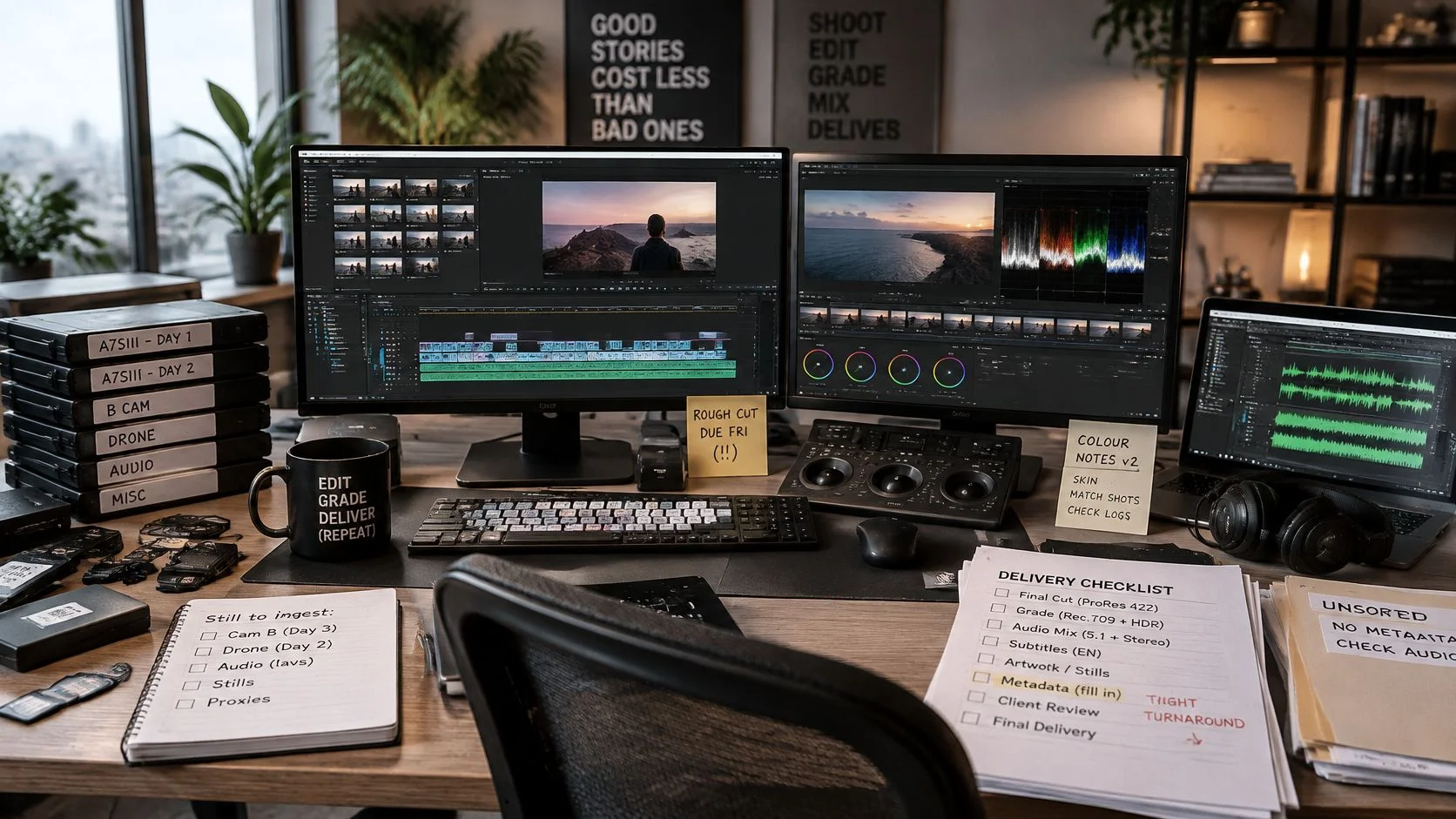
The cheapest shoot can create the most expensive post. Compressed editorial time, incomplete metadata and poorly planned deliverables don't remove work. They move it downstream, where fewer people can fix it, approvals are tighter and remedial work is harder to forecast.
Say a production saves one filming day by shooting faster and logging less carefully. Editorial then loses time finding takes, syncing material and reconstructing decisions that should've been captured on set. If picture lock slips, sound and colour bookings move, VFX turnovers arrive late and delivery gets rushed. The production can easily pay for extra colour sessions, additional conform work and priority mastering that cost more than the day it saved.
Pricing Uncertainty Before It Hardens
Don't ask only what post should cost if everything goes cleanly. Price the uncertainty in each workstream while you can still change the plan.
- Turnovers: Cost what happens when editorial hands over late, incomplete or in the wrong format. A poor turnover creates reconform work in sound, colour and VFX at the same time.
- Approvals: Allow calendar time and labour for review cycles. A note that arrives late isn't free just because the change itself is small.
- Versioning: Budget for different cuts, aspect ratios, languages and distributor versions as separate outputs, not as quick exports.
- VFX changes: Separate approved shots from creative revisions. Once a shot is finalled, reopening it should trigger a visible change cost.
- Accessibility deliverables: Captions, subtitles and audio description need suppliers, checks and delivery slots. They aren't admin you can squeeze into the final afternoon.
- Archival storage: Media retention, backups and restoration access continue after delivery. Decide who pays, for how long and in what format.
Encoding choices belong in this conversation too, because deliverables multiply quickly once distributors, platforms and archives each want their own package. If you're comparing internal render capacity with external processing, it's worth taking time to explore cloud encoding with RenderIO and price the workflow against staff time, storage and turnaround risk.
Separate Pools for Separate Risks
Keep separate contingency pools for creative changes, technical failure and delivery compliance. They're triggered by different events and they need different sign-offs. A director's new VFX idea shouldn't consume the money held for a failed QC, and a technical redelivery shouldn't be debated as though it were a creative preference.
Track labour hours and approval gates for editorial, sound, colour, VFX, mastering and delivery. When a gate slips, convert that slippage into cost straight away. Extra assistant days, room holds, operator overtime and rebooked sessions should appear in the forecast in the same week the delay is accepted.
Carbon belongs in the same model. Compare remote review with travel, localised rendering with large data transfers, and storage choices as both emissions and cost variables. You're not bolting sustainability onto the budget as a policy note. You're recognising that resource choices already affect money, time and emissions together, and post is where those trade-offs are easiest to measure.
Track Spend Weekly and Catch Overruns Early
A monthly cost report tells you what already went wrong. A weekly reforecast gives you time to change crew bookings, renegotiate scope or move a post milestone before the money is committed. I'd book that review for the same time every Monday and treat it as a production meeting, not an accounting ritual.
UK spend itself shows why old assumptions decay quickly. The BFI's official 2024 statistics reported feature film production spend of £2.1 billion in 2024, a 56% increase on 2023's initially reported £1.36 billion figure. When market demand moves that sharply, rates, availability and facility pressure can move inside a single production cycle, so your forecast has to move with them.
The Weekly Routine
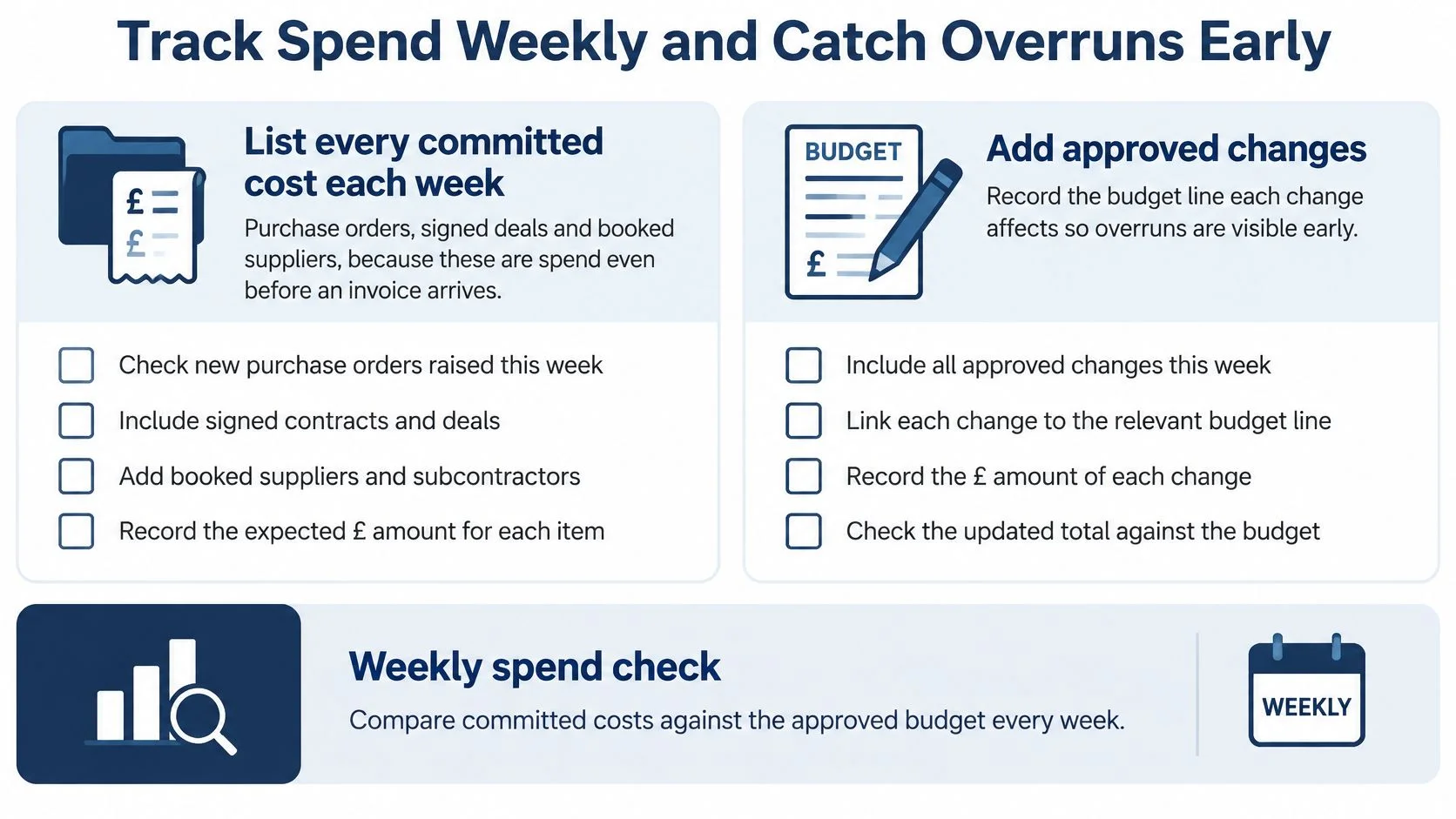
- List every committed cost. Enter purchase orders, signed deals and booked suppliers each week. These are spend even before an invoice arrives, because the production has already promised the money or consumed the resource.
- Add approved changes. Record each change against the exact budget line it affects, with the person who approved it. A change without a cost code is how scope grows invisibly.
- Add actuals as they're paid. Reconcile payments to commitments so you don't count the same booking twice or assume an unpaid invoice hasn't been incurred.
- Compare by cost code. A total that's on budget can hide labour running hot and post running artificially low because bookings haven't been entered yet. Cost code reporting exposes that offset before it becomes a surprise.
- Reforecast the estimate to complete. Build the remaining forecast from what's left to shoot, edit, mix, grade and deliver, not from the original plan. If you've used more editorial days than expected by picture lock, the remaining sound and delivery forecast needs to reflect the new reality.
Don't wait for invoices. A late invoice can hide a real overrun for weeks, especially in post where rooms, operators and freelancers may be booked through several suppliers. By the time the paperwork arrives, the suite time has been used and the chance to choose a cheaper route has gone.
Good variance reporting also needs a cause. The practical discipline behind financial management of projects is to connect each movement to a decision, a duration change or a rate change, so the next forecast improves rather than recording damage.
Reading the Symptoms
| Symptom | Likely Cause | Fix |
|---|---|---|
| Labour line over early | Overtime or extra crew days | Check call times and approve overtime weekly |
| Total over but labour on budget | Duration has grown | Recheck the schedule against days booked |
| One line over after a change | Change approved without a budget line | Require budget line sign-off before any change is approved |
| Several lines slipping at once | Decisions waiting on approval | Set decision deadlines in the schedule and track them weekly |
Report every variance under one of four causes, namely labour, duration, change orders or delayed decisions. That classification sounds simple, but it changes the conversation. You're no longer asking a department why it's over in the abstract. You're asking whether people worked longer, the job lasted longer, the scope changed or an approval arrived too late.
Each cause needs a different response. Labour overruns need call time discipline and overtime approval. Duration overruns need schedule surgery. Change orders need sign-off before work begins. Delayed decisions need deadlines owned by named people, because post houses can't hold rooms and operators indefinitely while notes sit unread.
An overrun without a cause will repeat next week. Name the cause while the booking can still be changed.
The One Decision to Make This Week
Decide whether your budget has a complete set of categories, three scenarios and a weekly cash curve. If any one of those is missing, build it before you approve more spend. Then book the first weekly reforecast and assign an owner for commitments, an owner for changes and an owner for actuals.
Most productions start this process in a spreadsheet, and that can work while commitments and actuals stay close together. It gets fragile when bookings, hours and invoices begin to diverge across suites, freelancers and suppliers. A scheduling and budgeting tool such as freispace is one practical option because budgets show live plan-versus-actual on every project instead of a month-end spreadsheet. A booking holds the suite, the operator and the kit, collects the hours worked, draws down the project budget, and becomes a line on the quote and then on the invoice.
That link matters more than the software category. When each budget line connects to a responsible department, a schedule task, a supplier commitment and an approval status, variance reporting stops being a hunt through email. You can see whether an overrun came from extra hours, a longer booking, a change order or a decision that waited too long, and you can act in the same week.
Budgeting a film well isn't about predicting every cost perfectly. It's about making uncertainty visible early enough that producers, line producers and post teams can choose their trade-offs deliberately. Protect the downside, price post before it becomes irreversible, and never let the bank balance be the first place a problem appears.
If you're ready to connect bookings, hours and budget drawdown instead of reconciling them after the invoice arrives, visit freispace to see how live plan versus actual tracking can support your next production. Bring your current budget categories and weekly reforecast with you, and judge it by one test, namely whether it shows an overrun early enough for you to change the plan.